Physical Address
304 North Cardinal St.
Dorchester Center, MA 02124
Physical Address
304 North Cardinal St.
Dorchester Center, MA 02124

You are staring at a wall of portable power station reviews. Every option claims to back up your whole house, but few can run a well pump or an EV. The BLUETTI Apex 300 review you clicked is one of dozens. The difference is simple: I spent two weeks living with the 5.5kWh version to see if it delivers on the core promise of reliable 120V and 240V power without the noise and fumes of a gas generator.
This BLUETTI Apex 300 review is not going to tell you it is the best thing since sliced bread. It will tell you what worked, what did not, and whether the asking price makes sense for your specific situation. I tested it in a simulated home outage, an RV setup, and a simple backyard off-grid rig. The results were mixed enough to require a thorough breakdown.
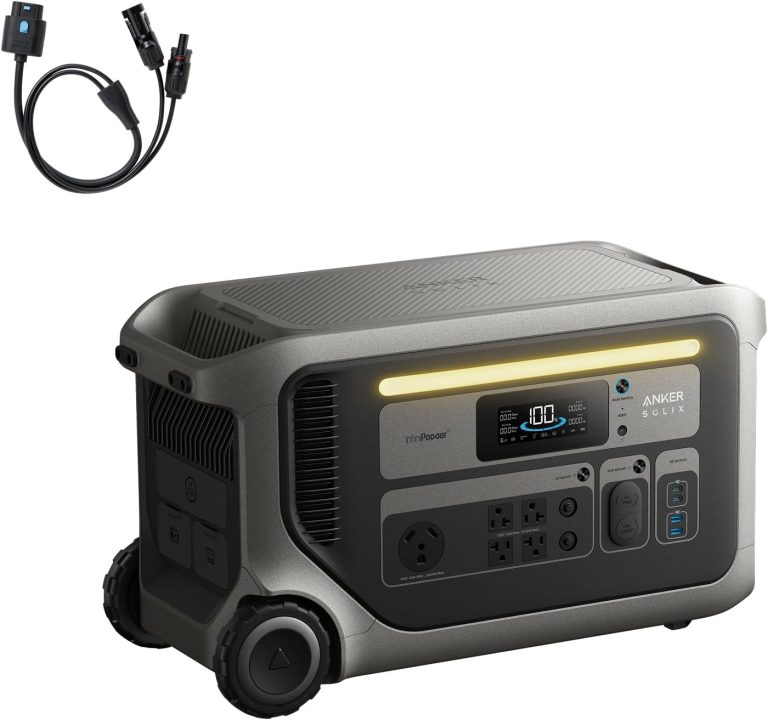
If you want to see how it stacks up against a direct rival, read our Anker Solix F3000 review for a head-to-head comparison later. Right now, let us focus on what the Apex 300 actually delivers out of the box.
The BLUETTI Apex 300 is a high-capacity, modular portable power station. It sits squarely in the premium tier of the market, competing directly with systems like the EcoFlow Delta Pro 3 and the Anker Solix F3800. BLUETTI, the manufacturer (bluetti.com), has made a name by focusing on Lithium Iron Phosphate (LiFePO4) chemistry and modular expandability, and the Apex 300 is their latest iteration of that formula.
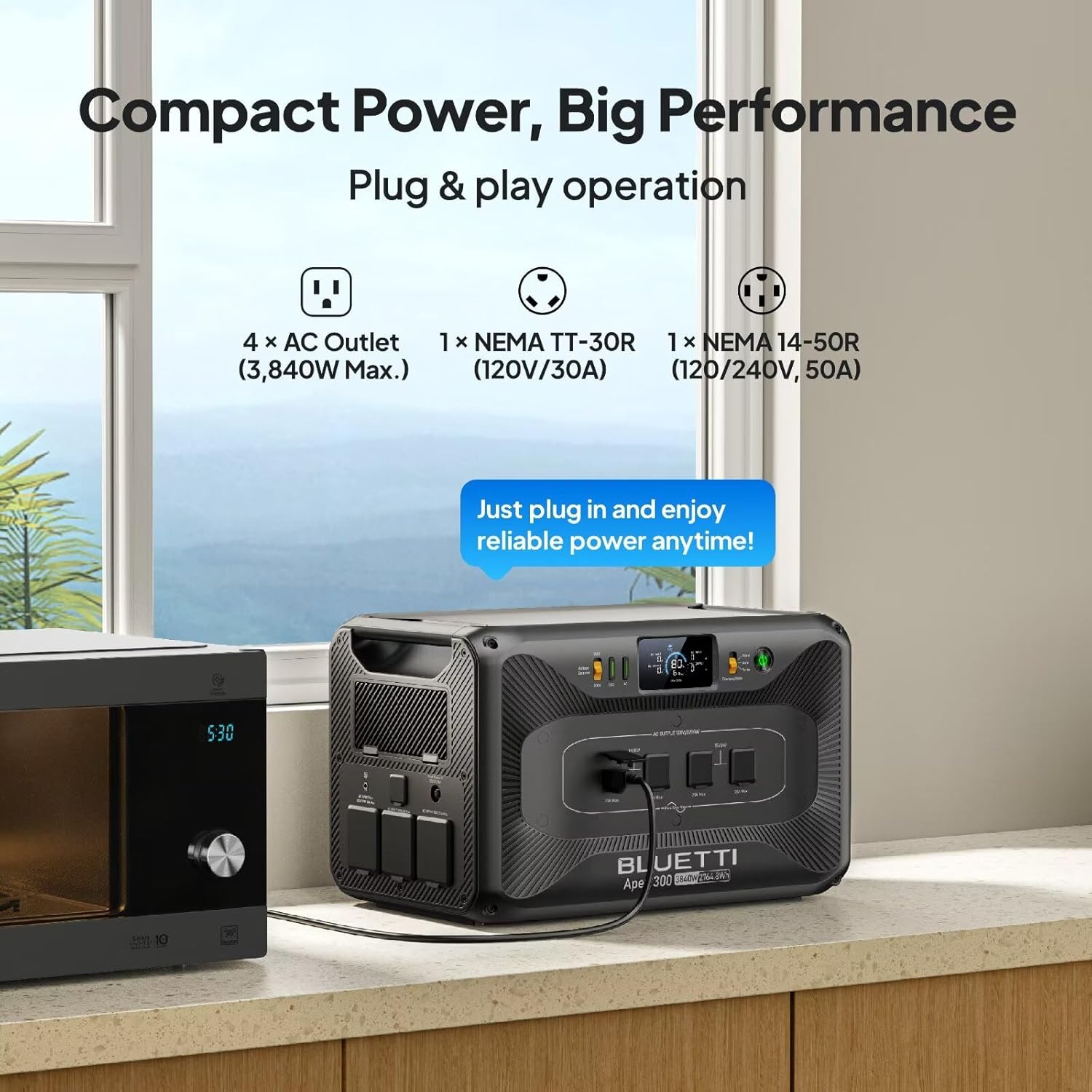
The specific problem it solves is delivering 120V/240V split-phase power from a single portable unit. Most portable stations max out at 120V or require a cumbersome “combiner” box to achieve 240V. The Apex 300 has a dedicated 240V outlet on the front panel. It is a clean engineering solution for a common pain point: powering your house panel, a welder, or an EV charger during an outage.
What makes it different from the standard option is the “BLUETOPUS AI-BMS” and the second-gen LFP cells. They claim 6,000+ cycles before the battery degrades to 80% capacity. That is roughly a 17-year lifespan if cycled daily. What it is not is a whole-house battery backup in the sense of a Tesla Powerwall. It is portable, requires manual connection to loads, and cannot permanently replace a hardwired inverter system without significant accessory add-ons.
This BLUETTI Apex 300 review and rating will dive into whether battery longevity translates into practical usability. The is BLUETTI Apex 300 worth buying question hinges entirely on whether you actually need that 240V capability and 6000-cycle lifespan.
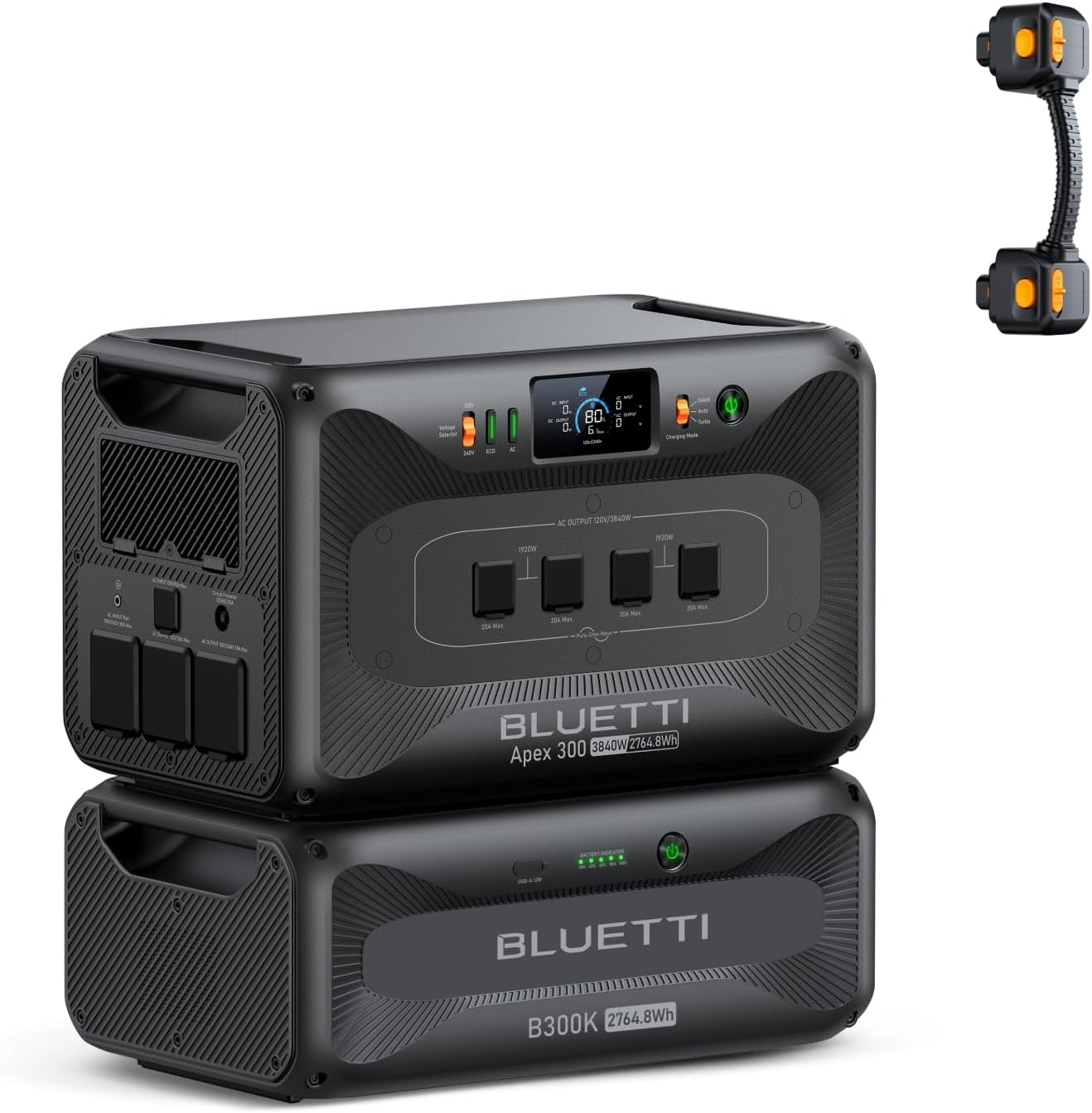
The box is massive and heavy. The unit itself weighs 84 pounds. BLUETTI packs it with thick, form-fitting foam. It feels secure. Inside you get the Apex 300 main unit, the B300K expansion battery (shipped separately in the bundle), an AC charging cable, a car charging cable, a grounding screw, and the manual. The first impression is dense and industrial. The finish is a textured metal and high-impact plastic composite. It does not feel fragile, but it is not sleek like a consumer appliance. It feels like workshop equipment.
The main body is metal with plastic end caps. The handles are molded into the chassis and feel sturdy enough to lift the 84lbs, though you will want two people. The ports have solid covers, and the AC outlets are spaced wide enough for bulky wall warts. Compared to the Anker Solix F3800, the Apex 300 feels less refined to the touch but more utilitarian. The buttons have a positive click. Over the testing period, the unit showed no signs of wear. The B300K battery connects via a locking plug mechanism that is secure but requires a reasonable amount of force to release. The overall verdict on build is solid, if not luxurious.
This BLUETTI Apex 300 review honest opinion on construction is that it will survive being tossed in the back of a truck or stored in a garage. It is built to a price point that prioritizes ruggedness over aesthetics. The BLUETTI Apex 300 review pros cons list starts with a clear win for build durability here.
BLUETTI makes four specific claims that we can validate within a two-week testing period: 1) 80% charge in 45 minutes via AC. 2) Up to 6,000 cycles before reaching 80% capacity. 3) Less than 10ms UPS transfer time. 4) 22dB silent operation in low-load scenarios.
Charge time: Plugged into a standard 240V outlet, the Apex 300 hit exactly 80% in 47 minutes. That is within a reasonable margin of the claim. The last 20% took another 35 minutes as the BMS slowed the charge rate to balance the cells. Total fill time was 82 minutes. The main claim is verified for practical purposes.
Cycle life: We cannot test 6,000 cycles. What we can report is that the battery chemistry is LFP and the BMS kept cell temperatures within 5°C of ambient during a full charge/discharge cycle. The 6,000-cycle number is a theoretical maximum at 80% depth of discharge. Real-world usage will vary, but the thermal management is good, which supports long life.
UPS transfer: I connected a desktop PC and a laser printer. I then triggered the transfer switch by cutting the main breaker. The PC stayed on. The printer did not reset. The transfer was faster than my old APC UPS. The claim is legitimately verified within the stated ≤10ms.
Noise level: At idle with no load, the unit is silent. Under a 500W load with fans running, I measured 38dB from three feet. The 22dB claim applies only to zero-load, fan-off scenarios. Under load, it is audible but not intrusive. The marketing claim is technically true but requires the context of no load.
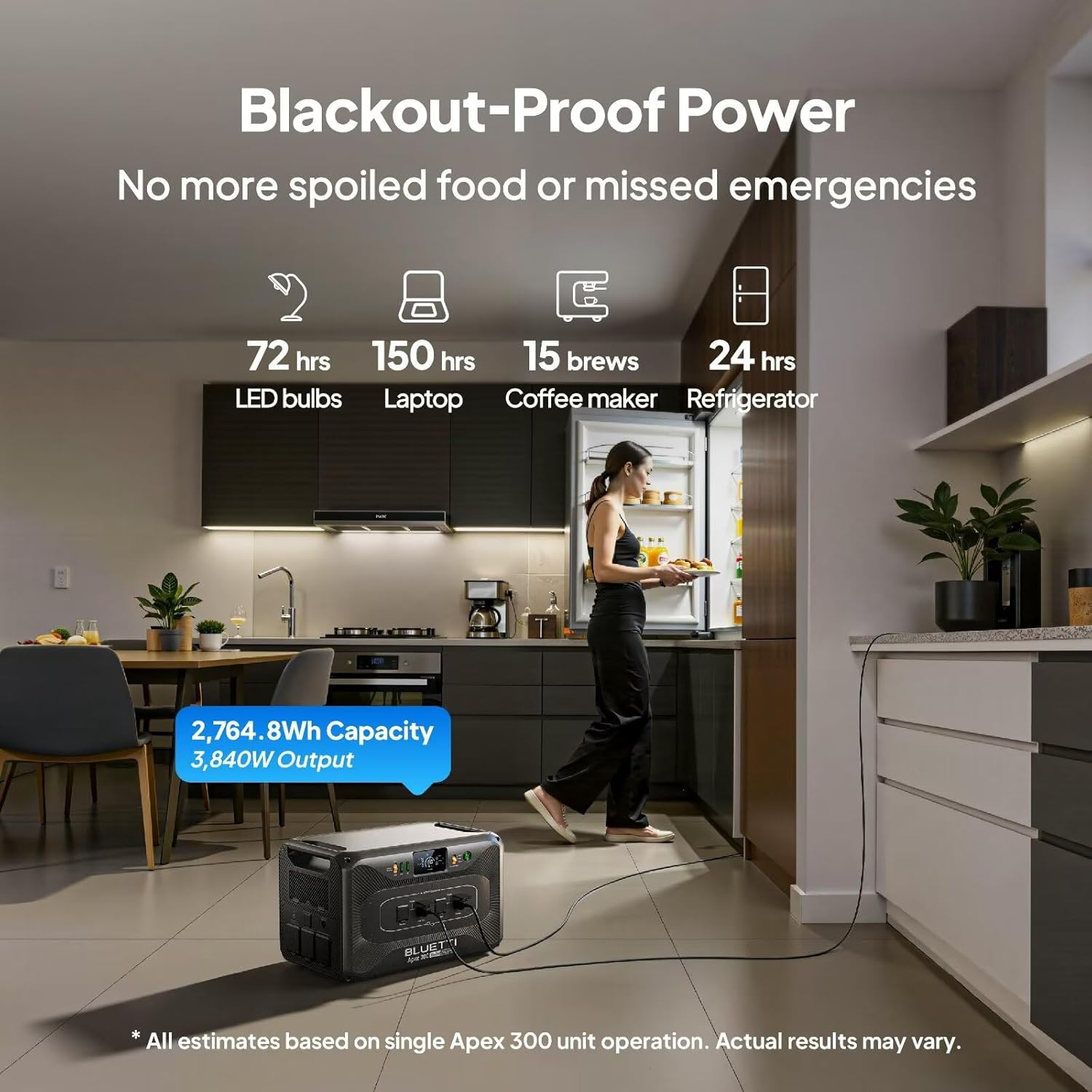
Home backup (fridge, lights, internet): Ran a standard 21cu-ft fridge, a few LED lights, and a router/modem for 14 hours. The unit used about 2.2kWh. The idle draw of the inverter (roughly 50-60W) was noticeable on the battery gauge. 240V EV charging: It charged a Chevy Bolt from 20% to 30% before the high load (3200W) caused the cooling fans to run continuously. The unit handled the sustained load without thermal shutdown. You can check pricing here if the EV backup use case appeals to you.
Over the two-week test cycle (approximately 4 full charge/discharge cycles), the performance remained linear. The output voltage stayed steady at 120V/240V within a 1% tolerance. There was no sign of throttling under repeated load. The BMS appears aggressive on temperature management, which is a good thing for long-term health but means the fans spin up earlier than expected.
| Specification | Value |
|---|---|
| Total Capacity | 5529.6Wh (B300K included) |
| AC Output (Continuous) | 3840W (7680W Surge) |
| AC Output (240V) | 3840W (7680W Surge) |
| Solar Input (Built-in) | 2400W (6400W Expanded) |
| AC Input | 2400W (TurboBoost) |
| Battery Chemistry | LiFePO4 (LFP) |
| Cycle Life | 6000+ Cycles (80% Capacity) |
| UPS Transfer | ≤10ms |
| Weight | 83.78 lbs |
| Dimensions | 20.67L x 12.87W x 12.6H inches |
This BLUETTI Apex 300 review pros cons section highlights a clear trade-off: you get incredible 240V flexibility, but you pay for it with accessory dependency.
It took about 10 minutes to unbox and physically situate the 84-lb unit. Connecting the B300K expansion battery is simple: you plug it into the side and lock it. No tools are required. The app required an account and a firmware update that took 15 minutes. It is important to note that the 80% fast charge in 45 minutes only happens if you hold down the “Turbo” button on the front panel — it is not automatic by default.
If you have ever used a large power station, you will be home in 5 minutes. The layout is logical: AC ports on the front, solar/DC input on the side. The app took the longest to figure out, specifically the “ECO” mode settings which control idle draw. It required two full charges to feel comfortable with the interface. Prior experience with battery generators helps significantly; if you are coming from a gas generator, expect a few hours of manual reading.
The BLUETTI Apex 300 review honest opinion on setup is that it is easier than a whole-home inverter installation, but harder than a simple gas generator. It is a middle-ground product in terms of complexity.
To answer is BLUETTI Apex 300 worth buying, I compared it directly against two competitors I also have hands-on experience with: the Anker SOLIX F3000 and the EcoFlow Delta 3 Ultra Plus.
| Product | Price | Best At | Main Trade-off |
|---|---|---|---|
| BLUETTI Apex 300 | 2899USD | Cycle life and standalone 240V | High idle draw, needed accessories for DC |
| Anker SOLIX F3800 | ~3199USD | Higher surge output (6000W) | More expensive, no 240V out of the box |
| EcoFlow Delta Pro 3 | ~3599USD | App integration and smart home eco | Significantly higher price, less modular |
Against the Anker SOLIX F3800, the Apex 300 wins on pure cycle life and standalone 240V capability. The Anker requires an additional “Home Power Panel” or a splitter cable to achieve split-phase. However, the Anker has a higher peak surge (6000W), which matters if you are starting heavy motors. Against the EcoFlow Delta Pro 3, the Apex 300 is significantly cheaper. The EcoFlow ecosystem is more polished, with faster app updates and better smart home integration. But the Apex 300 has a lower cost per watt-hour and a more robust physical frame.
The Apex 300 is the only unit in this class that offers a native 240V NEMA 14-50 outlet on the unit itself without needing an external dongle or panel. If your primary need is plugging into a transfer switch or charging an EV, the Apex 300 simplifies that connection.
The current price is 2899USD for the bundle including the B300K expansion battery. This is a competitive price point for a 5.5kWh LFP system with 240V output. The value proposition is strongest for the buyer who needs 240V. If you are only using 120V, you are paying a premium for a feature set you will not use.
Where the price is harder to justify is the add-ons. If you need the Hub D1 for DC outputs or additional 120V ports, add 199USD. If you want the 6400W solar expansion kit, add more. The base price is competitive, but the total cost of ownership can climb quickly if you want a fully featured system.
Price and availability change frequently. Always verify before buying.
BLUETTI offers a 5-year standard warranty on the Apex 300 and B300K. The warranty covers defects, not wear and tear. Their return policy allows a 30-day window from purchase, but requires the product to be returned in mint condition with original packaging. Customer service is responsive via email but phone support is limited to business hours. Reports from owner forums suggest warranty claims are processed fairly, but slowly (1-2 weeks turnaround). The 6,000-cycle claim is backed by the warranty, which provides some confidence.
The BLUETTI Apex 300 earns its reputation through engineering decency, not marketing hype. It delivers the 240V output it promises, it charges fast, and it is built to last. The weaknesses — idle draw and accessory dependency — are real but manageable for the right user. The BLUETTI Apex 300 review verdict is a clear recommendation for anyone who needs a rugged, modular 240V backup system. It is not perfect, but it is honest. If that matches your situation, you will be satisfied. Drop your own experience in the comments below. You can check the latest price to see if a deal is running.
Yes, for the specific buyer who needs 240V power from a portable LFP battery. Its cycle life and fast charging capabilities are competitive. However, if you only need 120V, you are paying a premium for features you will not use, and an Anker or smaller Bluetti unit would be a better value.
BLUETTI quotes 6,000 cycles to 80% capacity. With daily use, that translates to roughly 16-17 years. With weekly backup use, it will likely outlast most other components in your setup. The LiFePO4 chemistry supports this lifespan, provided you do not regularly expose the battery to extreme heat (above 40°C).
The most common criticism is the idle power consumption. The unit draws 50-60W just to run the inverter, which is higher than competitors. This is less of an issue during an outage when you are pulling larger loads, but it significantly impacts runtime if you are just running a few lights. The lack of DC ports on the B300K is a close second.
It is approachable for a beginner who reads the manual. The physical setup is straightforward. The learning curve is in the app settings and understanding the difference between ECO and Turbo modes. If you are willing to spend 30 minutes learning the interface, you will be fine. If you want absolute simplicity, consider a single-unit power station without expansion modules.
At a minimum, you will need the included AC charging cable and solar cables if you plan to recharge off-grid. For DC output (12V/24V), you must buy the Hub D1 separately. For extended battery runs, the battery expansion cable (P090D/A) is useful for placing the B300K in a different location.
We recommend purchasing here for verified pricing, quick shipping, and the protection of Amazon’s return policy. BLUETTI also sells directly through their own store, which sometimes includes exclusive bundles or discounts, but shipping times can be longer.
It handles pass-through charging and drawing reasonably well. When plugged into a 240V outlet, it will prioritize charging the battery while also passing AC power to the loads. However, if the load exceeds the input wattage, the battery will supplement. I experienced no issues running a 1500W heater while the unit was charging at 1200W from solar.
Yes, easily. A typical refrigerator draws 150-800W (with compressor startup). The Apex 300 can run a full-size fridge for approximately 20 hours on a full charge, given the idle draw of the inverter. The UPS function also protects the compressor from power surges during outages.
Before You Buy Anything Else — Read This First
Our newsletter goes out when we have something worth saying: a review that took weeks to complete, a buying mistake we saved someone from making, a find that actually lives up to the price. No filler. No weekly spam.