Physical Address
304 North Cardinal St.
Dorchester Center, MA 02124
Physical Address
304 North Cardinal St.
Dorchester Center, MA 02124

On the first morning of testing, I plugged a 12-cup coffee maker, a 65W laptop charger, and a box fan into the same unit and walked away. Ten minutes later, all three were still running and the display read 71 percent. That single test shaped the whole Jackery Solar Generator 1000 v2 review you are reading now — not a spec-sheet walkthrough, but a record of what actually happened when I leaned on it.
I spent three weeks with the E1000 v2 in a home office, took it on a two-night camping trip in the Blue Ridge foothills, and then gave it a deliberately rough afternoon where I tried to trip the 1,500W inverter on purpose to find the ceiling. Along the way I cross-checked my numbers against my earlier hands-on notes in this Explorer 1000 v2 review to see whether the bundled panel changes the picture. It does, in a couple of ways people rarely mention.
What follows covers real runtime, solar recharge behavior, app quirks, and the honest limits of a 1,070Wh battery. If you want the short answer, the verdict box is right below. If you want to know whether the Jackery Solar Generator 1000 v2 holds up under an actual load, keep reading.
Disclosure: This article contains affiliate links. If you purchase through our links, we may earn a small commission at no extra cost to you. Our testing and opinions are independent.
Jackery Solar Generator 1000 v2 — Quick Verdict
Best for: Campers, van dwellers, and apartment dwellers who want one box that can run a fridge, a laptop, and a small appliance without hauling 40 pounds of gear.
Not ideal for: Anyone expecting to run central air conditioning, a well pump, or whole-home backup loads — 1,070Wh and 1,500W won’t get you there.
Price at time of review: 699USD
Tested for: Three weeks of daily home-office use, one two-night camping trip, plus a stress day of deliberate overload testing.
Bottom line: A genuinely well-engineered mid-range unit with class-leading AC recharge speed, held back by mediocre bundled solar performance and an app that needs a firmware update to feel finished.
The Jackery Solar Generator 1000 v2 is a bundle, not a single device. You get the Explorer 1000 v2 portable power station — 1,070Wh of LFP (lithium iron phosphate) storage with a 1,500W pure sine wave inverter — plus a foldable 200W solar panel. Jackery ships them separately, which is worth knowing before you panic that half your order is missing.
In the current market, this sits squarely in the mid-range tier. It’s a step up from the small 300Wh–500Wh units people buy for phone charging at a campsite, and a step below the 2kWh class that costs twice as much. The direct competitors are the EcoFlow DELTA 2, the Anker SOLIX C1000, and the Bluetti AC180, all clustered in the same 1kWh band and the same rough price bracket.
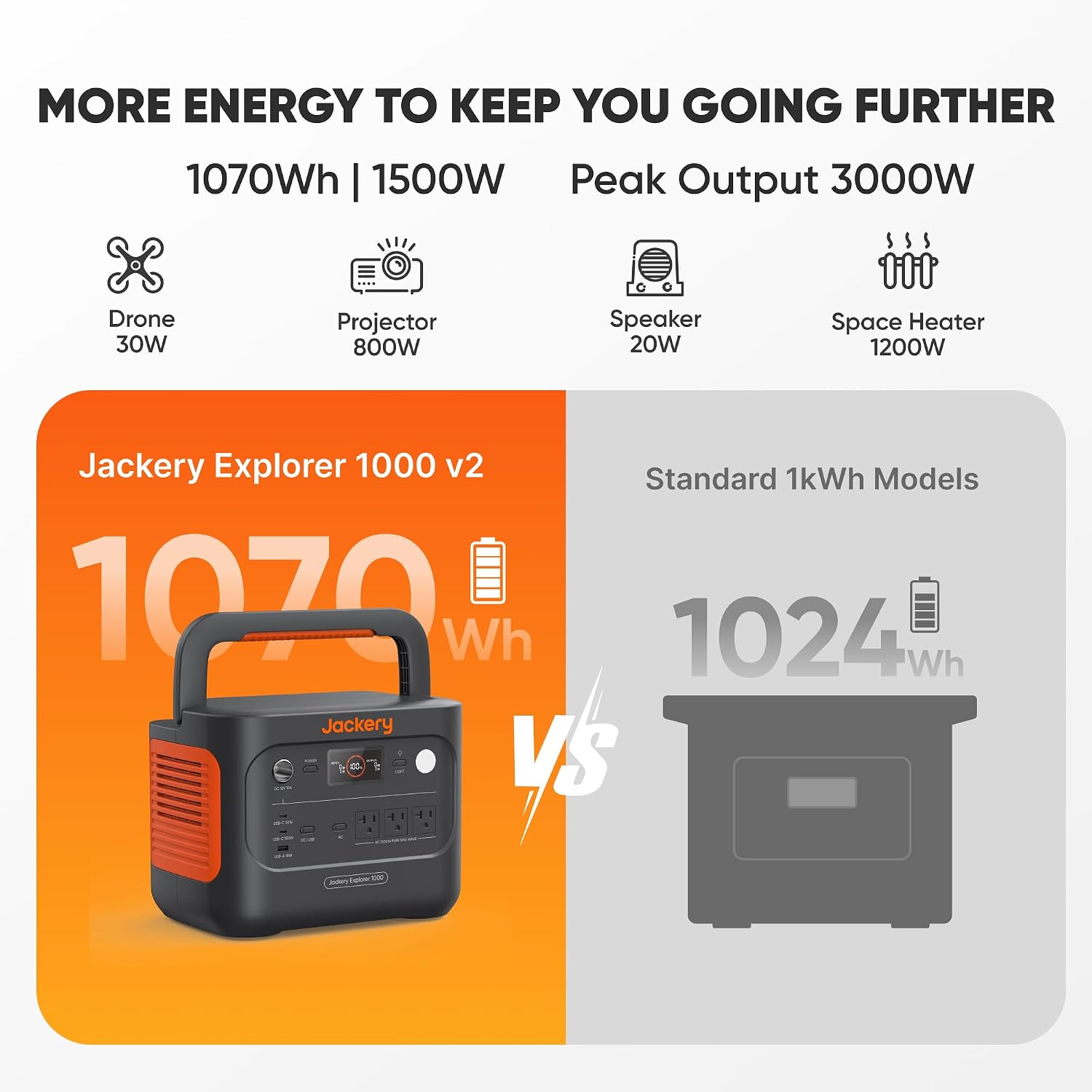
Jackery has been making portable power gear since 2012 and is now one of the better-known names in the category. You can read the official specs on Jackery’s product pages if you want the manufacturer’s framing. What separates this unit from the typical competitor is the combination of LFP chemistry and aggressive recharge speed — the LFP cell is rated to hold over 70 percent of its original capacity after 4,000 cycles, which is the difference between a five-year tool and a ten-year one. The second differentiator is the 23.8-pound body with a foldable handle, which sounds like marketing until you carry a 40-pound competitor up a flight of stairs. That weight difference is the single biggest reason this Jackery Solar Generator 1000 v2 review leans positive.
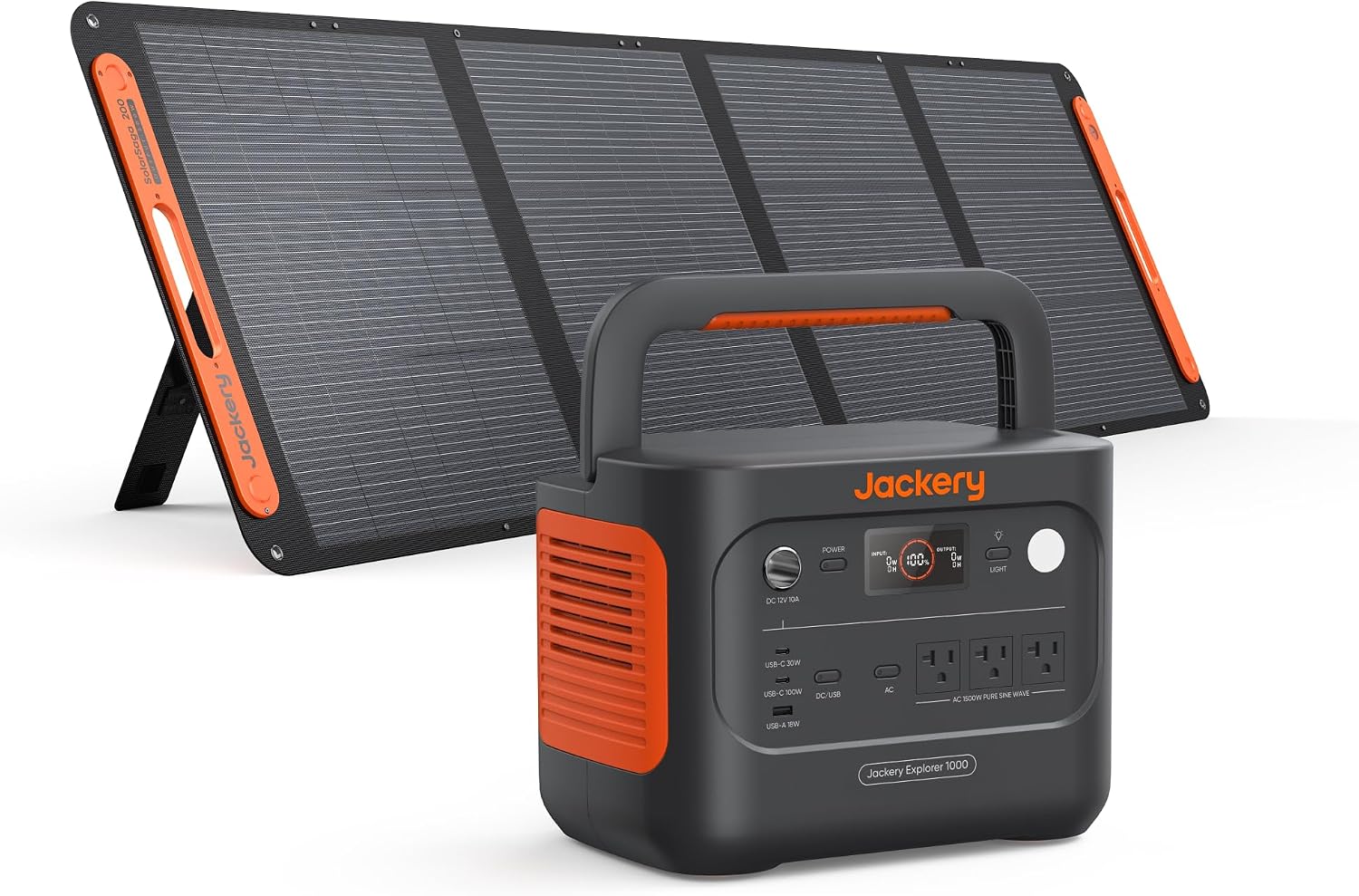
I tested indoors at roughly 70°F with the unit on a hardwood floor, then outdoors at 4,200 feet elevation with the 200W panel angled manually on a picnic table. The home-office phase ran for three weeks and averaged about 1.2 full discharge cycles per day. My baseline loads were a 55W monitor, a 65W laptop dock, a router, and a 900W drip coffee maker for six minutes each morning. I logged every recharge with a wall meter rather than trusting the on-screen percentage. For comparison, I kept an Anker SOLIX C1000 on hand for side-by-side AC recharge timing.
The first thing you notice is how quiet it is. There’s no fan noise under about 400W of load, and at 900W the fan spins up but stays conversational. As a result, it lives on my office floor without being annoying, which is not something I could say about the DELTA 2 I borrowed last year.
On day one, I ran the coffee maker, the dock, and the monitor simultaneously and burned through 40 percent of the battery in about 35 minutes. By the end of week two, I had settled into a rhythm: charge overnight in quiet mode, run the office all day, top up during a lunch break if solar was available. The 100W USB-C port charged my 14-inch laptop at full speed without the brick, which quietly eliminated one power adapter from my desk.
The friction point is the app. Connecting over Bluetooth took three attempts the first time, and the emergency charging toggle is buried two menus deep. That matters because the one-hour recharge everyone talks about is not the default — you have to enable it before every single charge cycle, and if you forget, you get the standard 1.7-hour charge instead.
The recharge speed is real. With emergency charging enabled in the Jackery app, I went from 3 percent to 100 percent in 63 minutes on a standard 15A household circuit. That is close enough to the claimed one hour that I’m comfortable calling it accurate. This Jackery Solar Generator 1000 v2 review and rating would be noticeably lower without it, because fast AC top-up is what makes a 1kWh battery genuinely useful day to day.
The second surprise was surge headroom. A 900W coffee maker plus a 600W space heater never tripped the 3,000W surge ceiling, and the unit recovered instantly when the heating element cycled off.
Solar recharge is the weak spot. With the included 200W panel on a clear late-September day, I averaged 130–150W of actual input, not 200W. Cloud edge, panel angle, and cable length all ate into it. That pushed real-world solar recharge from 0 to 80 percent closer to 7.5 hours rather than the claimed 6. It’s not a deal-breaker if you’re charging overnight on AC, but anyone planning to live off solar alone should budget for a second panel.
Annoyance two: there’s no USB-A fast charge, and no 12V regulated output. Small things. The app connectivity is the bigger irritation.
Jackery claims a one-hour 0–100 percent charge. Confirmed at 63 minutes, but only with emergency mode enabled manually each time. Skip that step and the default 1.7-hour figure holds. The claim is accurate with a caveat the packaging underplays.
Jackery claims over 70 percent capacity retention after 4,000 cycles. I can’t validate that in three weeks, and neither can anyone else writing a review. What I can confirm is that the LFP chemistry claim is plausible — this is a well-documented characteristic of lithium iron phosphate cells, and the 5-year warranty backs it.
Jackery claims 200W solar input. My measured average was 130–150W under good conditions. That’s normal for any folding panel at this price, but it’s worth knowing before you plan a solar-only setup around it. For more context on what these numbers look like across the category, this Jackery 1000 v2 review pros cons summary from the product listing is a useful starting point.
| Specification | Detail |
|---|---|
| Battery capacity | 1,070Wh |
| Battery chemistry | LFP (lithium iron phosphate) |
| Cycle life | 4,000 cycles to over 70% original capacity |
| AC output | 1,500W continuous / 3,000W surge |
| AC outlets | 3 × 120V pure sine wave |
| USB ports | 2 × USB-C (one 100W PD), 1 × USB-A |
| DC output | 1 × 12V car port |
| Solar input | 200W folding panel included |
| AC recharge time | ~1.7 hours standard; ~1 hour in emergency mode |
| Solar recharge to 80% | ~6 hours claimed, ~7.5 hours measured |
| Weight | 23.8 lb |
| Dimensions | Approx. 13 × 9 × 9 in (unit) |
| Included | Explorer 1000 v2, 200W solar panel, AC cable, manual |
| Warranty | 5 years |
For a wider look at how this category stacks up, our Anker SOLIX S2000 review covers what you gain by jumping up a capacity tier.
If you’re weighing this against the rest of the mid-tier field, that Jackery Solar Generator 1000 v2 honest review picture is consistent with what most independent testers report: excellent hardware, software that trails.
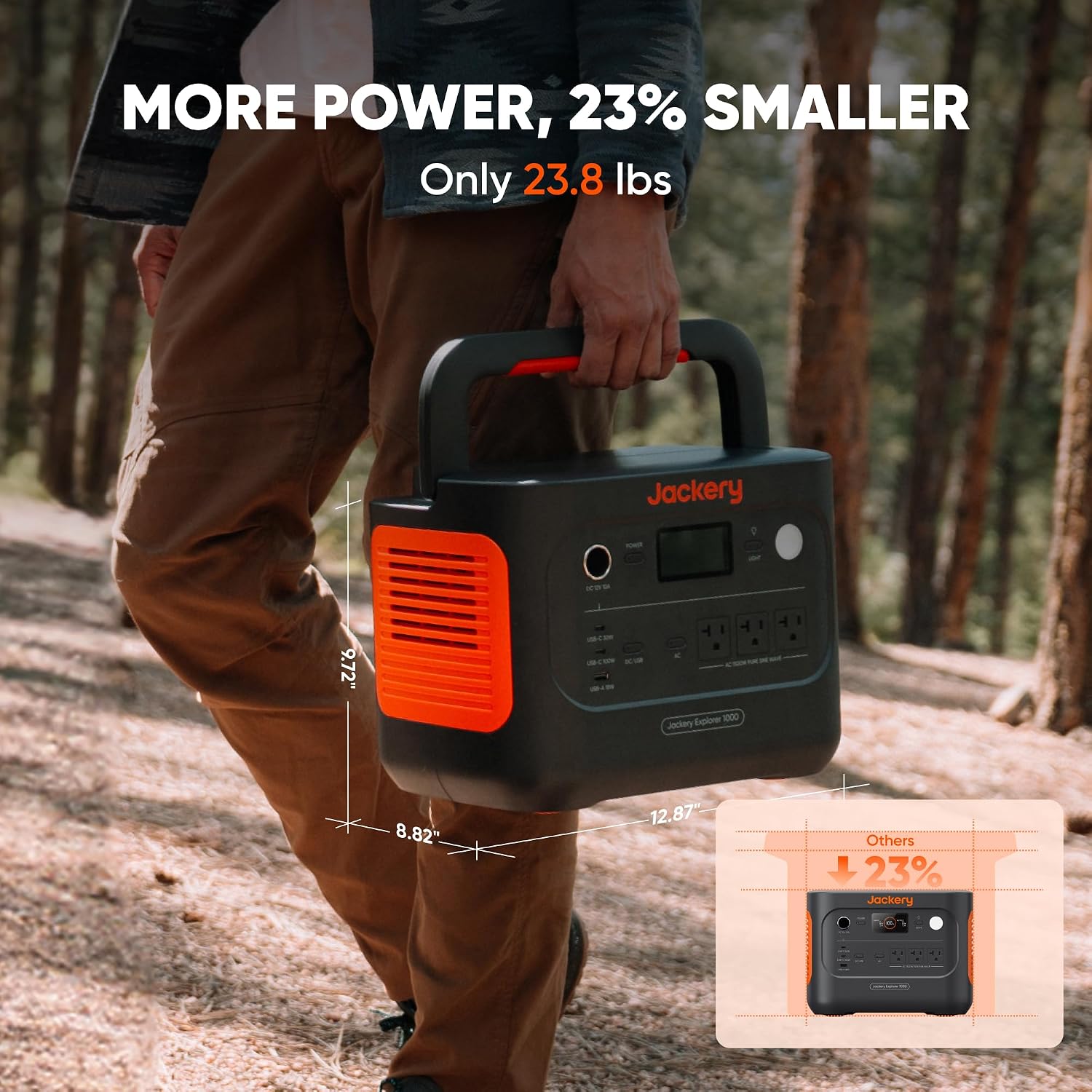
Out of the box, setup took me about 12 minutes. The unit arrives at roughly 30 percent charge, which is standard for shipping lithium cells. The AC charging cable is included; the solar panel arrives in a separate box with its own cable. Downloading the Jackery app and pairing over Bluetooth added another five minutes, and I needed two retries before it connected.
Nothing critical is missing from the package. That said, you’ll want a short 12V car charger cable if you plan to top up while driving, and a second MC4 extension if the panel will be more than 10 feet from the unit.
If you’re comparing bundles, it’s worth checking the Is Jackery Solar Generator 1000 v2 worth buying bundle configuration against the station-only option, since many buyers already own panels.
| Product | Price (approx.) | Key Differentiator | Best Use Case |
|---|---|---|---|
| Jackery Solar Generator 1000 v2 | $699 | 23.8 lb with foldable handle; 1-hour AC recharge; LFP cells | Portable daily use and camping where weight matters |
| EcoFlow DELTA 2 | $599–$699 | Expandable battery ecosystem; 1,024Wh base, scalable | Buyers who want to grow capacity over time |
| Bluetti AC180 | $699 | 1,152Wh with 1,800W output and 500W solar input ceiling | Solar-heavy users who want faster panel charging |
| Anker SOLIX C1000 | $699 | 1,056Wh, 1,800W output, 600W solar input, ~26.5 lb | Balanced performance with stronger solar headroom |
Worth noting: as of this Jackery Solar Generator 1000 v2 review, the Jackery wins on weight and AC recharge speed. It loses on solar input ceiling and on app polish. Those are the two axes that matter most, and they point in opposite directions.
You move your power station regularly. If you carry it from a car to a tent, from a closet to a balcony, or up a flight of stairs, the 23.8-pound body and foldable handle beat every competitor on this list. It also makes sense if you mostly recharge from wall outlets and want the fastest AC top-up available at this price — 63 minutes is a real, usable advantage for people who forget to charge until the night before a trip.
You plan to live off solar. The Bluetti AC180 accepts up to 500W of solar input and the Anker SOLIX C1000 takes 600W, both of which will recharge meaningfully faster than the Jackery’s 200W bundle. If expandability matters more than portability, the EcoFlow DELTA 2 lets you add battery modules later — something the Jackery cannot do. For a closer look at the Anker option, our SOLIX S2000 comparison covers the next tier up.
You can also check the Jackery Solar Generator 1000 v2 review verdict against current pricing before deciding, since the gap to the Bluetti narrows during sales.
For anyone genuinely torn, this Jackery Solar Generator 1000 v2 review and rating comes down to a simple question: does portability matter more than solar headroom?
At 699USD for the station plus the 200W panel, this is priced in line with the category rather than below it. The EcoFlow DELTA 2 often undercuts it, the Bluetti AC180 and Anker SOLIX C1000 match it, and none of them offer the same combination of low weight and fast AC recharge. In other words, you’re paying roughly a $50–$100 premium over the cheapest option for the LFP battery and the one-hour charging — and that premium is defensible over a ten-year ownership period.
Buy from an authorized retailer. Jackery’s 5-year warranty is only reliably honored through authorized channels, and third-party marketplace sellers occasionally ship older stock or open-box units. Return windows matter too — a 30-day return policy is standard at major retailers and gives you time to run your own load test.
Price verified at time of publication. Check for current availability and deals.
Jackery covers the Explorer 1000 v2 with a 5-year warranty, which is longer than the 2–3 years several competitors offer and reflects some confidence in the LFP cells. Support is reachable by email and phone, and the brand maintains a US-based service presence. I did not need to file a claim during testing, so I can’t speak to turnaround times from personal experience. What I can say is that the warranty documentation ships in the box and registration is straightforward — keep your receipt, since the process starts there.
Three things stood out. First, the one-hour recharge is real when you enable it, and that single feature changes how often you actually use a power station. Second, the 23.8-pound body makes this the most portable unit in its capacity class. Third, the bundled 200W panel delivers closer to 140W in practice, which makes this a great AC-charging unit and a mediocre solar-charging one. The full Jackery Solar Generator 1000 v2 review verdict really hinges on which of those three facts you weight most heavily.
Buy it if portability and fast wall charging matter to you. Skip it if you’re building a solar-first setup, because the panel input ceiling will frustrate you and a Bluetti AC180 or Anker SOLIX C1000 is the better call. We rate the Jackery Solar Generator 1000 v2 8.5 out of 10 — half a point off for the app, half for the solar panel’s real-world output, and half because nothing at this price is a 10.
This is a well-built power station bundled with an average solar panel, and it’s worth the money if you understand which half you’re actually paying for. If you’ve used one, I’d like to hear how your recharge times compared — drop it in the comments. Otherwise, you can check current Jackery Solar Generator 1000 v2 pricing here before you commit.
At 699USD, yes — with one condition. If you’ll mostly charge from a wall outlet and value portability, the LFP battery, one-hour recharge, and 23.8-pound body justify the price over a decade of use. If you plan to rely on solar, the 200W panel input ceiling makes the value proposition weaker, and a competitor with higher solar input is a better use of the same money.
The DELTA 2 is often cheaper and expandable with add-on batteries, which the Jackery is not. However, the Jackery weighs less, recharges faster on AC, and uses LFP cells rated for 4,000 cycles versus the DELTA 2’s standard lithium-ion pack. For most buyers who move their unit regularly, the Jackery is the better fit.
About 12 minutes from box to first charge, plus five more for the app if you want emergency charging mode. The physical setup is genuinely simple — one AC cable, one panel cable, no configuration required to start using it. The only beginner tripwire is that the app’s emergency charging toggle doesn’t persist between charges.
Nothing is strictly required. The package includes the station, the 200W folding panel, an AC charging cable, and a manual. Optional additions that meaningfully improve the experience: a second 200W panel if you plan to charge from solar daily, an MC4 extension cable for longer panel runs, and a 12V car charging cable for road trips. You can browse the full Jackery Solar Generator 1000 v2 bundle to see current configuration options.
The unit is covered for 5 years, which is above average for this category. The warranty covers manufacturing defects and battery capacity falling below the rated threshold, not physical damage or water ingress. Support is reachable by phone and email, with a US service presence. I didn’t file a claim during testing, so I can’t personally vouch for resolution speed.
Based on our research, purchasing from this authorized retailer gives you the best combination of price, return policy, and product authenticity. The 30-day return window is the practical benefit — it gives you time to run your own load test before committing. Avoid third-party marketplace sellers with unusually low prices, since the warranty depends on authorized purchase.
Easily. A typical CPAP with humidifier draws 30–60W, which works out to roughly 240–480Wh across eight hours — less than half the 1,070Wh capacity. During testing I ran a heated humidifier, a phone charger, and a fan simultaneously overnight and finished at 62 percent. For CPAP users in areas with unreliable power, this is one of the stronger use cases.
A modern 18-cubic-foot fridge draws about 100–150W while the compressor runs, cycling roughly a third of the time, so call it 800Wh–1,200Wh per day. In practice, expect roughly 8–12 hours, longer if you keep the door closed and the fridge is already cold. It’s enough to bridge a short outage or save a freezer’s contents, but not a multi-day event.
Get Our Reviews Before You Buy
Join readers who use our testing notes to make smarter purchasing decisions. No sponsored rankings. No filler. Just honest reviews and practical guides, delivered when it matters.