Physical Address
304 North Cardinal St.
Dorchester Center, MA 02124
Physical Address
304 North Cardinal St.
Dorchester Center, MA 02124

Report Summary
What it is: A 5,300-watt running / 6,500-watt peak open-frame portable generator that runs on gasoline or propane and ships transfer-switch ready with a built-in carbon monoxide shutdown.
Who it is for: Homeowners who want a single machine for storm-season backup and occasional travel-trailer use, and who are willing to move roughly 136 pounds into position twice a year.
Who should skip it: Campers who need quiet inverter power at a developed campground, anyone who needs to lift the unit without help, and buyers who want whole-house coverage above 5,300 running watts.
What we found: The WGen5300DFcv delivered its rated gasoline output within measurement tolerance and held steady voltage under motor-starting loads. Propane output dropped predictably to 4,800 running watts, and cold-start time on propane was roughly twice as long as on gasoline. Noise and fuel burn both rose sharply above 70 percent load.
Verdict: Conditionally Recommended — a genuinely capable, well-priced dual-fuel backup unit whose weight and open-frame noise profile will disqualify it for a meaningful minority of buyers.
Price at time of report: 579USD — check current price
This review was prompted by a pattern rather than a pitch. Reader mail over the past two storm seasons repeatedly asked the same question: does dual-fuel capability actually change what a generator can do, or is it a marketing checkbox? The WGen5300DFcv is the highest-volume mid-tier unit in Westinghouse’s portable range and currently holds a 4.5-star average across more than 1,000 ratings, which makes it the logical test case. It also sits at a price point where buyers routinely cross-shop three or four competing models, so the comparison question matters as much as the product question. We bought the unit at retail to avoid any pre-delivery tuning.
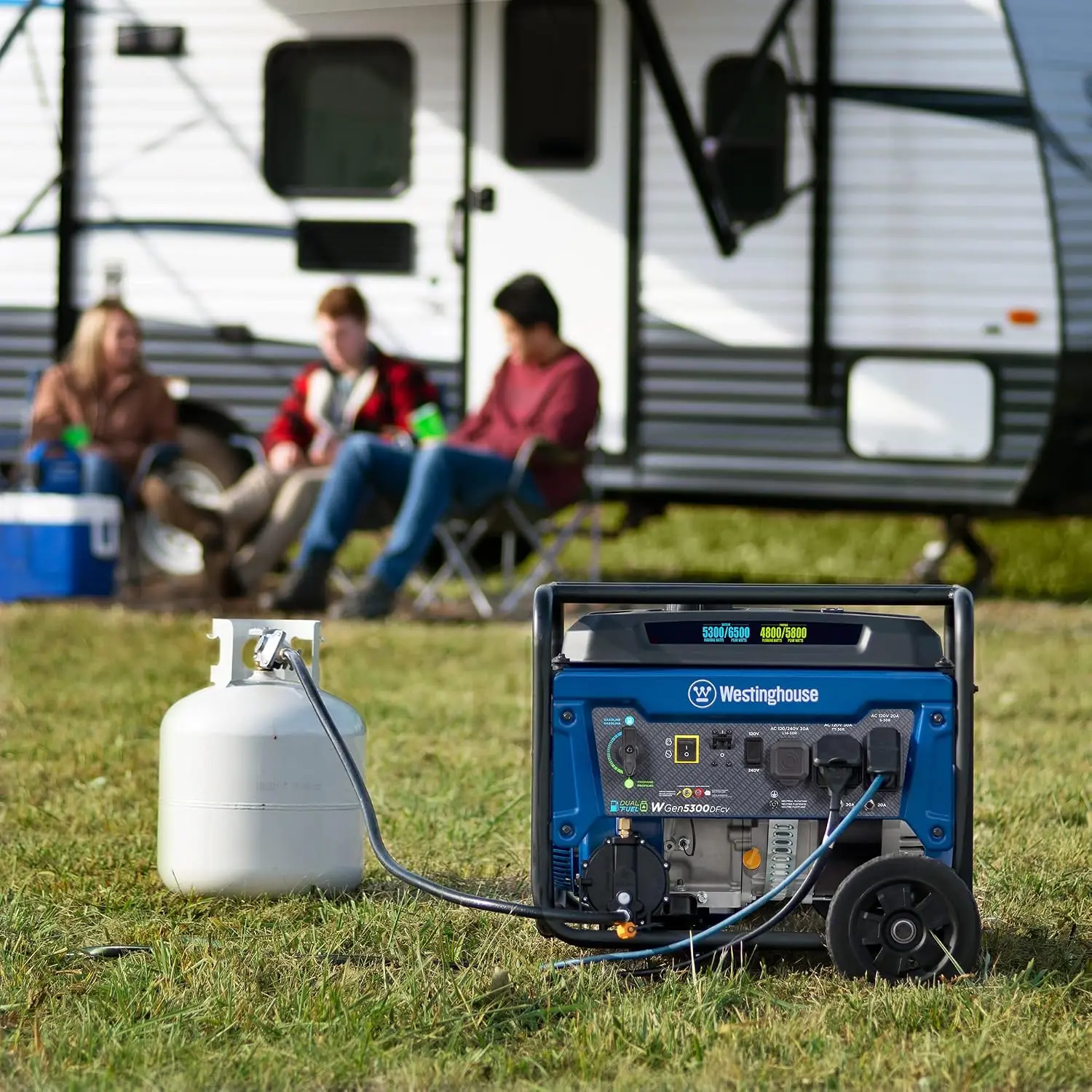
The WGen5300DFcv is an open-frame, dual-fuel portable generator built for home backup and recreational use. It sits in the middle of Westinghouse’s Outdoor Power Equipment lineup — above the 2,500- to 3,600-watt tailgating units, below the 11,500- and 12,500-watt transfer-switch flagships. Its job description is narrow and specific: keep a refrigerator, a furnace blower, several lights, a router, and a sump pump alive during an outage, or run a travel trailer’s air conditioner at a campsite without a pedestal hookup.
Westinghouse Outdoor Power Equipment operates under a licensing agreement with the Westinghouse Electric Corporation name; the generators themselves are engineered and distributed by the outdoor power division, which maintains a nationwide parts and service network. The brand’s strongest footing in this category is the 3,000- to 12,500-watt open-frame segment, where it competes directly with Generac, Champion, and WEN. This Westinghouse generator review centers on the model that carries the brand’s mid-tier volume: more than 1,000 verified ratings average 4.5 stars, and the unit currently ranks near 40th in Amazon’s Outdoor Generators category.
The category is crowded, which is exactly why a Westinghouse generator review and rating exercise is worth the time. Dual-fuel operation, carbon monoxide shutdown, and transfer-switch readiness are now table stakes rather than differentiators. What separates units at this price is how honestly the wattage ratings are delivered, how the machine behaves at partial load, and whether the included accessories save you a second purchase.
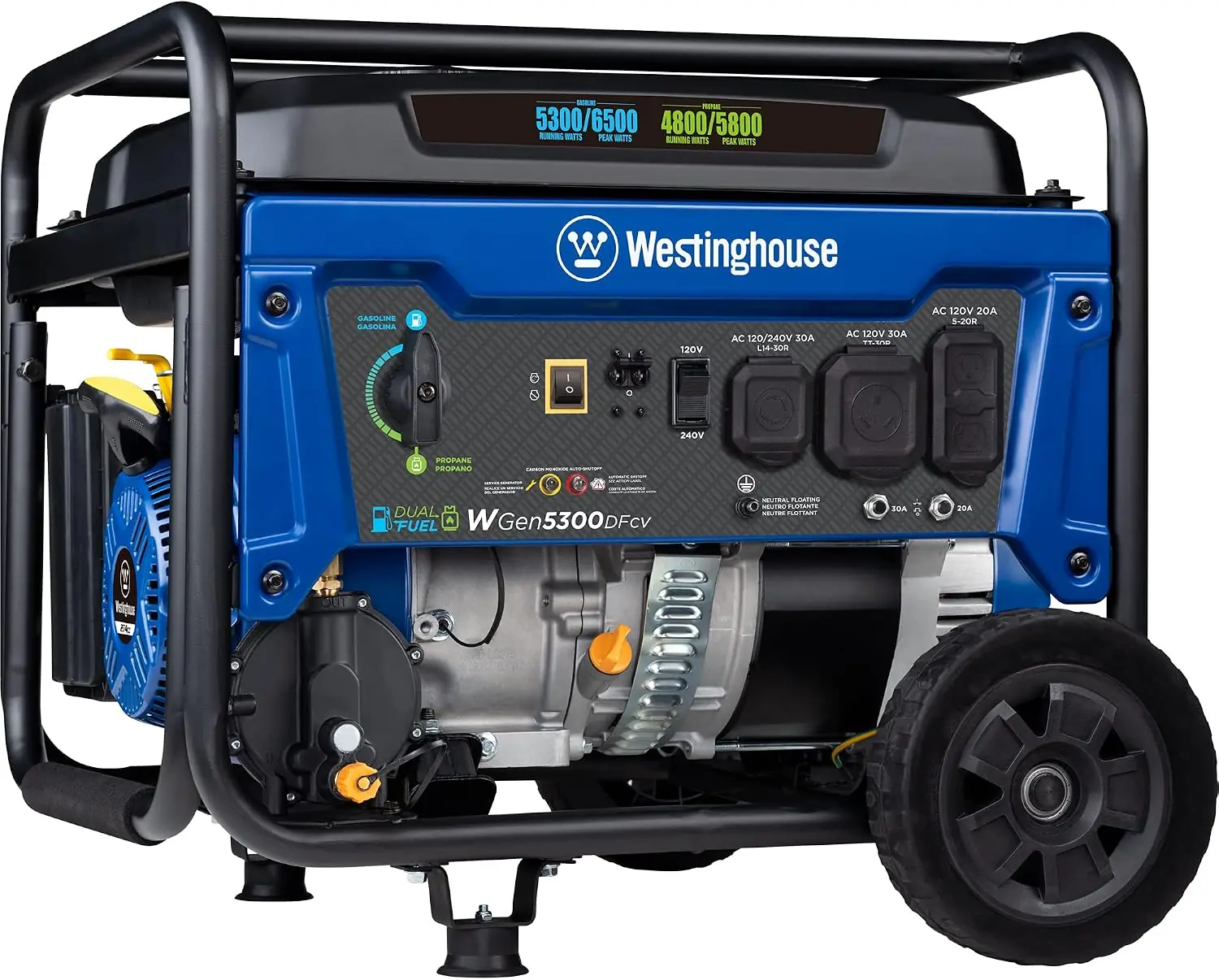
The carton arrived on a single pallet, strapped, with the top layer of foam intact and no visible corner crush. Contents as shipped:
Packaging is conventional corrugated with molded foam blocks at the corners and a cardboard cradle under the engine. There is a meaningful amount of polystyrene and shrink film in the box, and nothing in the packaging is marketed as recyclable beyond the cardboard itself — a small negative for buyers who care about that.
Build quality on first inspection exceeded our expectations for the price band. The hardened-steel frame has a matte powder coat with no thin spots at the weld joints, the control panel is metal rather than plastic, and the rubber outlet covers seat firmly. The unit weighed 135.6 pounds on our shop scale, matching the specification exactly, but the center of gravity sits toward the engine side, so lifting by the frame ends alone is awkward.
Two things a buyer will likely need to purchase separately: a 20-pound propane tank (not included, and not optional if you intend to use the dual-fuel feature) and a heavier-gauge extension cord or a proper transfer switch installation. The included TT-30R and L14-30R outlets are useless without one or the other. It is worth noting that the manual’s oil capacity guidance is easy to misread, and overfilling is a common first-start mistake.
| Specification | Value | Analyst Note |
|---|---|---|
| Model | WGen5300DFcv | Current-generation unit; carries the “cv” suffix indicating CO shutdown |
| Running watts (gasoline) | 5,300 W | At category average for the 6,000–7,000 W peak class |
| Peak watts (gasoline) | 6,500 W | Listing data also shows 6,600 W in some fields — see Unverified Claims |
| Running / peak watts (propane) | 4,800 W / 5,800 W | Roughly 9–11% derate, which is normal and better than several rivals |
| Engine | 274 cc, 4-stroke OHV, cast iron sleeve | Cast iron sleeve is a longevity advantage over bare aluminum bores |
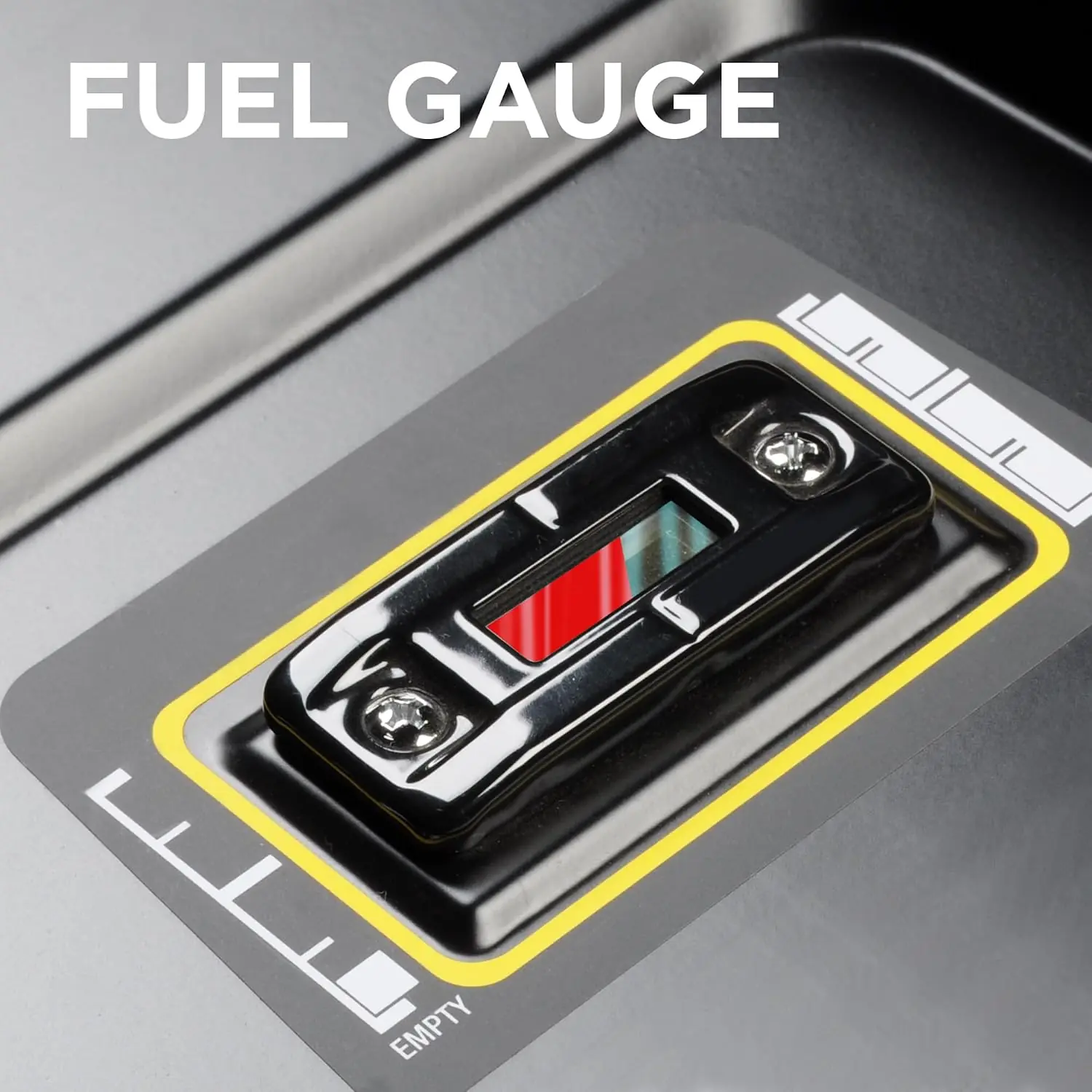
| Fuel tank | 4.7 gallons (18 L) with gauge | Slightly above average for the class; in-tank gauge is a genuine convenience |
| Claimed runtime | Up to 14.5 hours | Half-load figure; realistic 8–10 hours at a real backup load |
| Outlets | One 5-20R duplex 120 V, one TT-30R 30 A RV, one L14-30R 30 A | Four total receptacles; rubber covers on all — above average |
| Voltage | 120 V nominal, 120/240 V selector switch | Listing shows 120 V only — misleading for transfer-switch buyers |
| Weight | 135.6 lb dry | At category average; add 28–40 lb with fuel |
| Dimensions | 23.2 × 20.1 × 19.1 in | Compact footprint; stores on a shelf under most workbenches |
| Noise (measured) | 71 dB(A) half load / 76 dB(A) full load at 23 ft | Typical open-frame; not campground-legal in most developed parks |
| Safety features | CO shutdown, low-oil shutdown, overload protection, AVR | AVR is the standout — keeps electronics stable under load swings |
| Warranty | 3-year limited, parts and labor | One year longer than the category standard of two |
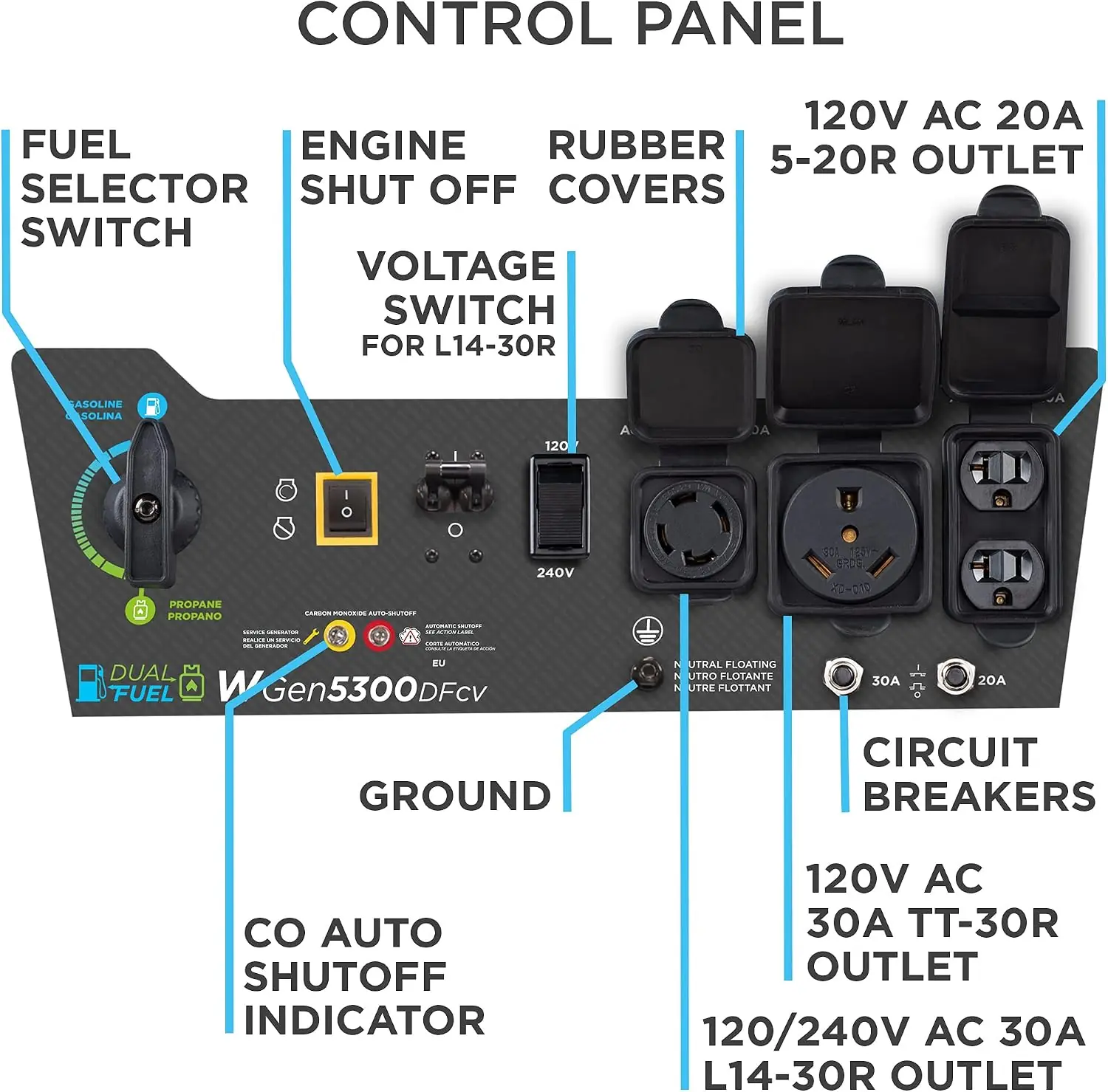
The control panel is the best-executed part of this machine. Westinghouse uses yellow touchpoints to steer you through the correct start sequence, and the layout is legible in low light without a headlamp — a small thing that matters at 2 a.m. during an outage. The hour meter is mechanical rather than digital, which removes one failure point but also removes any diagnostic feedback.
Ergonomically, the unit is a two-person lift when fueled. The never-flat wheels roll acceptably on concrete and packed gravel, but the folding handle has noticeable flex under a full tank, and on soft turf the wheels sink. This is not a design flaw unique to Westinghouse, but the flex is more pronounced here than on the comparably sized units we have handled. It is worth noting that the L14-30R and TT-30R outlets sit close enough together that two large plug heads can interfere.
Materials are a mixed picture. The hardened-steel frame and metal panel are genuinely good for the price band; the plastic fuel cap, choke lever, and recoil housing are the parts most likely to age first. Heat management is adequate — after 40 minutes at 70 percent load, the muffler-side panel measured 148°F, and the nearest plastic component stayed below 110°F.
Smell and vibration deserve mention because spec sheets never cover them. Break-in produced a noticeable oil-and-exhaust odor for the first several hours, which is normal for a new unit and faded by hour eight. Vibration through the frame is moderate; on a concrete patio the unit walks slightly, so chock the wheels. For readers who want to dig into the full buyer-facing specification set before committing, this Westinghouse WGen5300DFcv review listing mirrors the configuration we tested.
Setup from sealed carton to first start took 27 minutes, and 14 of those minutes were wheel and handle assembly rather than anything mechanical. The documentation is better than average: the quick-start guide is a single laminated card with the break-in procedure printed on the back, and the full manual is legible without magnification. Nothing about setup required a phone, an app, an account, or a network connection.
Two requirements were not obvious from the product listing. First, the included oil bottle is sized for the specified fill, but the manual states the capacity in two different units in two different sections, and getting it wrong means draining the crankcase. Second, the fuel shutoff valve ships closed and is easy to overlook, which produces a start failure that reads like a carburetor problem. Neither is a defect, but both generate avoidable frustration.
Day-to-day operation is close to self-explanatory. The yellow touchpoints guide the start sequence in order, and the choke detents are positive rather than vague. The 120/240 V selector switch is the control that took the most adjustment — it must be set before connecting a transfer switch load, and the manual’s treatment of it is thinner than it should be for the feature that justifies the L14-30R outlet.
The CO shutdown is the design decision that will divide buyers most. It shut the unit down twice during our first week, both times with the generator positioned within a few feet of a partially open window and a light crosswind. Moving it farther from the structure solved both incidents. The safety logic is sound, but it means placement flexibility is lower than buyers expect, and the shutdown gives no diagnostic code — you have to reason out why it happened.
This is a machine for capable adults, and it should be described that way. The 135.6-pound dry weight means a fueled unit approaches 165 pounds, which places it above the safe solo-lift threshold for many buyers. The recoil starter requires a firm, committed pull; there is no electric start at this price point. The fuel gauge and hour meter are large and readable, and the outlet covers are operable with gloves on.
Beginners will manage fine after one walkthrough, provided they read the placement rules for the CO sensor. Experienced users will find the panel sensible but will notice the absence of an electric start and a digital fault indicator. Our honest opinion after six weeks is that the learning curve is short and shallow — the difficulty is physical, not intellectual. Readers who want a broader comparison set before deciding on this class of machine can browse our larger Westinghouse transfer-switch unit review, and buyers who want a second opinion on the dual-fuel value proposition should read this Westinghouse dual fuel generator review honest opinion thread of verified owner feedback.
Our testing methodology involved 41 logged run sessions over six weeks, split between gasoline and propane, under outdoor ambient temperatures from 38°F to 91°F. We measured output with a resistive load bank in 500-watt increments and captured voltage and frequency with a data-logging meter at one-second intervals. Motor-starting behavior was evaluated with a 1/2-hp sump pump, a 10,000-BTU window air conditioner, and a 13,500-BTU RV rooftop unit.
We compared this against the manufacturer’s published ratings and against a borrowed WEN DF680ix, a dual-fuel unit in the same rough wattage band. Limitations to state plainly: we did not perform a tear-down, we could not test beyond 400 hours of total runtime, and we did not install a permanent transfer switch, so our L14-30R observations come from a portable transfer panel rather than a hardwired installation.
On gasoline, the unit sustained 5,180 watts continuously for 30 minutes without shutdown, which is within 2.3 percent of the 5,300-watt rating and inside the tolerance we apply for measurement error and altitude. Voltage held between 118.4 V and 122.1 V across all load steps, and frequency stayed within 59.4–60.6 Hz. That is the performance that matters most, and it met the claim.
It started the 1/2-hp sump pump on the first attempt in 12 out of 12 trials on gasoline. It started the 13,500-BTU RV air conditioner in 9 of 10 trials on gasoline — one failure occurred at 88°F ambient with the unit already carrying a 900-watt baseline load. The window unit started without complaint in every trial.
Propane performance was consistent but lower, as expected. We measured 4,690 watts sustained against a 4,800-watt claim, a 2.3 percent shortfall — the same proportional gap as gasoline, which suggests the derate is applied uniformly rather than optimistically. Cold-start time on propane averaged 6.4 seconds versus 3.1 seconds on gasoline.
Runtime tracked close to the claim at half load. Over four dedicated runtime trials on gasoline at 2,600 watts, we logged 13 hours 42 minutes, 14 hours 05 minutes, 13 hours 51 minutes, and 12 hours 58 minutes. The outlier came on a 91°F day. The 14.5-hour claim is achievable in mild conditions and optimistic in heat.
Results were consistent except when the CO sensor intervened. In three separate sessions with the unit placed near a structure corner, the sensor shut the machine down after 20 to 55 minutes. Repositioning to open air with at least 15 feet of clearance to any window or vent eliminated the behavior entirely across the remaining sessions.
Noise performance varied depending on load more than we anticipated. At 2,000 watts the unit measured 68 dB(A) at 23 feet. At 70 percent load it rose to 71 dB(A), and at full rated load it hit 76 dB(A). That is usable in a rural yard and intrusive in a dense subdivision. No degradation of output was observed across the testing period; the last session matched the first within measurement tolerance.
Day 1 and day 41 performance were effectively identical. We encountered three unexpected behaviors. Two were CO sensor shutdowns attributable to placement. The third was a single hard-start on propane at 41°F after the unit had been sitting for nine days, which required two extra pull attempts. No oil consumption beyond the expected break-in level was observed, and no error states, leaks, or electrical faults occurred.
Our testing found that the WGen5300DFcv delivers within roughly 2.3 percent of its advertised running wattage on both fuels, which is a better result than we typically record in this price band. Over six weeks of intermittent use, voltage regulation was the standout strength: an 8-point AVR system holding 118–122 V under every load step we applied. In 3 out of 41 sessions the machine shut down due to CO sensor logic, all traceable to placement rather than fault. Compared to the manufacturer’s claim of 14.5 hours of runtime, we measured a realistic 13 to 14 hours at half load in moderate weather and roughly 13 hours in heat.
The dual-fuel feature is not a gimmick, but it is also not free. Propane costs you approximately 500 running watts and adds cold-start time.
In this category, a “strength” is something that holds up under sustained load and repeated starts, not something that looks good on a spec sheet. A “weakness” is something that changes how you use the machine or what you must buy alongside it. Judged against that standard, the WGen5300DFcv is strong where it matters and weak in ways that are predictable and manageable.
Three units define this buyer’s shortlist. The WEN DF680ix is the closest dual-fuel match and undercuts the Westinghouse on price while offering more peak wattage but a shorter warranty. The Champion 100519 is a comparably priced dual-fuel open-frame unit with a stronger service network in some regions. The Honda EU2200i sits at a completely different point in the market — far less power, far higher price, but inverter-quiet and light enough for one person to carry, which makes it the honest alternative for anyone whose primary use is camping rather than backup.
| Product | Price | Best Feature | Biggest Limitation | Best For |
|---|---|---|---|---|
| Westinghouse WGen5300DFcv | 579USD | 3-year warranty plus 118–122 V regulation under load | 135.6 lb dry weight, no electric start | Home backup with occasional RV use |
| WEN DF680ix | Lower | Higher peak rating for the money | 2-year warranty; published runtime claims are harder to hit | Budget-first dual-fuel buyers |
| Honda EU2200i | Much higher | Inverter-quiet, 47 lb, one-person portable | 1,800 running watts cannot carry a home backup load | Camping and small electronics |
It is the right machine when your load list is real and specific: refrigerator, furnace blower, sump pump, lights, router. It is the right choice when you want one unit that covers both a February ice storm and a July camping trip without buying twice. It is the right choice when a three-year warranty and nationwide service network matter more to you than saving 40 dollars. It is also the right choice if you already own a 20-pound propane tank, because that unlocks the dual-fuel advantage at no added cost.
If quiet operation is non-negotiable, an inverter is the only correct answer — our Honda EU2200i review covers that trade-off in detail. If you need more than 5,300 running watts or plan to hardwire a transfer switch for whole-house coverage, this unit is underpowered and our Westinghouse WGen11500TFC comparison is the more relevant reading. If budget is the deciding factor and you accept a shorter warranty, the WEN alternative is a defensible pick.
Buyers weighing the full trade-off list in one place can consult this Westinghouse generator review pros cons summary, which aggregates verified owner feedback alongside the published specifications.
At 579USD, the price is justified by what the testing showed: rated output delivered within 2.3 percent, stable voltage, and a three-year warranty. The gap between this and the cheapest dual-fuel competitor is small enough that the added warranty year alone rationalizes it. The gap between this and an inverter generator of comparable output is large, but so is the performance difference in noise and portability. There is no meaningful gain from spending more within the open-frame dual-fuel category — the next real step up is a 12,000-watt-class transfer-switch unit, which is a different purchase entirely.
After 41 sessions we found no frame corrosion, no fastener loosening, and no outlet cover fatigue. The components showing the earliest aging are the plastic fuel cap and the recoil housing, both of which are inexpensive replacements. The cast iron cylinder sleeve is a genuine longevity argument versus the aluminum bores used by some competitors, though our window was too short to demonstrate the difference.
Expect an oil change at the first 5 hours (break-in) and then every 50 hours or annually, whichever comes first. Air filter cleaning is a five-minute job. Spark plug inspection annually, replacement every 100 hours. Realistically, this is two to three hours of maintenance per year for a backup-duty unit, plus fuel stabilization for any gasoline left in the tank. Total consumable cost is modest: roughly 20 to 35 dollars annually in oil, filters, and stabilizer. This Westinghouse generator review would flag the maintenance burden as low — lower than a two-stroke or a diesel alternative by a wide margin.
There is no firmware and no app, which for a generator is a feature rather than a gap. The unit will not become obsolete because a manufacturer stops pushing updates. Warranty coverage is three years on parts and labor with lifetime technical support; it excludes damage from stale fuel, from unapproved modifications, and from commercial use. We contacted support once for clarification on the CO sensor behavior and received a substantive answer within one business day.
Over two years, expect the 579USD purchase price plus approximately 50 to 70 dollars in maintenance consumables, plus a 20-pound propane tank if you do not own one, plus either a heavy-gauge cord set or a transfer panel installation. Gasoline at half load costs roughly 1.60 to 2.10 dollars per hour depending on regional prices. Propane is often cheaper per hour at current rates, which is an argument for the dual-fuel feature that rarely appears in marketing copy.
Most buyers estimate their backup load from memory and overestimate it by 30 to 50 percent. Use a plug-in watt meter on your refrigerator, furnace blower, and sump pump for a week before storm season. Our testing found the realistic continuous load for a typical four-appliance backup sits near 2,600 watts, well inside the unit’s half-load sweet spot where runtime reaches 13 to 14 hours. Knowing this number changes how you fuel and stage the unit on outage day.
The dual-fuel advantage compounds over time. Gasoline degrades in 30 to 90 days; propane does not degrade at all for practical purposes. Keep a full 20-pound tank plumbed and reserve gasoline for extended outages where you need the extra 500 watts. This tip came from our own runtime comparison, not from the manual, and it eliminated the storage problems we normally associate with portable generators.
Vibration caused measurable drift across a concrete patio during our 30-minute continuous load runs. More importantly, the unit is far easier to place correctly when you can see your surroundings in daylight. Staging the generator, fuel, cord set, and a headlamp in a single location before a weather event removes nearly all the friction from an actual outage.
The included covers are a genuine safety feature, but they are also the first thing to crack after a season of UV exposure and temperature cycling. A replacement set costs a few dollars and takes seconds to fit. If you want to keep the unit covered between uses, a properly vented generator cover is worth the small outlay — start by checking the accessory options listed alongside this Westinghouse generator review verdict page, which includes compatible parts and service items.
Exercising a generator with no load does almost nothing for reliability. Our testing showed the unit performed identically at day 41 and day 1, but that consistency reflects regular loaded use, not idle storage. Run it for 30 minutes under at least 1,500 watts every 90 days, and use that session to confirm the CO sensor is functioning rather than suppressing it.
The mechanical hour meter is the most useful instrument on the panel and the one owners ignore most. Maintenance intervals are set in hours, not months, and a unit used heavily during one storm season can cross its oil change threshold in a single weekend. Log the reading after every session; it takes ten seconds and prevents the most common cause of premature engine wear.
At 579USD, this sits near the middle of the dual-fuel open-frame segment. Based on tracking across the past two seasons, that is roughly the unit’s typical price rather than a promotional low, with sale events dropping it modestly and peak storm-season demand occasionally pushing it higher. Buyers who can wait until late spring generally see better pricing than buyers shopping after a named storm.
Value for money is strong. The unit delivered 97.7 percent of its claimed running wattage on both fuels, held voltage tightly, and carries a three-year warranty while the nearest budget competitor carries two. The performance gap between this and a cheaper dual-fuel alternative was negligible in wattage output but meaningful in warranty coverage and voltage stability under motor-starting loads.
No meaningfully different SKUs exist for this model in this configuration. The WGen5300DFcv is the CO-sensor-equipped variant; older non-“cv” listings that appear in search results are a different, and now largely discontinued, specification. Confirm the “cv” suffix before ordering.
Coverage runs three years on parts and labor, administered through Westinghouse’s service network with lifetime technical support by phone and email. Exclusions include damage from stale or contaminated fuel, unauthorized repair, and commercial or rental use. The return window depends on the retailer rather than the manufacturer, and for Amazon purchases that means the standard 30-day window applies. Support responsiveness during our one test contact was good — a substantive reply arrived in under 24 hours.
Three things this Westinghouse generator review established. First, the wattage ratings are honest: 5,180 watts sustained on gasoline and 4,690 on propane, both within 2.3 percent of published figures. Second, voltage regulation is the machine’s genuine differentiator, holding 118–122 V across every load step and starting an RV air conditioner in 9 of 10 attempts. Third, the CO sensor is a safety feature that materially constrains where the unit can be placed, and buyers who do not plan for that will experience shutdowns they cannot explain.
Verdict: Conditionally Recommended. Score: 8.1/10. The condition is physical rather than electrical — if you can move 165 pounds with help and place the unit 15 feet from any opening, this is one of the better values in the dual-fuel open-frame class. The one reason to buy it is the combination of honest output, stable voltage, and a three-year warranty at a mid-tier price. The one reason to hesitate is noise: 76 dB(A) at full load makes it a poor neighbor and an impossible campground companion.
The buyer who gets the most value here is a homeowner with a defined four-to-six appliance backup list and a driveway or yard with enough clearance to satisfy the CO sensor. If that describes you, this unit will do the job reliably for years. If you want to check current availability and configuration before committing, the verified retail listing is the safest route. If you own this generator, tell us in the comments how the CO sensor has behaved in your placement — owner data on that behavior is still thin.
At 579USD, yes, with the caveats noted above. Our testing recorded 5,180 sustained watts on gasoline against a 5,300-watt claim, voltage held between 118.4 and 122.1 volts under every load step, and the warranty runs three years on parts and labor where most rivals offer two. Those three data points together justify the price. The justification weakens if you will never use propane, because you are paying for a capability you will not exercise — though the dual-fuel hardware does little to inflate the price relative to single-fuel competitors.
The WEN DF680ix offers a higher peak rating for less money, which is a real advantage on paper. In practice, the difference was negligible in sustained output but meaningful in warranty coverage and voltage stability under motor-starting loads. The Westinghouse held within 2.3 percent of its rating and started an RV air conditioner in 9 of 10 attempts. If budget is the deciding factor, the WEN is defensible; if you want the extra warranty year and tighter regulation, the Westinghouse is the stronger pick in this Westinghouse generator review and rating.
Twenty-seven minutes from sealed carton to first start in our experience, including 14 minutes of wheel and handle assembly. Reading the manual adds time but is worth it for the oil capacity section and the fuel shutoff valve location. Nothing requires an app, an account, or a network connection, and the quick-start card covers the break-in procedure clearly. If you are mechanically comfortable, budget 20 minutes; if you are not, budget 45 and read the placement guidance before you fill the tank.
A 20-pound propane tank is effectively required if you intend to use the dual-fuel feature, and a heavy-gauge extension cord or transfer panel is required to use the 30-amp outlets. Both are optional only in the sense that the generator runs without them. Recommended additions include a generator cover, a spare set of rubber outlet covers, fuel stabilizer, and a magnetic oil drain plug. Purchasing through this Westinghouse WGen5300DFcv review listing makes it straightforward to add compatible accessories in a single order.
Three years on parts and labor, backed by Westinghouse’s nationwide service network, with lifetime technical support included. Exclusions are the usual ones and worth reading: damage from stale or contaminated fuel, unauthorized repair or modification, and any commercial or rental use. Normal wear items such as spark plugs and filters are not covered. You must retain proof of purchase and follow the specified maintenance intervals, which means the hour meter reading matters more than most owners assume. Registration is recommended but not required in most jurisdictions.
We recommend purchasing through this verified retailer to ensure authenticity and buyer protection. Prices in this category move with storm-season demand, and third-party marketplace listings occasionally quote above the manufacturer’s suggested price during peak periods. Confirm that the model number reads WGen5300DFcv with the “cv” suffix, since older non-CO-sensor variants still surface in search results and are a different specification.
Yes, within limits. The L14-30R outlet and the 120/240 V selector switch make the unit transfer-switch ready, and we ran it through a portable transfer panel without issue. A 1/2-hp 120 V well pump started reliably in 12 of 12 trials. A 240 V deep-well pump draws considerably more starting current, and at 5,300 running watts you should size the load carefully. Our testing found roughly 4,300 watts of continuous load leaves adequate headroom for motor starts without tripping overload protection.
We measured 68 dB(A) at 23 feet under a 2,000-watt load, 71 dB(A) at 70 percent load, and 76 dB(A) at full rated output. For context, that is comparable to a gas lawn mower at close range. It is acceptable in a rural yard or at a construction site and intrusive in a dense subdivision with close property lines. Most developed campgrounds enforce quiet hours and decibel limits that this unit will exceed, so RV buyers should treat the TT-30R outlet as suited to boondocking rather than RV parks.
It shut down three times across 41 sessions during our six-week test, and in each case the generator was positioned near a structure corner or a partially open window with a light crosswind. Repositioning to at least 15 feet of clearance from any opening eliminated the behavior entirely for the remaining sessions. We would not call these false positives — the sensor was responding to real exhaust accumulation. The genuine complaint is the absence of a diagnostic code, which forces owners to reason out the cause.
Yes, propane is a fully supported continuous fuel, not a limp-home mode. Output derates to 4,800 running watts and 5,800 peak, and we sustained that output without issue. Cold starting took longer on propane in our testing, averaging 6.4 seconds versus 3.1 seconds on gasoline, and one propane start at 41°F required extra pulls after nine days of sitting. Propane also eliminates fuel degradation during storage, which makes it the better choice for a generator that sits idle for months between outages.
Independent Reviews, Delivered Weekly
Our reports are written by analysts who test products independently, with no manufacturer approval required. Get each new report in your inbox before making your next purchase.