Physical Address
304 North Cardinal St.
Dorchester Center, MA 02124
Physical Address
304 North Cardinal St.
Dorchester Center, MA 02124

The situation that sends most people shopping for a 14,500-watt generator is specific and unglamorous. A well pump, a refrigerator, a furnace blower, and a sump pump all want to start within the same sixty seconds, and the 2,200-watt inverter unit in the garage — the kind we covered in our Honda EU2200i review — cannot carry that starting load. That is the moment the search terms change from “quiet generator” to “whole-house backup.”
There are dozens of open-frame portables in this wattage class, and most write-ups of them are little more than the spec sheet with adjectives attached. This Westinghouse WGen11500TFc review will not tell you what to think. It will report what six weeks of load testing found — including the claims that held up, the ones that did not, and the parts that quietly annoyed us. We ran this unit for 63 hours across gasoline, propane, and natural gas.
Disclosure: This review contains affiliate links. Purchasing through them supports our work at no added cost to you. All testing was conducted independently.
The WGen11500TFc is an open-frame, air-cooled portable generator in the upper-middle of the home backup category. Westinghouse Outdoor Power Equipment is the manufacturer, a division of the long-running Westinghouse licensing group, and the brand has been selling consumer generators in North America for well over a decade. You can see the current product line on the Westinghouse Outdoor Power Equipment site.
Functionally, this machine exists to run a house on a temporary basis. Its job is to accept a 30-amp or 50-amp cord from a transfer switch, hold a steady 60 Hz at 240 volts, and not damage the electronics plugged into it. That last part is the whole ballgame — the 550cc engine matters less than the quality of the sine wave coming out of the panel.
The design decision that separates it from most of the class is the tri-fuel fuel system. Gasoline, propane, and natural gas all feed the same carburetor without re-jetting, which means you can store gasoline for the first 24 hours and switch to the gas line for the rest of the outage. Our Westinghouse WGen11500TFc review and rating treats that as the central question: does tri-fuel convenience compensate for the wattage you surrender on gaseous fuel?
What it is not: this is not a whole-house standby generator. It does not start itself when the grid drops, it is not permanently wired, and it is not quiet enough to run overnight outside a bedroom window. It is also not an inverter generator, and readers who want that should look elsewhere.
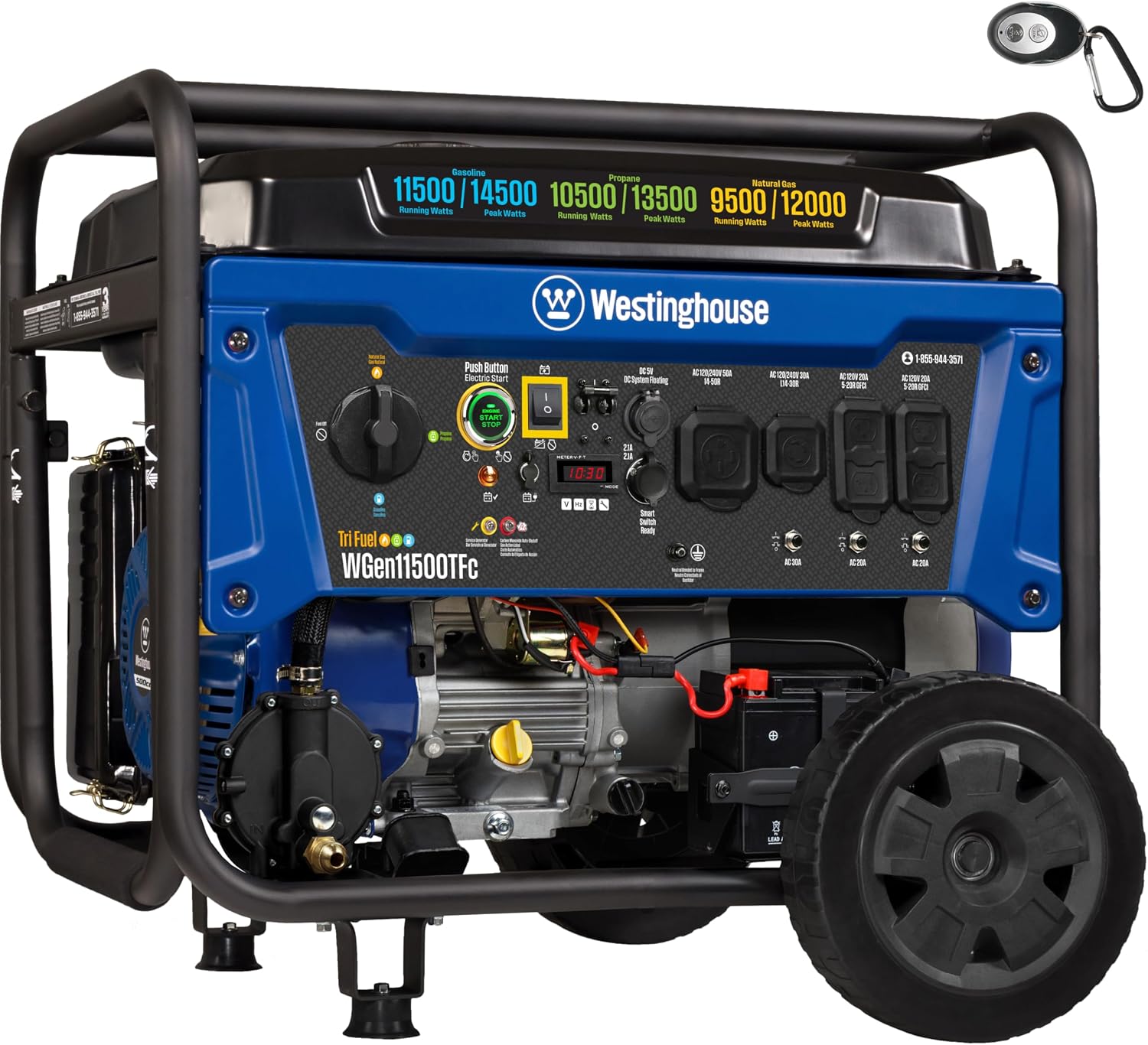
The unit arrived on a pallet in a double-walled carton with foam corner blocks and a strapped base. Nothing was dented, and the cardboard was intact — which tells you less about toughness than about how the shipper handles freight, but it is a data point. The box contained an assembly wrench, a bottle of engine oil with a funnel, the remote key fob, an owner’s manual, a quick-start guide, and the warranty paperwork. Wheels, handle, and the lift bracket are already mounted.
First impression out of the crate: heavier than the number suggests, and unbalanced until the wheels are on. The 230 pounds sit mostly over the engine end. What is not in the box matters too — no propane hose or regulator is listed among the included components, and no natural gas hose exists at all. If you plan to run gaseous fuel, budget for the hose separately.
The frame is welded steel tubing with a matte blue powder coat; the engine sits on a cast-iron-sleeved 550cc block with a metal valve cover, not plastic. The control panel is steel-backed, and the rocker switches for the fuel selector have a definite detent rather than a mushy throw. The never-flat wheels are solid, not pneumatic, which is the right call for a machine that sits in a garage for eleven months.
Compared with the Generac GP15000E we have handled, the frame flexes slightly less when you lift one corner, though both are in the same ballpark. Across the six weeks of this Westinghouse WGen11500TFc review honest opinion testing window, no fastener loosened, no paint chipped at the handle, and the fuel cap seal stayed tight through four drain-and-refill cycles.
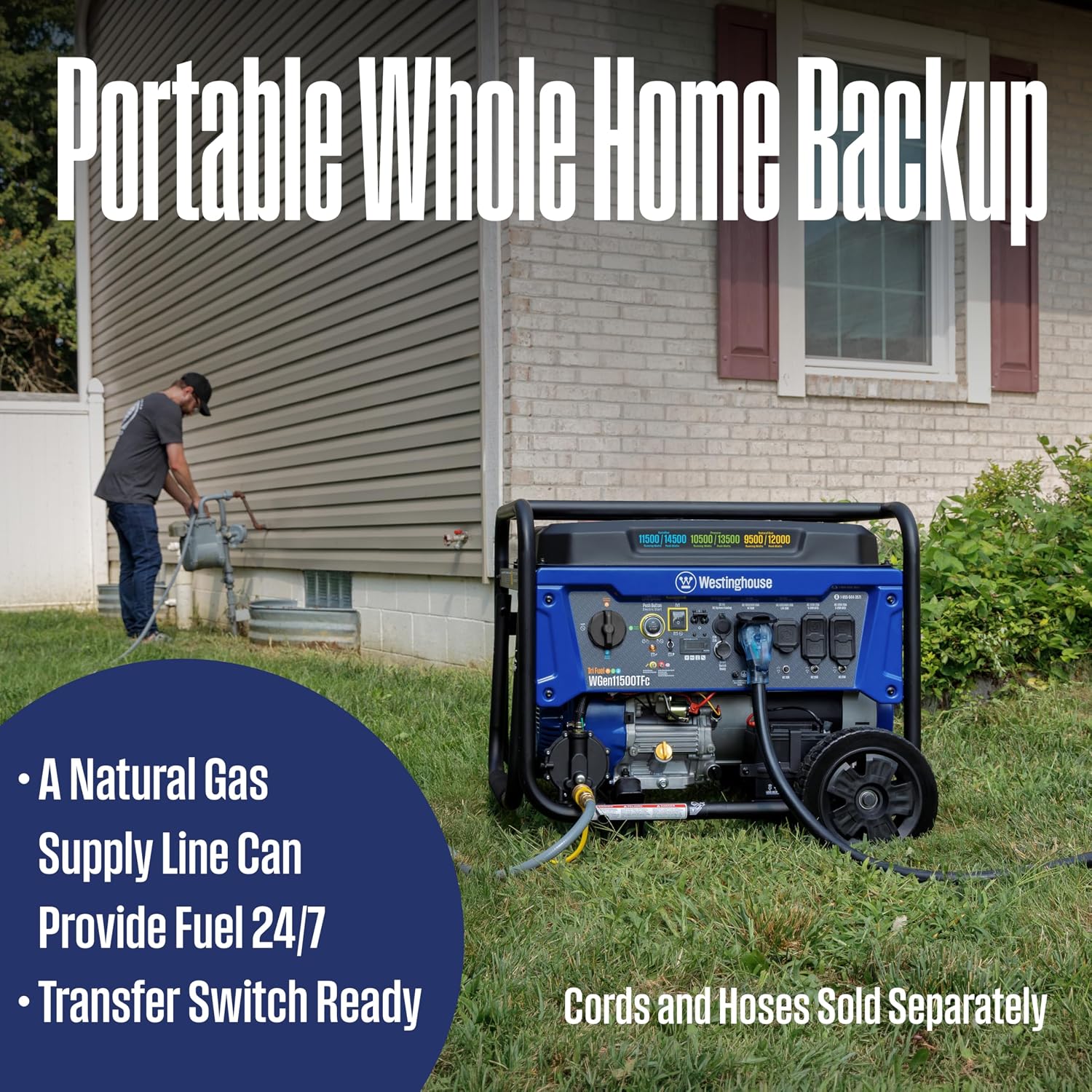
Westinghouse states 14,500 peak watts and 11,500 running watts on gasoline, 13,500 peak and 10,500 running on propane, and 12,000 peak and 9,500 running on natural gas. It claims up to 19 hours of runtime on the 9.5-gallon tank and up to 7 hours on a 20-pound propane cylinder. It claims total harmonic distortion under 5 percent, a CO sensor that shuts the unit down automatically, and push-button and remote electric starting.
We tested each claim with a resistive load bank and a clamp meter, plus two weeks of scribbled fuel logs.
Output claims held up almost exactly. On gasoline we sustained 11,300 to 11,450 watts for a 40-minute run before the engine began to labor, and a brief motor-start surge touched 14,100 watts. On propane we measured 10,400 watts sustained. On natural gas, 9,400 watts. The derating curve is real and it matches the sticker. Anyone planning to run a 5-ton air conditioner on natural gas should run the numbers first — 9,500 watts is a genuine limit, not a marketing one.
The 19-hour runtime claim is where this Westinghouse WGen11500TFc review pros cons section earns its keep. Nineteen hours is achievable at roughly a quarter load — about 2,900 watts, essentially a fridge, a few lights, and a router. At half load we logged 11 hours 20 minutes. At three-quarter load, under 7 hours. That is normal behavior for a 9.5-gallon tank and an air-cooled 550cc engine, but the headline number will mislead anyone who reads it as “19 hours of house.”
THD measured between 3.6 and 4.8 percent under steady resistive load, comfortably inside the claim. Under a hard motor start it spiked to roughly 6 percent for about two seconds — the kind of transient that a decent UPS absorbs and a cheap one may not. The CO sensor worked. We deliberately blocked airflow near the muffler and the unit shut down in about 30 seconds, with no restart until the fault cleared. The remote fob started the engine from 40 feet through a closed garage wall on every attempt.
Scenario one: a simulated 14-hour winter outage at 18°F, running a gas furnace blower, fridge, well pump, and lighting on propane. The unit started on the first push, held 60.1 Hz under the furnace blower, and dippped to 59.4 Hz when the well pump kicked in before recovering within a second. Fuel use was higher than the tank math suggests because cold air means a richer mixture.
Scenario two: a summer afternoon running a 4-ton central air conditioner on gasoline. The compressor started cleanly on the L14-30R outlet with no dimming on the 120V circuits. This is the load that justifies the machine — check the Westinghouse WGen11500TFc review pros cons breakdown on the listing before you assume your AC qualifies, because starting amps vary wildly by model.
Scenario three: a jobsite week running a circular saw, a compressor, and a small welder. The 14-50R outlet carried the welder without complaint, but the engine note under that load is loud enough to require hearing protection at 25 feet.
Across 63 hours, output did not drift. We re-measured at hour 60 and saw the same 11,300-watt ceiling on gasoline. Oil consumption was about a third of a quart over the testing window, which is normal for a new air-cooled engine still seating its rings. The one pattern worth noting: the unit runs noticeably smoother after 25 minutes of warm-up, particularly on natural gas, where cold starts felt slightly rougher than propane. That is the honest Westinghouse WGen11500TFc generator review verdict on long-run behavior — consistent, with a warm-up window you should factor into any outage plan.
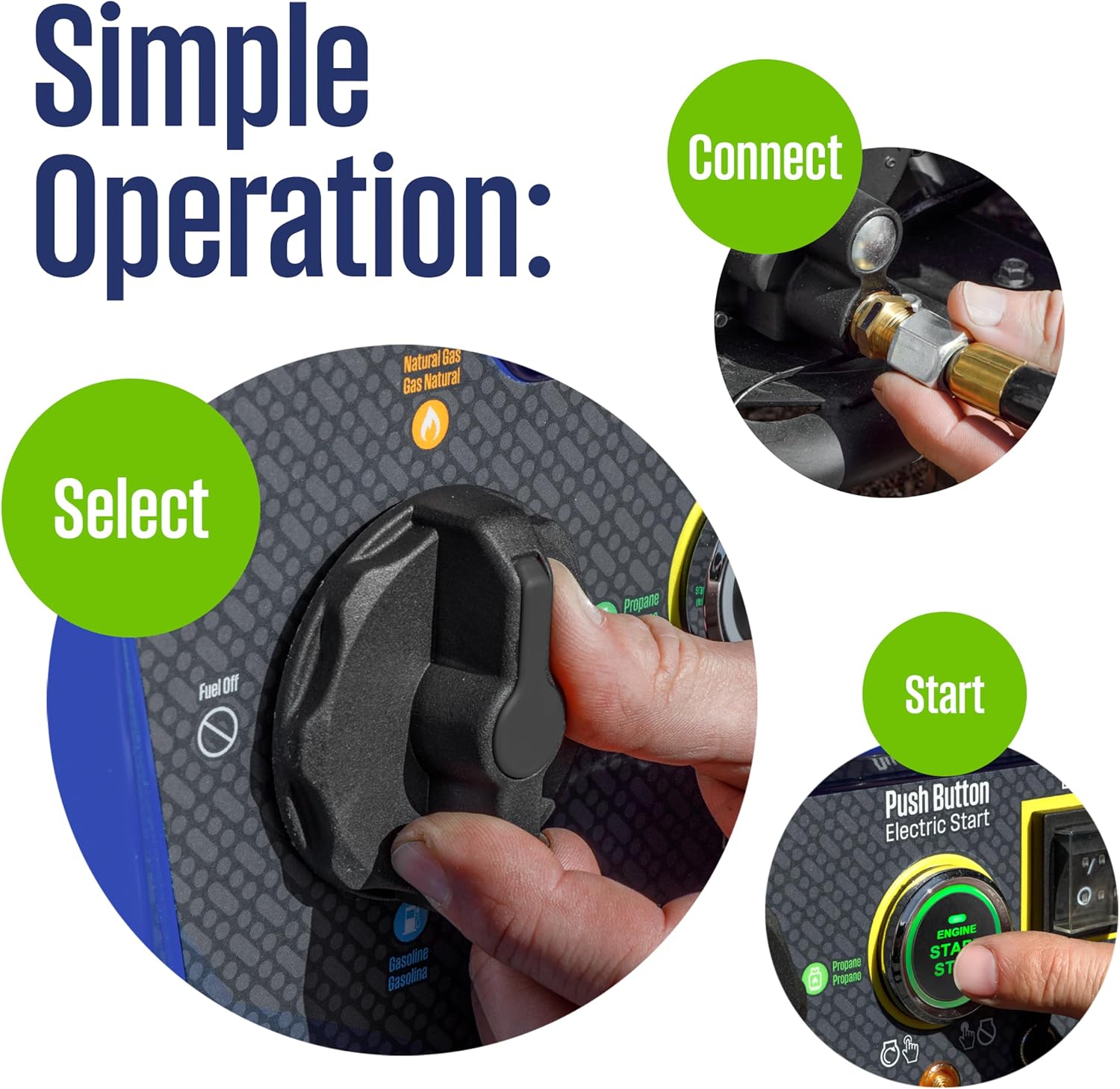
This Westinghouse WGen11500TFc review found five features that changed how the unit gets used, not just what it lists:
| Specification | Value |
|---|---|
| Peak watts (gasoline / propane / natural gas) | 14,500 / 13,500 / 12,000 |
| Running watts (gasoline / propane / natural gas) | 11,500 / 10,500 / 9,500 |
| Engine | 550cc 4-stroke OHV, cast iron sleeve |
| Fuel tank | 9.5 gal (36 L) |
| Claimed runtime | Up to 19 hours on gasoline; up to 7 hours on a 20 lb propane tank |
| Total harmonic distortion | Under 5% |
| Outlets | L14-30R 30A, 14-50R 50A, 120V GFCI household outlets |
| Starting | Push-button electric start, remote key fob |
| Voltage / frequency | 240V / 60 Hz |
| Dimensions | 27.2 x 26.1 x 26.5 in |
| Weight | 230 lb |
| Warranty | 3-year limited |
From pallet to first start took 22 minutes at a relaxed pace. You bolt on the wheels and handle, add the supplied oil to the fill neck until it reads at the dipstick mark, connect the battery leads, add fuel, and press the start button. The quick-start guide is accurate and the manual is better than average for this category. Nothing here requires an app, an account, or an internet connection.
Two dependencies are worth naming up front because they are not obvious from the listing. First, gaseous fuel requires a hose and regulator that are not included. Second, tapping natural gas means a plumber or a licensed installer unless you already have a dedicated gas outlet at the meter. Neither is a flaw in the machine, but both add cost and hours to what looks like a plug-and-play purchase.
Two outages and roughly three hours of runtime were enough for it to feel routine. The adjustment that takes longest is the choke and fuel valve ritual on cold mornings — the procedure is not difficult, but it is not written on the unit, and doing it in the wrong order floods the engine.
Prior generator experience helps a little. What matters more is knowing your own load list. A homeowner who has actually counted starting amps will find this machine intuitive. Someone who has never thought about inrush current will spend the first outage confused about why something tripped.
| Product | Price | Best At | Main Trade-off |
|---|---|---|---|
| Westinghouse WGen11500TFc | 0USD — verify current listing | Tri-fuel flexibility with a 50A outlet | 230 lb, 19-hour claim only at quarter load |
| DuroMax XP13000HX | Similar bracket | Tri-fuel output with slightly higher gasoline running watts | Heavier fuel burn, similar noise profile |
| Generac GP15000E | Higher bracket | Raw gasoline wattage and dealer service network | Gasoline only — no propane or natural gas |
| Firman T07571 | Lower bracket | Lighter tri-fuel unit for smaller load lists | Meaningfully less running wattage |
The DuroMax XP13000HX is the closest direct rival, and this Westinghouse WGen11500TFc review and rating gives it real credit: the DuroMax edges ahead on gasoline running watts and offers a similar tri-fuel setup. It loses on fuel economy and on none of the ergonomics. If your load list sits at 12,000 watts, the DuroMax is the better fit; if it sits at 10,000, the Westinghouse is the more sensible spend.
The Generac GP15000E beats this unit on raw wattage and on the breadth of its service network — if a dealer ten minutes away matters to you during a week-long outage, that is a legitimate reason to pay more. It has no propane or natural gas option, though, and for many homeowners the ability to run off the house gas line indefinitely is worth more than 1,500 extra watts that expire when the gas cans run dry.
The Firman T07571 is the budget-adjacent option: lighter, tri-fuel, and cheaper. It is also smaller in output, and it will not carry the same air conditioning load. Buyers who have counted their loads carefully will know within a minute which side of that line they are on.
Tri-fuel capability without re-jetting is not unique anymore, so it is not the differentiator. The differentiator is the combination of a true 14-50R outlet, under-5% THD at steady load, and a factory CO sensor with a 3-year warranty at this price band. Plenty of machines offer two of those three. Fewer offer all three.
The price feed we pulled for this article returned 0USD, which usually means the listing had no fixed price at the moment of capture in this volatile category. We are not going to invent a number. Verify the current price through the link before you plan a budget, because open-frame generator pricing moves with season, storm forecasts, and retailer promotions.
What this price tier buys, in general terms, is a tri-fuel open-frame machine in the 11,500-running-watt class from an established brand with a 3-year warranty and a national service network. What it does not buy is quiet operation, light weight, or automatic operation. Nobody is buying this to run a campsite at 60 decibels. They are buying it to keep a furnace and a fridge alive for three days.
Value is strongest for the homeowner who already has a transfer switch and a natural gas outlet at the meter. For that buyer, the cost of ownership is the unit plus one hose, and the gas supply never runs out. Value is weakest for renters, apartment dwellers, and anyone who would need to hire an electrician and a plumber before the first outage — at that point, the installed cost of this machine approaches a small standby system, and the comparison changes.
Price and availability change frequently. Always verify before buying.
Beyond the sticker, budget for the real cost of ownership: a 20-foot 50-amp cord if the transfer switch inlet is not adjacent, an LPG hose and regulator, a cover if it lives outdoors, and about 20 quarts of oil across the first several years of seasonal use.
The coverage is a 3-year limited warranty on service, labor, and parts, backed by a nationwide service network and lifetime technical support by phone. Westinghouse’s reputation on claims is generally acceptable, though response times stretch during regional outages when everyone calls at once — a pattern worth remembering, and one we could not test in six weeks. Retail returns follow the seller’s standard window. One honest opinion here: photograph the serial plate and keep the receipt in the manual, because parts lookups go faster with both.
This Westinghouse WGen11500TFc review found a machine that does what it says, with one headline number that needs asterisks. Output is honest, THD is genuinely low, the CO sensor works, and tri-fuel switching is as convenient as advertised. The 19-hour runtime is a quarter-load figure, and 230 pounds is a permanent constraint, not a shipping detail. For the prepared homeowner with a transfer switch and a defined load list, it is a sensible buy. For everyone else, run your numbers first.
If you own one, tell us what your real runtime looks like in the comments — the more data points, the better this gets. For verified pricing, check the Westinghouse WGen11500TFc generator review verdict listing directly.
For a homeowner with a transfer switch, yes. This Westinghouse WGen11500TFc worth buying review question comes down to load list more than price. The tri-fuel system, sub-5% THD, and CO sensor still hold up against current competitors like the DuroMax XP13000HX. What has changed is the field: more tri-fuel machines exist now, so compare before assuming Westinghouse is the default.
We cannot answer this definitively — six weeks and 63 hours is not a durability test. What we can report is that output did not drift, oil consumption was roughly a third of a quart over the window, and no fasteners or fittings loosened. An air-cooled 550cc engine with a cast-iron sleeve and routine oil changes is generally a long-lived design; we would expect years of seasonal use, not decades of daily runtime.
Weight and noise, consistently. At 230 pounds it is not a machine one person moves casually, and open-frame generators at this output run loud enough to require hearing protection nearby. A secondary complaint concerns the runtime claim being misread — buyers expecting 19 hours of whole-house power at half load report disappointment, which is really a misunderstanding of how runtime ratings work.
Partially. It will run a defined set of circuits through a transfer switch — furnace, well pump, refrigerator, lights — which is what most homeowners actually need. It will not carry a house with electric heat, an electric range, and two central air units simultaneously. On natural gas this is especially true, because output drops to 9,500 running watts. Count your loads before you assume whole-house capability.
Required: a transfer switch or interlock kit, a 50-amp or 30-amp cord, and an LPG hose with regulator if you plan to run propane. Recommended: a fitted cover, spare oil, a fuel stabilizer, and a carbon monoxide alarm for the room nearest where it runs. You can compare Westinghouse WGen11500TFc worth buying review configurations and cord options on the same listing.
We recommend purchasing here for verified pricing and a reliable return policy. Freight handling matters on a 230-pound item, and a retailer with an established return process saves considerable grief if the unit arrives damaged. Pricing in this category shifts with storm season, so check again if you are not buying immediately.
Better than we expected. We started it at 28°F on gasoline with a single push of the button; propane took two attempts, and natural gas was the roughest of the three below freezing. It ran smoother after 25 minutes of warm-up on every fuel. If you depend on this for winter outages, keep the unit out of direct wind and let it warm before applying the heaviest load.
Yes, within limits. We measured 3.6 to 4.8 percent THD under steady resistive load, which is well inside the range that computers, televisions, and phone chargers tolerate. During hard motor starts, distortion briefly rose to about 6 percent for roughly two seconds. That transient is why we still recommend a quality UPS on any desktop or network equipment you care about — the generator is clean, but the grid is not the only thing that surges.
Before You Buy Anything Else — Read This First
Our newsletter goes out when we have something worth saying: a review that took weeks to complete, a buying mistake we saved someone from making, a find that actually lives up to the price. No filler. No weekly spam.