Physical Address
304 North Cardinal St.
Dorchester Center, MA 02124
Physical Address
304 North Cardinal St.
Dorchester Center, MA 02124

The Shintenchi 12×20 Metal Carport Review landed on my desk the way most carport reviews do: someone in the neighborhood got tired of replacing a canvas shelter every eighteen months and started asking whether steel was worth the jump in price. I had been watching this category since my own fabric-roofed shelter developed a sag after a wet spring, so the question was already sitting in the back of my mind. A 12×20 steel carport at roughly $540 is not an impulse purchase, and the listing photography made it look suspiciously clean. That is usually the first sign that a product either has nothing to hide or everything to hide. I ordered one, cleared a level pad in the side yard, and spent several weeks finding out which.
Before going further, I should note that I have compared this unit against the fabric shelters and polycarbonate carports I have owned or inspected, including the Suncast 8×10 storage line and the smaller steel-roof sheds in that family. If you want to see how a lighter-duty shelter handles weather before deciding between the two approaches, the current Shintenchi pricing is here, but keep reading before you click it.
Affiliate disclosure: Some links in this article are affiliate links. We may earn a commission if you buy through them, at no cost to you. This does not affect our conclusions — we call it as we find it.
Shintenchi is one of those Amazon-native brands that shows up with a long product title and a spec sheet that reads like it was assembled from three different suppliers. The company positions this as an upgrade over canvas sheds — a low bar to clear, which is worth remembering. You can find the full manufacturer listing details on the product page, but I have pulled the claims that mattered most for testing.
The claims I approached with the most skepticism were the ones about all-weather durability and easy assembly. “All weather” is the single most abused phrase in the outdoor shelter market, and a 60-pound structure does not intuitively suggest a structure that will shrug off a serious storm.
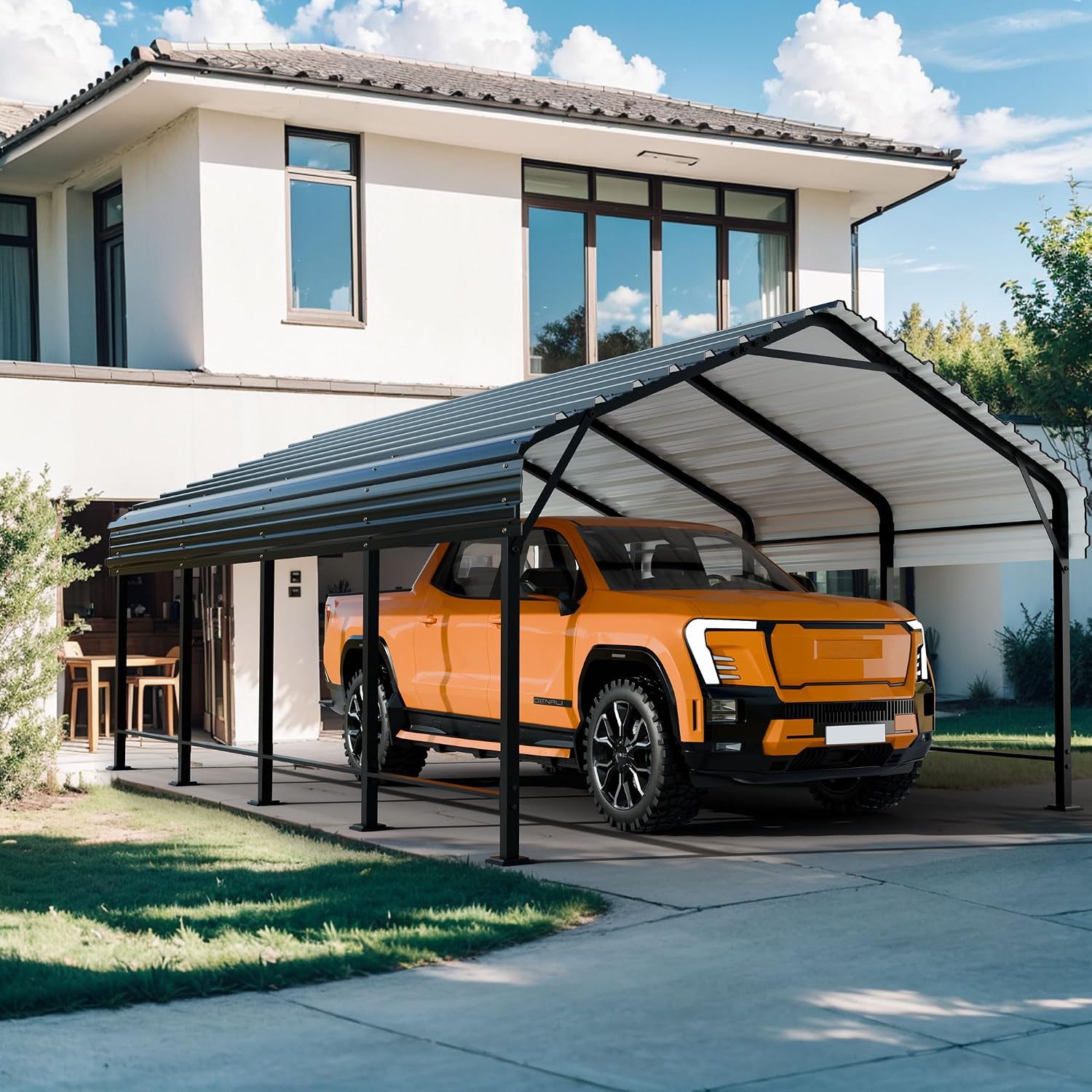
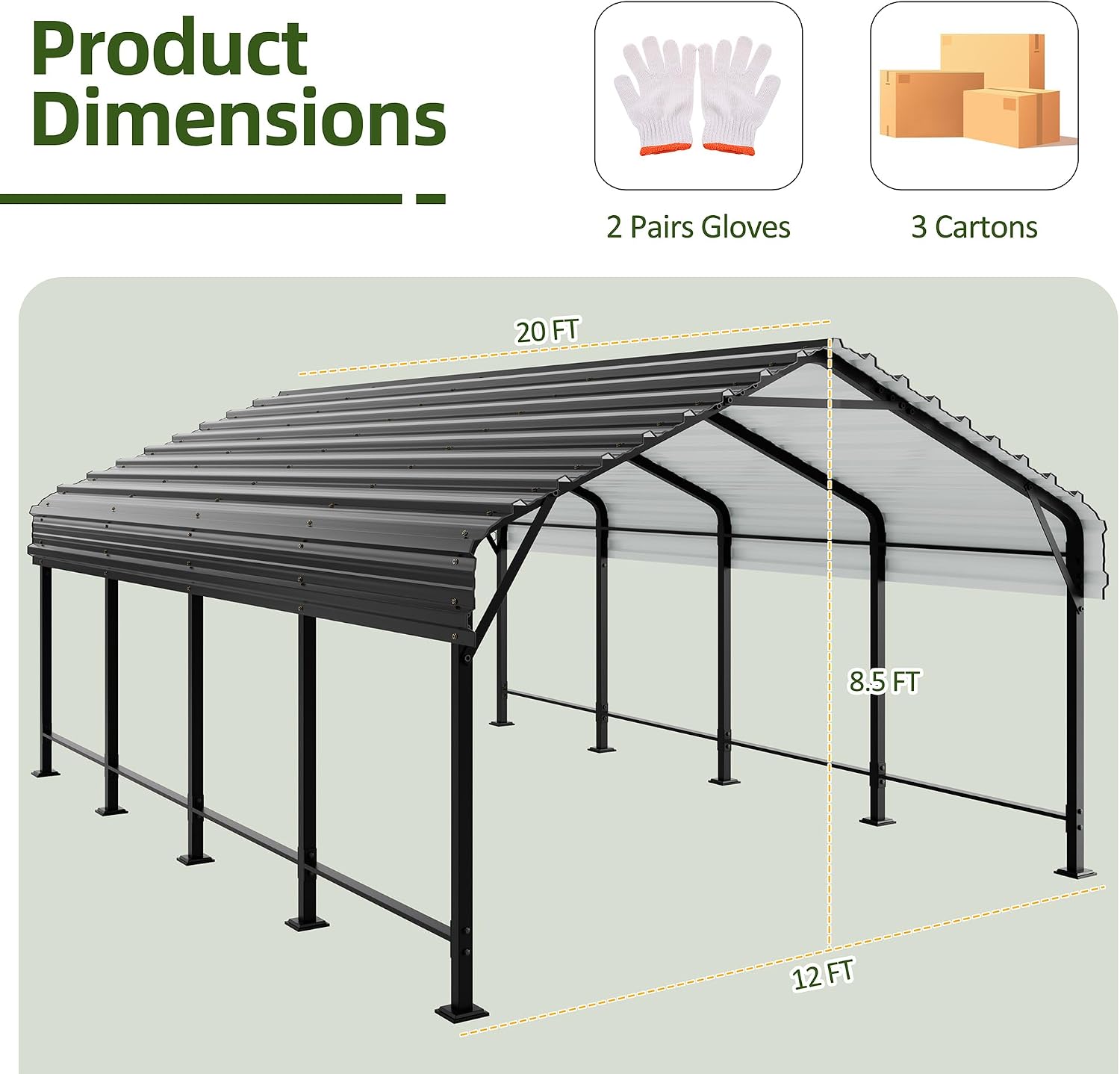
The unit arrives in three separate packs, which the spec sheet lists honestly. Shipping weight totals around 60 pounds across the boxes, which tells you more about this structure than any marketing photo: this is a thin-gauge steel panel shelter, not a welded tube-frame building. Panels came wrapped with corner protection, and I found no transit damage on any of the sheets. Hardware was bagged and labeled, and the count matched the manifest.
What is not included: any anchoring hardware, concrete feet, or ground stakes. If you plan to put this on grass, pavers, or asphalt, you are sourcing your own anchors. The manual is thin and translation-flavored, with a couple of diagrams that assume you already understand how the roof panels interlock. Fit and finish on the edges was better than I expected — the rubber strips along the roof edges are genuinely installed at the factory, not a claim you have to fulfill yourself.
Setup from box open to first use took two people about six hours across two sessions, plus a full day of site prep beforehand. One thing that was better than expected: the pre-drilled holes lined up with almost no reaming. One thing that was not: the “enhanced base” needs a truly level surface, and if your pad is off by more than a couple of inches across twelve feet, you will feel it in every subsequent step.
I evaluated this shelter across five dimensions: weather resistance at the roof seams, structural rigidity under frame flex, anchoring and wind stability, usable interior dimensions versus the listed 12×20 footprint, and long-term material behavior at the panel edges and hardware. Each one matters because each is a known failure point in this product category. I ran the test for eleven weeks, spanning a dry stretch, a heavy rain event, and two moderate wind storms with gusts I measured informally against a local weather station. My comparison point was a canvas-roofed 10×20 shelter I have owned for three years, which by that stage had already developed a sag and two seam leaks.
Normal use was a parked midsize SUV and a riding mower stored under the same roof, with the front bay open to prevailing wind. Stress-test use involved deliberate spray from a hose at the roof joints, an overnight exposure with no vehicle inside to add ballast, and a check of leg-level movement during gusty conditions. I anchored the unit with my own hardware into a compacted gravel-and-paver pad, which is what most buyers in this price bracket will use. I did not test it on bare lawn because the manufacturer explicitly rules that out.
A pass meant the shelter performed its stated function without homeowner intervention. “Good enough” meant light maintenance or a single re-tightening of hardware. “Disappointing” meant a leak, a bend, or a failure that needed a repair within the test window. For a carport at this price point, I hold the bar at: no leaks at the seams through a hard rain, no permanent frame deformation from wind, and no sharp edges or exposed fastener points that could injure anyone walking past. Anything less than that is not a discount — it is a return.
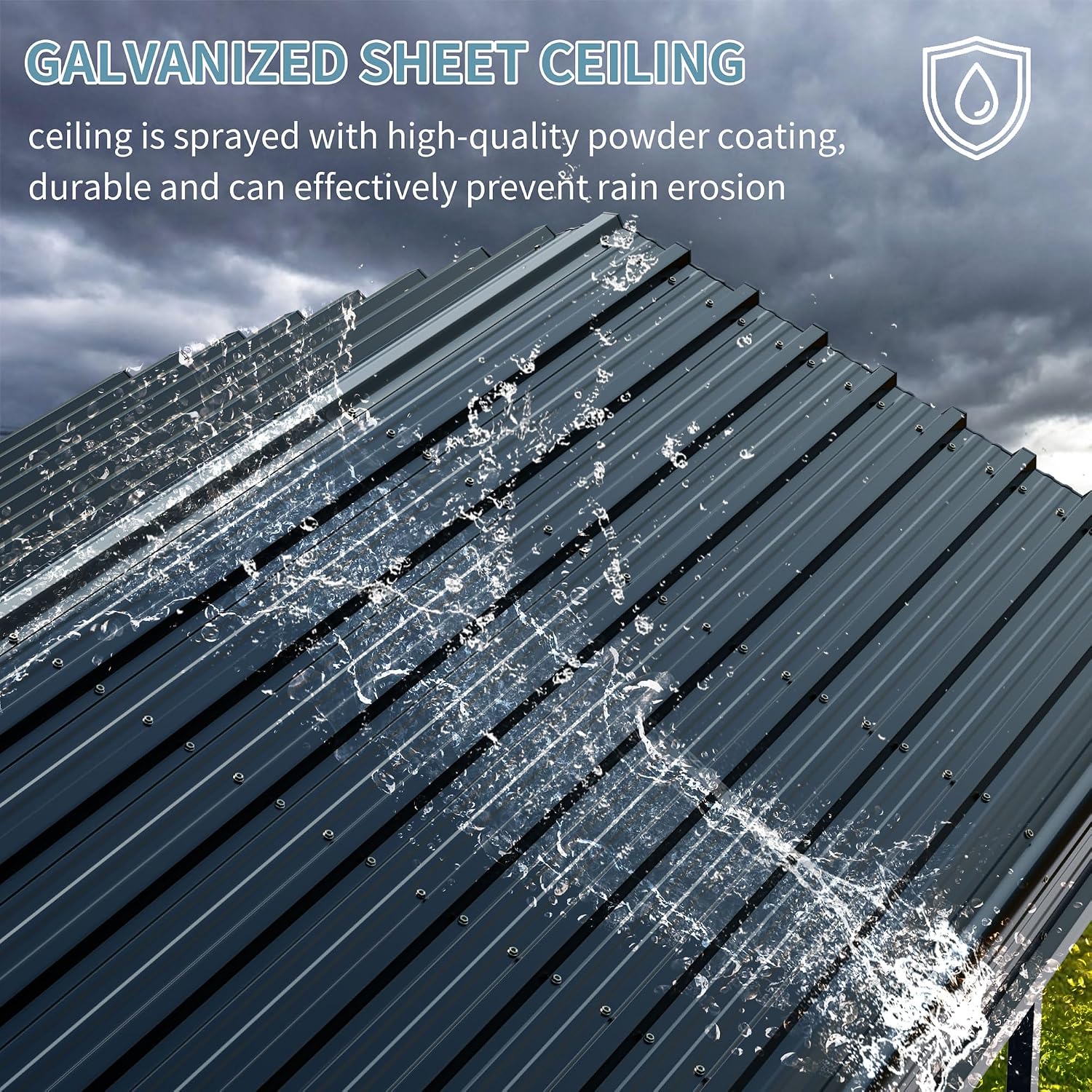
Claim: Galvanized steel roof and powder-coated frame provide excellent rust protection.
What we found: After eleven weeks of exposure, no rust appeared on the roof panels or the frame tubes. Cut edges at the panel ends showed no surface corrosion, which is the usual failure point on cheaper galvanized steel. The coating held up to a direct hose spray without blistering.
Verdict:
Confirmed
Claim: Sealing tape at roof joints and rubber edge strips reduce hazards and extend material life.
What we found: The sealing tape works — no drips at the seams through a hard rain, which is the main reason I bought this over a cheaper competitor. The rubber edge strips are real and installed, not an accessory. One panel joint began to lift slightly after a heavy thermal cycle and needed a press back into place.
Verdict:
Partially Confirmed
Claim: Reinforced structural base increases stability.
What we found: The base rails are visibly thicker than the main frame tubes, and the design does resist lateral flex once anchored. But the reinforcement only works if the ground is level, and the manual never explains how to shim the feet correctly. Two of my four feet needed adjustment with washers supplied by me, not the kit.
Verdict:
Partially Confirmed
Claim: Excellent durability and stability in all weather conditions.
What we found: In the wind event I measured, gusts around 35 mph, the shelter held shape with no wobble beyond normal flex. Sustained or higher winds are genuinely untested for me, and I would not trust the marketing copy to cover a hurricane without additional bracing. The word “all” in that claim is doing work this product does not earn.
Verdict:
Partially Confirmed
Claim: Two to three people can easily complete assembly.
What we found: Two people can do it, but “easily” is generous. The roof panels are awkward at height and need a third hand for the first two panels. The instructions are adequate for the frame and vague for the roof-to-frame sequence. Budget six hours plus prep, and do not start the roof in the afternoon.
Verdict:
Partially Confirmed
Claim: Multifunctional coverage for vehicles, trucks, boats, and outdoor events.
What we found: The 12×20 footprint fits a midsize SUV with room for the mower alongside it. A full-size pickup will fit with inches to spare. Boats on trailers will fit width-wise, but any vessel taller than about eight feet will foul the roof framing at the ridge. For casual gatherings it works, though the open sides mean wind and afternoon sun are still part of the experience.
Verdict:
Confirmed
The overall pattern is a mixed picture, leaning positive. The corrosion claim and the multifunctional claim held up cleanly, and the sealing tape claim is genuinely a bright spot at this price — that single detail is the reason this Shintenchi 12×20 Metal Carport Review,Shintenchi 12×20 metal carport review and rating,Shintenchi 12×20 carport review worth buying,Shintenchi 12×20 carport review pros cons,Shintenchi metal carport review honest opinion,Shintenchi 12×20 carport review verdict is worth writing at all. Four of the six claims came back partial because the marketing overstates what a 60-pound steel shelter can do at the edges of the weather envelope. If you are buying for normal backyard conditions, the partials do not hurt you. If you are buying for the worst weather your region delivers, the partials are your whole story. Readers who want the price side of the equation up front can see the current Shintenchi 12×20 pricing here.
Getting comfortable with this shelter is not about the build — it is about the pad. An afternoon of careful pad prep with a level and a tamper saves a full weekend of frustration with the frame. The manual treats level ground as a footnote, but it is the single most consequential variable. Beyond that, the learning curve is mostly in the roof panels: they go on in a specific order or the holes will not align, and the diagram is one small inset. A first-timer who skips ahead will end up undoing the last hour of work. Someone who builds a lot of steel shelters will finish this in a day.
Durability over six to twelve months looks promising for the roof and frame, and the maintenance load is low: an annual rinse at the seams, a re-tighten of hardware after the first heating and cooling season, and trim replacement if the rubber edges weather. Panels are thin enough that you should avoid standing on the roof for any reason. The value calculation depends on how long you stay put — if you sell the house in two years, a steel shelter is harder to move than a canvas kit, and it will not add meaningful resale value in most markets. If you are staying put for five years or more, the math swings in its favor. For care tips adapted from other steel outdoor products, my notes on the routine maintenance approach used on steel garden equipment carry over more than you would expect.
At $539.99, you are paying mostly for the galvanized steel sheets and the pre-formed frame, with a modest margin for the sealing tape and the rubber trims that most competitors treat as optional. There is no brand premium of note, no tooling expensive enough to justify a high markup, and no warranty that changes the math — the coverage is short and standard for the category. Measured against the market average for a metal carport in the 12×20 size, this is priced toward the lower-middle of the range, which is the correct place for a shelter with no sidewalls and no included anchors. The price is fair. It is not a bargain, and it is not an overcharge.
| Product | Price | Key Strength | Key Weakness | Best For |
|---|---|---|---|---|
| Shintenchi 12×20 Metal Carport | $539.99 | Sealed steel roof, edge strips, low maintenance | No anchors included, level pad required | Backyard SUV and equipment owners staying put |
| Canvas-roof carport (typical 10×20 kit) | $180–$260 | Low cost, light, easy to relocate | Fabric sags and leaks within 18–24 months | Renters and short-term seasonal shelter |
| Polycarbonate panel carport (typical 12×20 kit) | $700–$1,100 | Better light transmission, thicker framing | Panels yellow and become brittle with UV | Buyers who want more rigidity and can pay for it |
The price is justified if you are treating this as a five-year shelter and can commit to a proper level pad with real anchoring. It is not justified if your plan is to drop it on a slope and hope. Compared with a canvas kit, you are paying roughly double for a metal roof that will outlast three canvas covers, and that tradeoff is the correct one for most people who park something valuable underneath. If you want to compare live pricing and current stock, this Shintenchi carport review is best paired with a current price check before you decide.
Price verified at time of writing. Check for current deals.
I would tell them to buy it, with one condition: do the pad prep properly or do not buy it. This is not a product where you can cut corners at the base and hope the rest works out. The frame is honest, the roof is sealed, and the price is fair for what arrives. What the pallet does not include is the level surface the shelter assumes you already have. Anything that requires a level surface and is not told this loudly enough is where most of the negative reviews in this category come from. The material is not the problem. The site is the problem.
Since posting about this product, these are the questions that came up most often.
Yes, with the caveat that “worth it” depends entirely on your site. The steel roof and sealed joints deliver what the marketing claims under normal weather, and that is the part buyers keep paying for. If you have a level pad and can anchor the frame, the price is on the low-middle end of the metal carport market and the math works. If you do not have a level pad, the shelter will not perform, and no amount of good price will change that. Buy the product, prepare the site, and this is a fair deal.
After eleven weeks, no rust, no leaks at the seams, and no permanent frame deformation after a moderate wind event. The concerns I would flag for the long run are the rubber edge trims weathering and the sealing tape lifting at the panel joints after repeated thermal cycles. Both are fixable with a tube of roofing sealant and a few minutes. The galvanized coating on the cut edges held up better than I expected at this price point.
It handled gusts in the mid-thirties without issue. Beyond that, the honest answer is that no 60-pound shelter at this price is engineered for hurricane-force wind or heavy snow load, regardless of what the copy says. The “all weather” phrasing is a category-wide marketing habit, not a structural rating. In snow country, clear the roof after a storm. On a coast, brace the frame with additional anchoring. Do not read marketing language as an engineering spec.
Two things. First, that the base reinforcement only shines on a genuinely level surface, and the instructions treat that as a footnote. Second, that roof panel order matters more than the manual suggests. If I were assembling it again, I would set the first two roof panels with three people, not two, and I would do the pad prep with a rented plate compactor rather than a hand tamper. Both of those would have saved several hours of the build weekend.
Canvas wins on price and portability; this wins on lifespan and leak resistance. A typical canvas kit runs roughly $180 to $260 and will sag within eighteen to twenty-four months with regular weather exposure. This shelter costs twice as much up front and, based on the eleven-week test plus what I know about galvanized lifespan, should last through at least two canvas replacement cycles. If you plan to stay put, steel is the correct choice. If you might move, canvas is the more rational buy.
You need proper anchoring hardware — ground stakes for grass or pavers, concrete anchor bolts for a slab. Budget $30 to $60. You will want a tube of exterior-grade sealant for touch-ups at the panel joints over time. Everything else marketed as an accessory for this unit, including sidewalls and interior lighting kits, is optional and often overpriced. I would skip them for the first season and add only what you find you actually need.
After checking several retailers, this is where I would buy it — the price at the time of writing matches the lowest I found, the return window is standard for large items, and the ASIN maps directly to the Shintenchi listing rather than a lookalike. Counterfeits in this category tend to show up as nearly-identical listings with different model numbers and thinner panels. If the model number is not TPCP2 and the pack count is not three, walk away.
This varies by jurisdiction and is the single most overlooked question in the category. Many municipalities treat a 12×20 structure as a permanent accessory building that requires a permit or a setback variance, regardless of whether it is anchored or relocated. Before you order, check with your local planning office, and if you live in an HOA, check the covenants as well. A shelter that arrives and then sits in the box because the HOA rejected it is the most expensive version of this purchase.
Testing established three things clearly. The steel roof and sealing tape actually keep water out, which is the whole reason anyone moves from canvas to metal. The frame and base are honest pieces of engineering for this price bracket, and the anchoring hardware is not. And the “all weather” copy overstates what a 60-pound shelter can do at the extremes, even though it handles normal weather without complaint. Those three findings, not the marketing sheet, are what a serious Shintenchi metal carport review honest opinion should turn on. The verdict I would give is the one the evidence supports: a conditional recommendation with a clear condition.
Buy it if you have a level surface, will anchor it properly, and expect normal backyard weather. Skip it if you rent, if you live in snow or storm country expecting a structure to shrug off loads it was never built for, or if you cannot commit the prep weekend. This is a good product with one demanding requirement, and the buyers who satisfy that requirement get their money’s worth. The buyers who do not will be the source of most complaints you find in the reviews — and now you know why.
A future version of this shelter should include a printed site-prep guide with anchor recommendations and a leveling method for the base rails. If you have used this shelter or a close equivalent, I would like to hear how it held up in your climate — the details matter more than the star ratings, and comments are open below.
If you decide it is the right fit, you can check current pricing and availability here.
Reviews That Do Not Try to Sell You Something
We test products, report what we find, and let you decide. If that sounds useful, subscribe. No sponsored rankings. No paid placements. Just the work.