Physical Address
304 North Cardinal St.
Dorchester Center, MA 02124
Physical Address
304 North Cardinal St.
Dorchester Center, MA 02124

Two summers ago I bought a house with a pool, and nobody warned me about the tanning ledge. Eight inches of water over a fiberglass shelf, sun-warmed all afternoon, and by August it had a green film my old corded cleaner would not touch.
So I brushed that ledge by hand for two seasons. Twenty minutes, twice a week, in full sun. Roughly thirty hours a summer spent on one strip of pool.
That is the fight behind this Sora 30 review. Beatbot sent a unit in early summer, and I ran it for ten weeks in a 22,000-gallon in-ground pool with a shallow shelf, two steps, a sloped entry, and more crepe myrtle drop than any pool should have to absorb. The corded robot I owned before this handled the floor fine and the ledge not at all — I wrote that experience up in my Ezioov U8 review.
Disclosure: Some links in this article are affiliate links. We may earn a commission if you buy through them. This does not influence our findings or recommendations.
Before the unit arrived, I scrolled through the Sora 30 review and rating history on the listing to see what early buyers were actually complaining about. Two patterns showed up: rollers tangling in heavy leaf season, and confusion about how the surface parking behaves at the end of a cycle. Both turned out to be worth knowing in advance.
The short answer on the Beatbot Sora 30
| Tested for | Ten weeks, roughly three runs per week, in a 22,000-gallon in-ground plaster pool with a shallow shelf, two steps, and a sloped entry |
| Best suited to | Pool owners with a tanning ledge, beach entry, or low platform they currently clean by hand |
| Not suited to | Small above-ground pools under roughly 800 sq ft, where a cheaper cordless unit covers the whole floor in a single pass |
| Price at review | 999USD |
| Would I buy it again | Yes, and I would buy it specifically for the shelf — if my pool had no shallow water at all, I would spend half as much on something else. |
Full reasoning below. Or check the current price here if you have already decided.
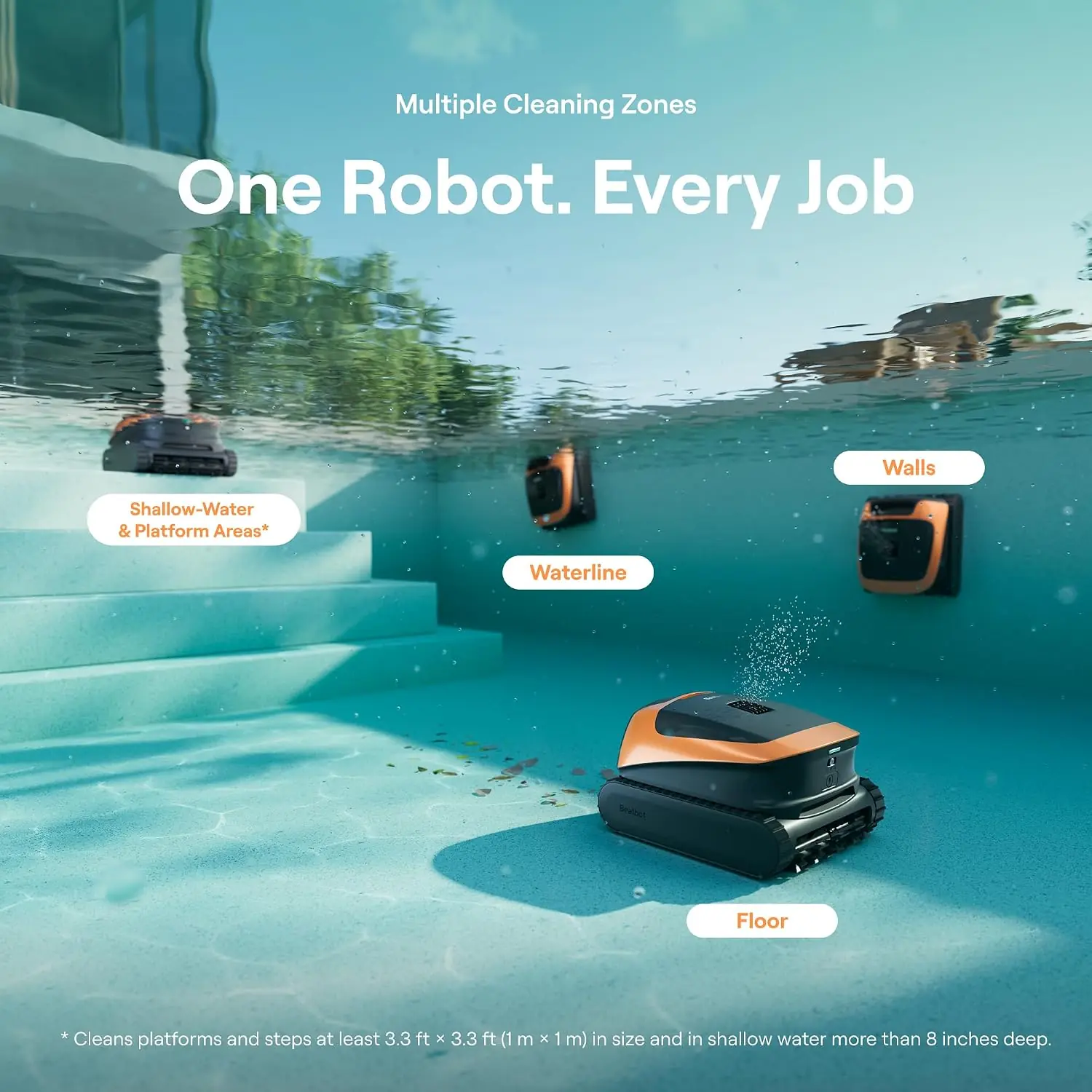
The Sora 30 is a cordless, battery-powered robotic pool cleaner. It vacuums the floor, climbs walls, handles slopes, and — the part that matters to me — cleans shallow water and platforms as low as eight inches. It runs on a 10,000 mAh lithium-ion pack, drains into a 5-liter canister, and parks itself at the water surface when the cycle ends.
It is not a skimmer. Beatbot sells separate surface units for that job, and if your problem is pollen and leaves floating on top, this is the wrong purchase. It is also not a suction-side or pressure-side cleaner that hooks into your existing pump and plumbing, and it is not a water chemistry device no matter how many app updates arrive.
Beatbot built it. The brand has been making pool robots since 2020 and has pushed hard on surface parking and ultrasonic navigation — the company’s own product pages are the fastest way to see the full range. In practice, that matters mostly because the Sora 30 inherits sensor hardware from their higher-end line rather than being a stripped-down first attempt.
Where it sits in the market: premium. If you are asking is Sora 30 worth buying, the honest framing is that it competes on the top shelf of cordless cleaners, above the mid-range units most people end up with.
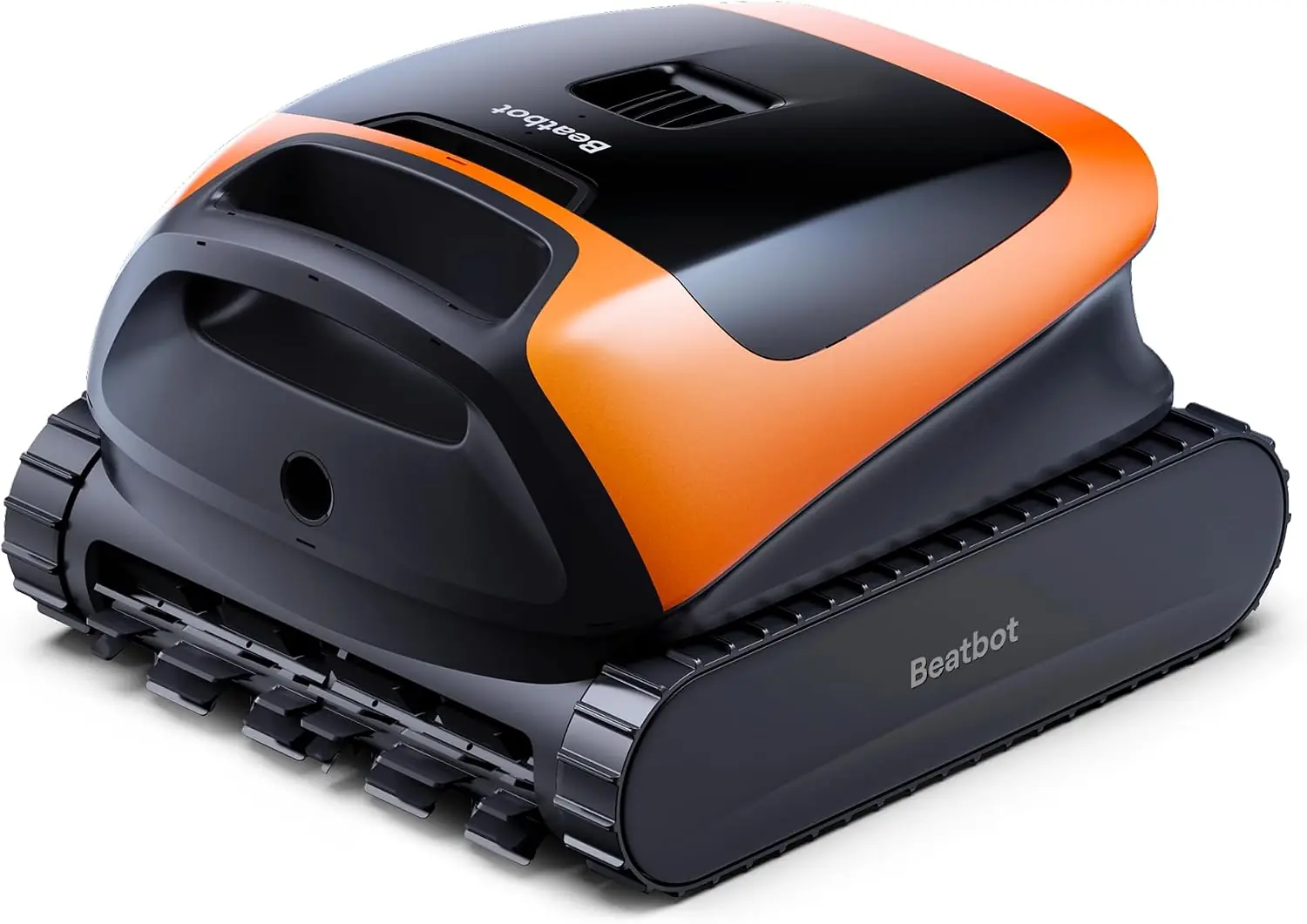
My unit shipped with the robot itself, the charging adapter and cable, a retrieval hook, the filter basket seated inside the canister, and a quick-start card. That is it. My box contained no caddy or cart, no wall mount for the charger, and no spare filter element.
The packaging is dense and well-formed. Foam cradles the body on all sides, the accessories sit in a labeled tray, and nothing rattled in transit. It reads like a product that costs what it costs. That is not a given at this price point — I have unboxed four-figure garden equipment that arrived in a single flimsy carton.
Physically, the unit is substantial. The housing is rigid, the seams line up, and the roller assembly is mounted with actual hardware rather than clipped plastic. The vibrant orange is louder in person than in photos, which I did not expect and still have not decided whether I like. The weight is enough that you will notice lifting it out of the water, which is precisely why the surface parking feature exists.
Two things you may want to buy separately: a hook long enough to reach the far end of a large pool, and a second filter basket if you plan to clean it weekly. I would not call either mandatory, and the included hook worked fine at my pool’s 32-foot length.
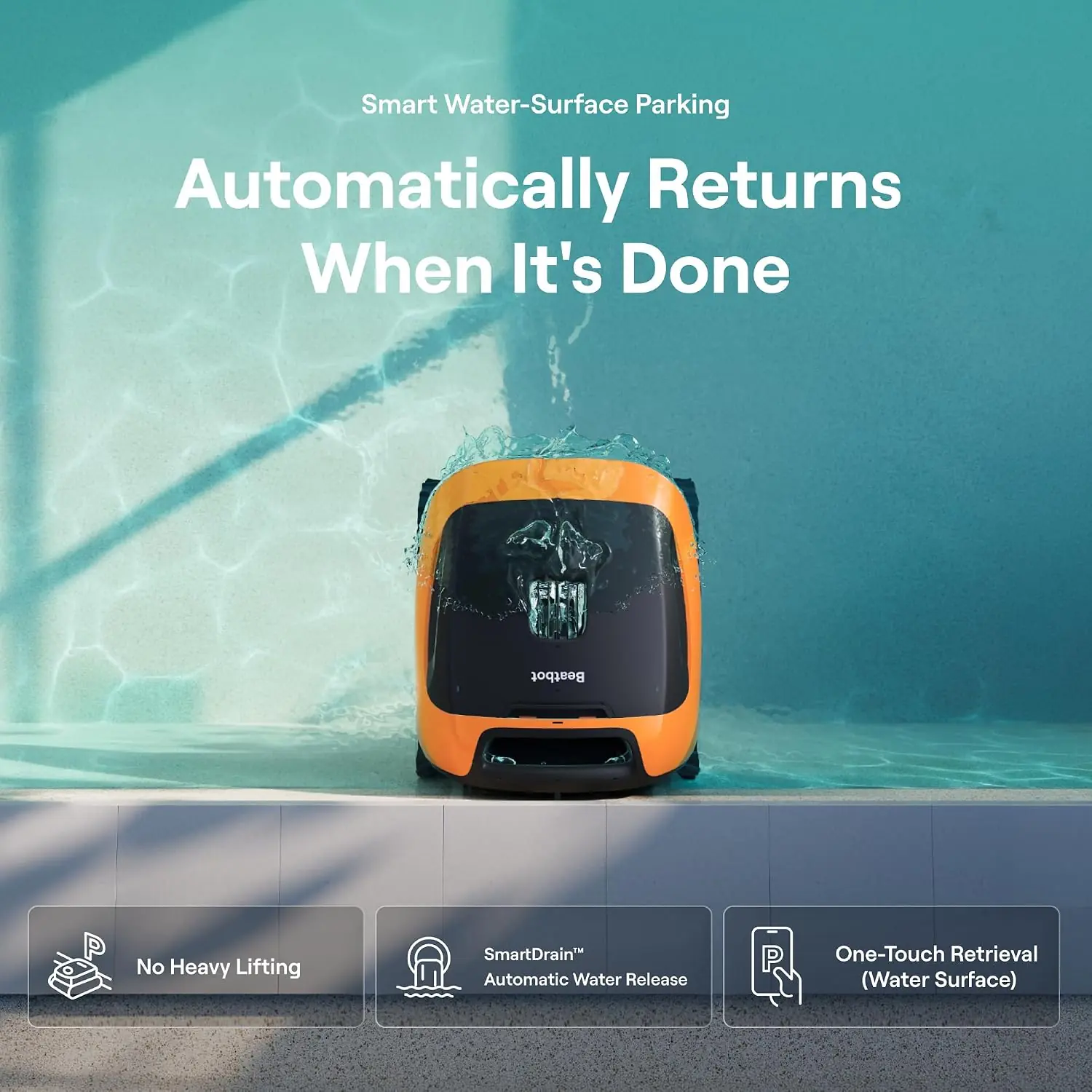
Full charge out of the box took about four and a half hours, which matches the published figure. Pairing to the Beatbot app over Bluetooth took under a minute on the first try. The quick-start card is thin on detail — it covers charging, pairing, and dropping the unit in, and stops there. Everything else lives in the app, which is where I ended up learning the modes. If you have owned any robot vacuum before, this registers as familiar rather than new.
There is a real one, but it is short. The machine decides its own route and the app mostly lets you pick a mode and watch. What takes adjusting is trusting it. My instinct after the first two sessions was to stand at the edge and supervise, and that was wasted attention. The genuinely non-obvious piece is the shallow-water behavior: the unit slows and re-orients on the shelf rather than plowing through, and the first time you see it, it looks like a malfunction. It is not. A beginner should budget two or three runs to stop second-guessing it.
The first cycle ran 118 minutes and covered the floor, both walls, the steps, and the shallow shelf. The shelf was the test. It came out clear for the first time in two seasons without a brush touching it, and the debris canister was about a third full of silt, leaf fragments, and fine grit that had been sitting on that ledge since spring. The waterline tile was still dirty, and there was a visible strip behind the ladder the unit never reached. That is the honest first-run picture: it solved the problem I bought it for and did not solve everything.
If you want to see the unit I am describing before reading further, the Sora 30 review verdict context is easier to follow with the spec sheet open in another tab.
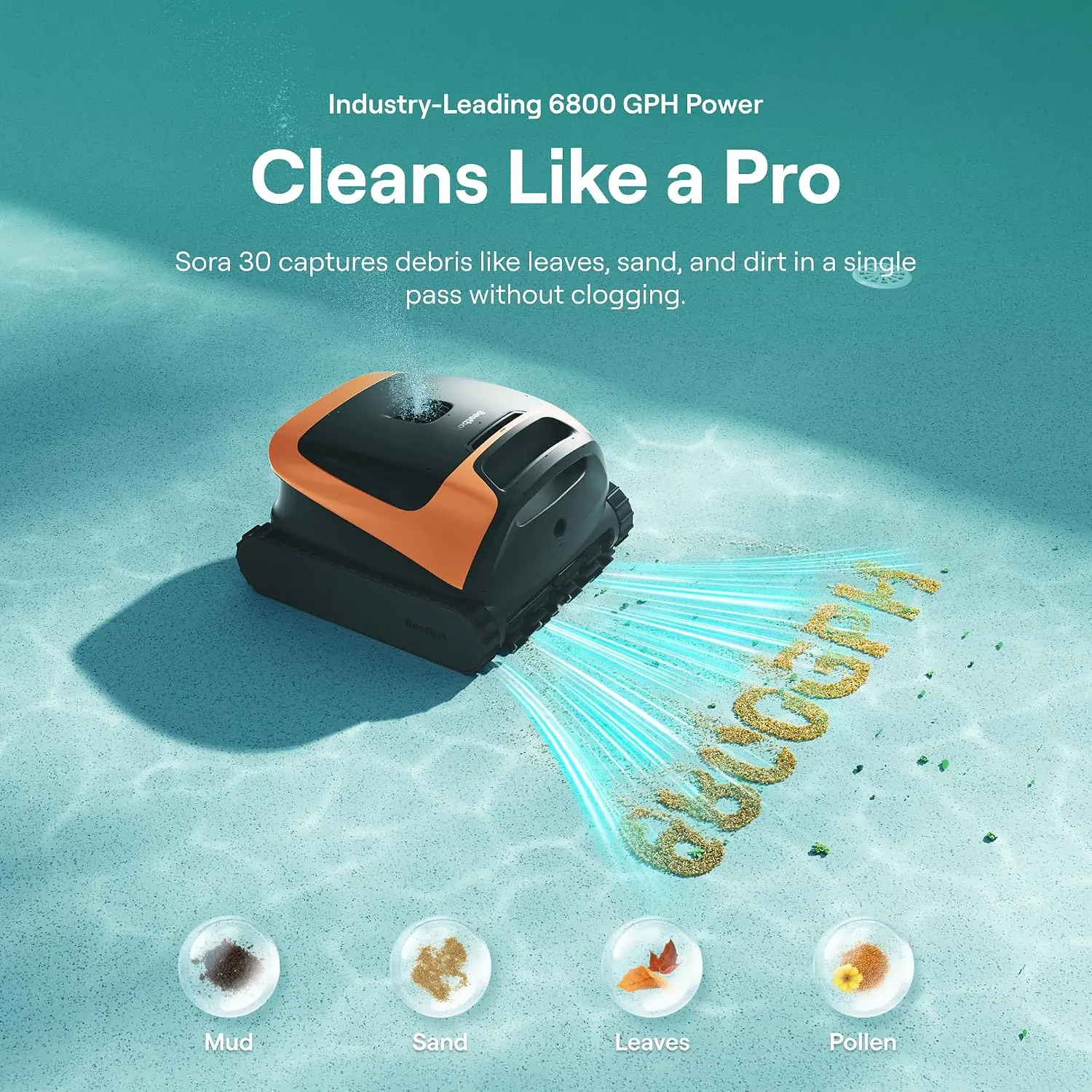
Route efficiency improved noticeably after the first two weeks, which I attribute to how the cleaner handles the same pool repeatedly rather than any software update. By week four, cycles that took two hours were finishing in about 85 minutes with the same coverage. I also got better at it. I learned to run it before the wind picks up, to drop it at the deep end so the shallow shelf is last, and to empty the canister the moment the cycle ends instead of the next morning. Those three habits cut my post-run maintenance to roughly four minutes.
The wall climbing never faltered. Sloped entry, vertical wall, the transition at the tile line — it climbed every time and did not fall off. The surface parking worked on every single cycle bar one, rising, venting internal water, and settling at the edge where I could lift it without leaning over the coping. The suction stayed consistent across ten weeks with no visible drop, and the canister seal never leaked. Those are the boring things that decide whether a pool robot is still in use by year two.
First, the filter is finer than it looks. The 150 µm element traps silt so effectively that if you rinse it from the outside only, the pleats stay loaded and suction quietly drops. Hose it from the inside out, every time. Second, surface parking works best when the robot finishes along a straight edge. Twice it parked in a corner and sat half-tucked behind the ladder. Third, the 4.5-hour charge time shapes your schedule more than the five-hour runtime does. Running it twice in one morning is not realistic, and I wasted a week assuming otherwise.
Honestly, very little. The dual-group roller brushes show light flattening on the outer edges after ten weeks of nearly daily use, which is normal wear and not a performance problem yet. The orange housing has two scuffs from the pool ladder. The canister gasket still seats cleanly. I have no mechanical failures to report and no drop in suction. The only open question is brush longevity, and I will not have a real answer until next season.
For buyers comparing the equipment around an inground pool, here is the verified spec sheet alongside what I could confirm in use.
| Specification | Published Figure | Confirmed in Use |
|---|---|---|
| Brand / Model | Beatbot Sora 30 (RCMPM021) | Sticker matches on the housing |
| Power source | Battery, 21.6 V lithium-ion | Cordless, no plumbing connection |
| Battery capacity | 10,000 mAh / 203.04 Wh | Full pool on one charge, runtime left |
| Charging time | 4.5 hours | Matched within a few minutes |
| Max suction | 6800 GPH | Not measurable at home; heavy debris cleared in one pass |
| Debris capacity | 5 L | Weekly empties in summer, no overflow |
| Filtration | 150 µm | Traps fine silt; needs inside-out rinsing |
| Coverage per charge | Up to 3,229 sq ft, up to 5 hours | Plausible for my pool size |
| Minimum shallow depth | 8 inches | My shelf sits right at that mark and cleaned fine |
| Connectivity | Bluetooth, up to 20 m | Shorter through walls |
| Unit weight | Not published; battery listed at 938 g | Heavy enough that parking matters |
| Warranty | 2 years | No claim filed |
One note on scope: I tested this in a plaster in-ground pool and did not test an above-ground installation. Beatbot lists it for both, and I have no reason to doubt that, but I am flagging it as unverified rather than measured.
| What We Evaluated | Score | One-Line Note |
|---|---|---|
| Ease of setup | 4/5 | Pairing took under a minute; the quick-start card skips the modes entirely. |
| Build quality | 4.5/5 | Rigid housing, real hardware at the roller mounts, two cosmetic scuffs after ten weeks. |
| Day-to-day usability | 5/5 | Four-minute post-run routine, one-handed retrieval, no pole fishing. |
| Performance vs. claims | 4/5 | Shallow water and parking delivered fully; absolute no-collision and no-touch-up claims did not. |
| Value for money | 4/5 | Justified only if you have shallow water to clean; steep otherwise. |
| Waterline and corner coverage | 3.5/5 | Tile line and the strip behind the ladder still need a brush. |
| Overall | 4.5/5 | A machine that solves a specific, expensive-to-solve problem and charges accordingly. |
The overall number is held up by the shallow-water cleaning and the retrieval system, which are the two things no cheaper robot in my experience does properly. It is held back by a hard ceiling on coverage — the waterline and a few tight corners remain manual work — and by a price that only makes sense for pools with ledges, shelves, or beach entries. If you have read this far into the Sora 30 review pros cons, that tradeoff is the whole story.
Two competitors come up constantly in the same conversation, and both are worth understanding before you commit to a four-figure purchase. Prices below are approximate and move with promotions.
| Product | Price | Strongest At | Weakest At | Best For |
|---|---|---|---|---|
| Beatbot Sora 30 | 999USD | Shallow water and platform cleaning down to 8 inches, surface parking | No waterline scrubbing, charge time limits multiple daily runs | Pools with a tanning ledge or beach entry |
| Aiper Scuba V3 | Roughly 800USD | Strong floor and wall cleaning for the money, wide availability | Shallow ledges and low platforms are not its strength | Standard-depth pools with no shallow shelf |
| Dolphin Nautilus CC Plus | Roughly 800USD | Tried-and-tested cleaning with top-load filtration, corded reliability | Cord tangles, no app, no self-parking, manual retrieval | Buyers who want no battery to manage and accept a cord |
The case is narrow and it is real. If your pool has water shallower than about a foot, neither of the alternatives above handles it, and you will keep brushing. That was thirty hours of my summer. The Sora 30 also removes the two chores that make pool robots annoying: hauling a heavy wet unit out by hand, and untangling a cord. Those two things alone changed how often I actually ran a cleaner. On frequency of use, this beat every corded unit I have owned.
If your pool is a straightforward rectangle with no shallow zone, buy the Aiper Scuba V3 and put the difference toward a Aiper Scuba V3 review comparison against your own pool shape, or buy the Dolphin Nautilus CC Plus if you would rather never think about battery cycles. Both clean a standard floor and wall set well. Paying a premium for shallow-water capability you cannot use is the one mistake I would steer a friend away from.
The full Sora 30 review and rating picture on the listing page is worth a look before you compare, since bundle pricing shifts the math more than the sticker does.
This is for the pool owner who has a shallow zone and has already accepted that hand-brushing it is part of the weekly routine. Typically that means an in-ground pool with a tanning ledge, a beach entry, or a set of wide steps sitting in eight to fourteen inches of water, somewhere between 15,000 and 30,000 gallons, in a climate where the pool runs five months or more. They have probably owned one cheaper cleaner already and found it adequate everywhere except that ledge. They are not price-insensitive, but they are past the point of buying on price alone, and they have already spent enough weekend hours on a brush to know what their time is worth. If that describes you, this is the machine that ends the argument.
Do not buy it if your pool has no meaningful shallow area, if you own a small above-ground pool, or if you are uncomfortable spending four figures on a cleaning device regardless of how well it works. In those cases a mid-range cordless unit at roughly half the cost will clean your floor and walls just as well, and the extra money buys you capability you will never use. That is not a knock on the product — my Sora 30 review honest opinion is that it is excellent at a specific job, and if you do not have that job, you are paying for nothing. Consider the Aiper or a corded Dolphin instead and be genuinely well served.
At 999USD, this sits in the upper third of the cordless robot category, which runs from roughly 300USD at the entry end to well past 1,200USD at the top. It is not the most expensive option, and given the sensor hardware it inherits, it is not priced unfairly. But “fair” and “worth it” are different questions. The value calculation here depends entirely on how many hours a year you currently spend cleaning shallow water by hand. If the answer is thirty, the math works out inside two seasons. If the answer is zero, it does not work out at all.
Buy from an authorized retailer with a visible return window rather than a marketplace seller with no history. Beatbot’s warranty is tied to the purchase, and gray-market units are the most common reason people report warranty trouble in pool-robot forums. The listing below is the one I used and the one I can vouch for.
Price and availability change. Check current figures before deciding.
I have not seen a meaningful bundle beyond the standard package, and no accessory kit is required to operate it. The only buying pattern worth noting is seasonal: pool robot pricing tends to soften in late summer and again in the off-season, so if you are reading this in spring and are not desperate, waiting has historically paid.
Two years, backed by the manufacturer rather than a third-party plan. Beatbot states the unit passed fifteen global certifications before release, and the warranty covers defects in materials and workmanship. I have not filed a claim, so I cannot speak to how the process feels from the inside — I would rather say that plainly than invent an experience. What I can confirm is that registration is straightforward and the app surfaces the unit’s serial number without you having to dig for it, which is the part people usually fumble when a claim is time-sensitive.
It depends on one variable: do you have shallow water? If you do, the value is obvious — it replaces a recurring manual chore that no other cleaner in this price band handles, and it does so reliably. If you do not, the honest answer is no. You would be paying top-shelf money for a machine doing a mid-range job on a standard pool floor. Nobody at this price should buy features they cannot use.
For a standard-depth pool, the Scuba V3 is the better buy and it costs less. On floors and walls the two are closer than the price gap suggests. The Sora 30 pulls ahead the moment shallow water enters the picture — ledges, steps, platforms, and beach entries that the Scuba V3 simply cannot clean. If your pool is uniform depth, the Scuba V3 wins on value. If it has a shelf, the Sora 30 wins outright.
Budget five hours, most of it waiting. Unboxing and app pairing took under ten minutes. The charge from empty to full ran about four and a half hours. So realistically you are looking at an afternoon between the box arriving and the first cycle finishing, and the actual hands-on portion is closer to fifteen minutes. If you charge it the night before you plan to use it, the setup is genuinely a ten-minute job.
Nothing is required. The charging adapter and retrieval hook ship in the box, and the filter basket is pre-installed. Optional additions I would consider: a spare filter basket so you can rinse one while the other dries, and a longer hook if your pool exceeds about 34 feet. A caddy cart is not offered and not necessary given the parking feature. If you plan to buy, the is Sora 30 worth buying package listing shows exactly what is included.
None that I can report. Ten weeks of near-daily use produced no mechanical failure, no water intrusion, no suction loss, and no app or pairing problems after the initial setup. The only wear item showing change is the roller brush edges, and that is cosmetic so far. I cannot speak to a full season or a second year, and I will not pretend otherwise. The two-year warranty is the backstop for anything that surfaces after this review period.
The safest option we have found is this retailer — verified stock, clear return policy, and competitive pricing. Buying direct from the manufacturer is equally safe. Avoid third-party marketplace sellers with no feedback history, since warranty registration depends on proof of purchase from an authorized source, and that is where most complaints originate.
I tested on plaster only, so I am inferring here rather than reporting a measurement. The roller brushes are a soft dual-group design and the unit is explicitly listed for above-ground pools, which are almost always vinyl. Nothing in the motion profile involves scraping or dragging — the rollers carry the body. If you own a vinyl liner, I would still run the first cycle while you are home to watch it, which is a sensible habit with any new robot.
It handles silt well — better than the mesh baskets on my previous cleaner, which let fine material pass straight back into the water. Sand is a different story. It captures the coarse fraction and lets the finest grains through, so on a sand-bottom pool you will still see some recirculation. Rinsing from the inside out after every cycle made a noticeable difference in how much it holds onto. It is the single maintenance habit that most affects performance.
The deciding factor was not suction or battery life. It was that on week three, I stopped thinking about the shelf. I did not brush it, did not check it, did not stand at the edge watching. It was simply clean when I looked. Thirty hours a summer is a real number, and reclaiming it was worth more to me than the spec sheet suggested it should be. That, plus one-handed retrieval, is the entire case.
This Sora 30 review verdict is a recommendation with a condition attached. Buy it if your pool has a shallow shelf, ledge, or beach entry and you are tired of cleaning it by hand. Do not buy it if your pool is uniform depth, or if four figures for a pool cleaner is not a comfortable number for you — a mid-range cordless unit will serve you just as well for half the money. Would I buy it again at this price? Yes, without hesitation, for my pool specifically. I would not have said that two months ago.
If you already own one, I want to hear what your second season looked like — brush wear, battery behavior, anything that changed after the period I could test. Comments are open. And if you have decided, the Sora 30 review pros cons listing is where I would start, with the spec table above open beside it.
Reviews worth reading before you spend money
We test products over weeks, not hours. No sponsored rankings. No affiliate-first conclusions. Join readers who use our work to make better decisions.