Physical Address
304 North Cardinal St.
Dorchester Center, MA 02124
Physical Address
304 North Cardinal St.
Dorchester Center, MA 02124

I have spent the last two Saturdays hunched over a bucket of car shampoo, glaring at a pressure washer that promised 2.0 GPM but delivered something closer to a garden hose with ambition. The rinse cycle alone took forever. Road grime laughed at me. I started wondering whether the problem was me or the machine, so I went looking for something that would not leave me negotiating with brake dust. That is what led me to the Active 3.0 pressure washer review I wish I had read before buying my previous unit — and eventually to the machine itself. I ordered one, set it up in my garage, and have been running it through everything I can throw at it for the past several weeks.
Disclosure: Some links in this article are affiliate links. We may earn a commission if you buy through them. This does not influence our findings or recommendations.
The short answer on Active 3.0 Pressure Washer
| Tested for | 6 weeks of weekend car washing, patio cleaning, and light deck work |
| Best suited to | Dedicated car enthusiasts and prosumer detailers who need consistent 3.0 GPM flow and are comfortable with a dedicated 20A circuit |
| Not suited to | Casual homeowners with standard 15A outlets who want a grab-and-go solution for occasional driveway cleaning |
| Price at review | 799.99USD |
| Would I buy it again | Yes — but only after verifying my electrical setup could handle it. If you have a 20A circuit, this is a genuinely different class of machine from anything I have used before. |
Full reasoning below. Or check the current price here if you have already decided.
The Active 3.0 is an electric pressure washer built around a 5-piston forged brass pump and a low-speed induction motor. It is designed to deliver 3.0 GPM at roughly 1000 PSI, which puts it in a category that sits between consumer-grade electric units and commercial gas-powered machines. It is not a portable unit you toss in the trunk for a quick rinse at the car wash. It weighs enough, and demands enough from your electrical system, that it lives in a dedicated spot in the garage or shop.
It is also not a standard 15A plug-and-play machine. The Active 3.0 requires a NEMA 5-20R receptacle on a dedicated 20A circuit. If your home has standard 15A outlets in the garage, you will need to factor in an upgrade before this unit can run. That is a meaningful constraint and one that separates this product from almost every other electric pressure washer at this price point.
Active Products Inc. makes this unit. They are not a household name in the way that some big-box brands are, but they have built a reputation in the detailing community for engineering pressure washers that prioritize serviceability over planned obsolescence. You can see it in the design choices — oil drain plug, accessible pump components, standard threading on the inlet and outlet. This is a review of a machine built for people who maintain their own gear.
In the market, the Active 3.0 sits at the premium end of electric pressure washers. It competes with units from Kranzle, AR Blue Clean, and the higher-end Ryobi models — but it undercuts most of them on price while delivering comparable flow rates. Whether that trade-off works for you depends on how much you value rebuildability and how tolerant you are of electrical requirements.
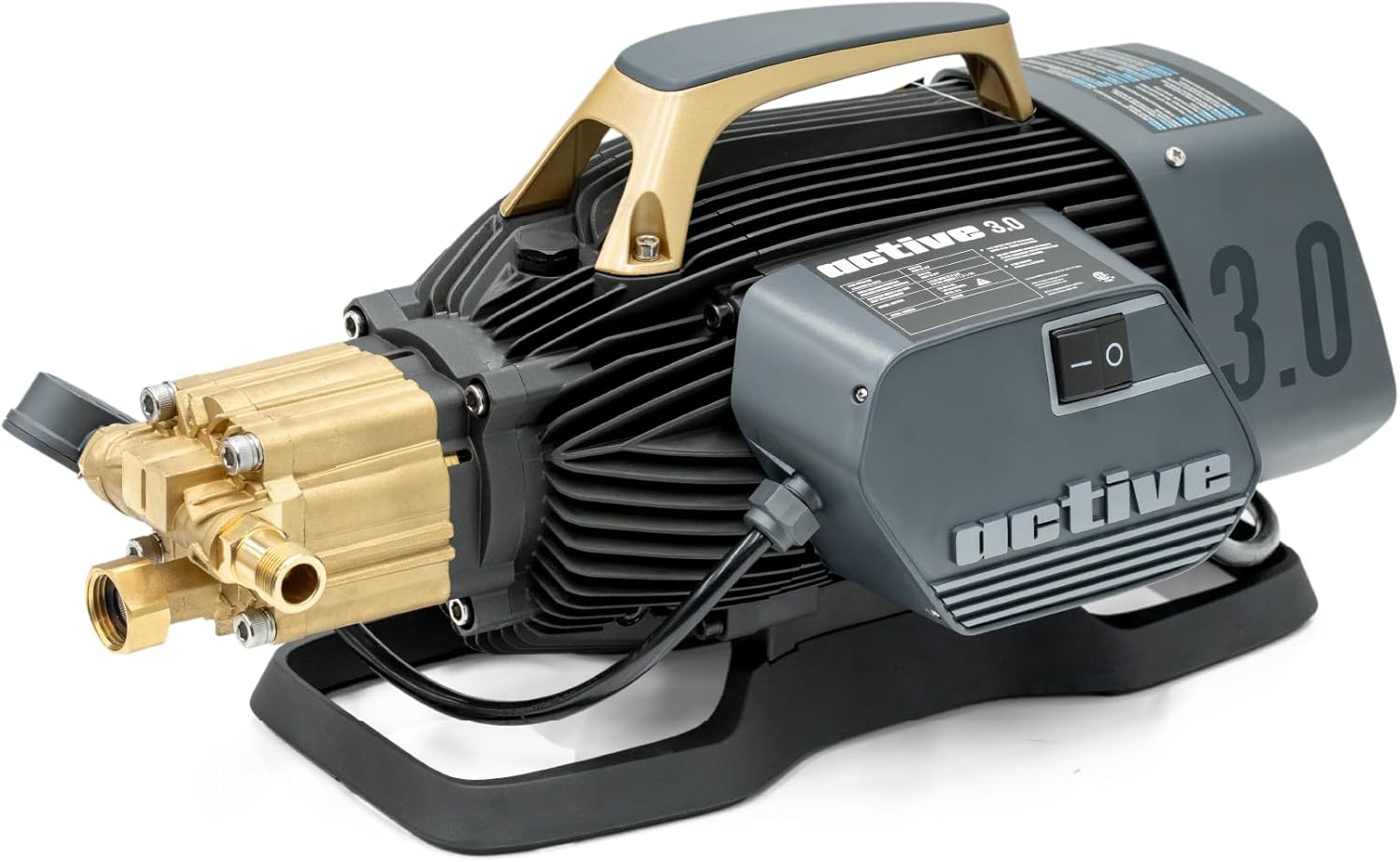
The box is straightforward — black, heavy, no flashy marketing graphics. Inside you get the pressure washer unit itself, a steel-braided rubber hose (roughly 50 feet), a trigger gun with a 6.3 orifice nozzle installed, a 1.65mm foam cannon nozzle, a bottle of 85W-90 oil for the initial fill, and a printed manual that is actually legible. There is no quick-connect kit, no extra set of orifice nozzles, and no storage bag. At this price point, I expected a bit more in the accessory department, but nothing that was missing felt critical.
The packaging is adequate — dense foam inserts, the hose coiled separately, the unit wrapped in plastic. Nothing arrived damaged. That said, the box does not communicate the premium nature of the product. If you are used to the glossy retail boxes that brands like DeWalt or Ryobi ship in, this will feel understated. It is a utilitarian presentation for a utilitarian tool.
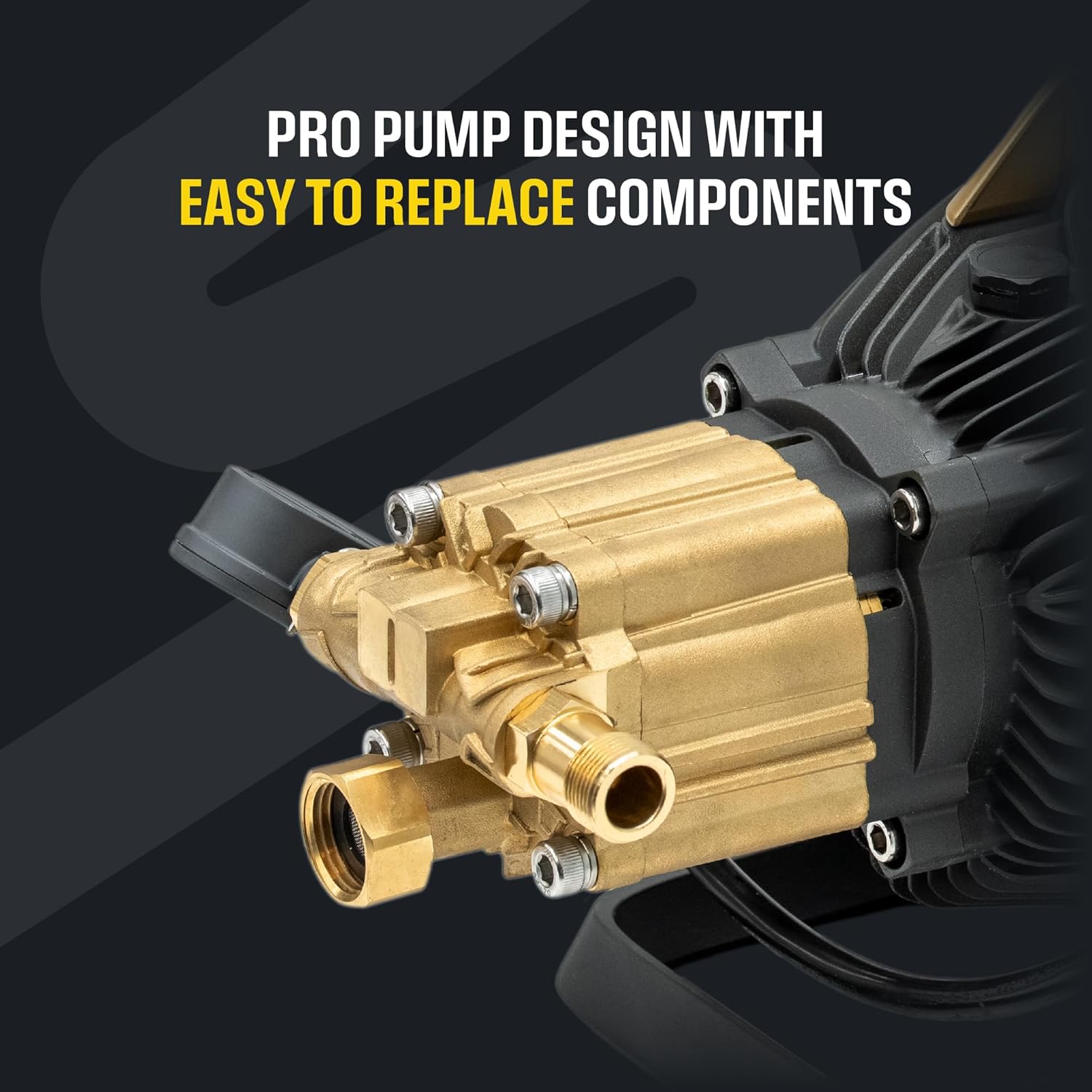
First physical impressions: the pump housing is cast metal, not plastic. The motor housing is steel. The frame feels rigid. At 16 inches long, 9 inches wide, and 8 inches tall, it is compact for what it contains, but it has heft. Pick it up and you immediately believe the 5-piston pump claim. The inlet is standard 3/4-inch garden hose thread (11.5 TPI). The outlet is M22-14mm, which is the standard for aftermarket pressure washer accessories. You will need a 20A receptacle to plug it in — the NEMA 5-20P plug is unmistakable with its sideways prong.
One thing you should buy separately: a 12 AWG extension cord no longer than 50 feet if you cannot reach the machine directly. Standard 14 AWG cords will not handle the current draw and could cause voltage drop that prevents the machine from reaching peak pressure.
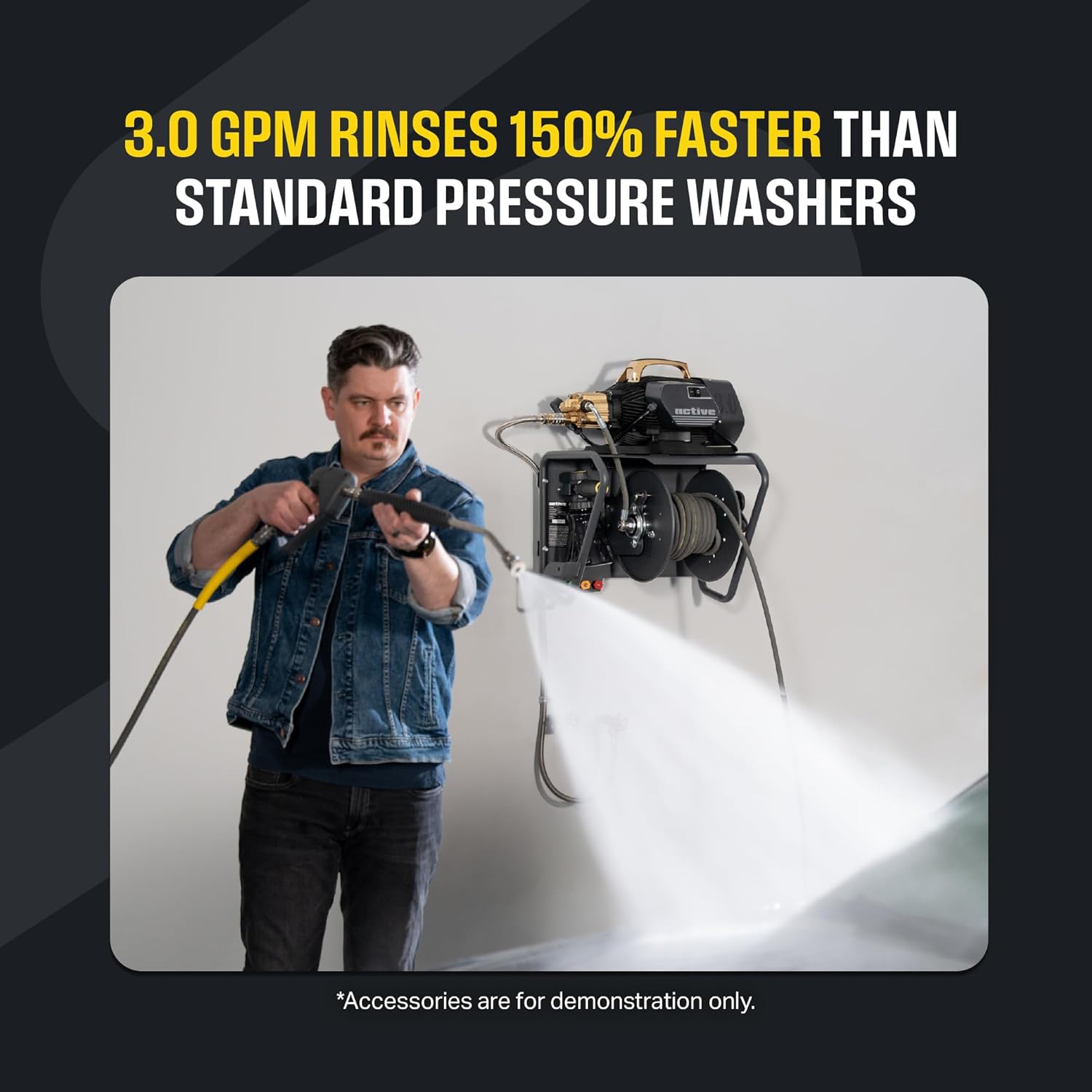
Setup took me about 20 minutes, most of which was spent confirming that my garage receptacle was actually a 20A circuit. The manual is clear about the electrical requirements, but if you are not used to checking breaker panels, you will want to confirm before unboxing. The oil fill is straightforward — the manual specifies 85W-90 and tells you where the fill and drain ports are. I filled it, connected the garden hose, attached the pressure hose, and primed the line. No tools required beyond what you would have in a basic household drawer. The documentation is good enough that someone with no pressure washer experience could get through it, but I would not call it intuitive. There is a moment where you have to push the hose fitting onto the outlet and twist until it seats — that took me two tries.
There is a learning curve, but it is short and specific to the electrical demands. Once you have the circuit sorted, the machine itself is simple to operate. The trigger gun has a comfortable grip and the nozzle swaps easily. The main thing I had to adjust to was the flow. After years of using a 1.8 GPM unit, 3.0 GPM felt like opening a fire hydrant. You need to be deliberate about where you point the nozzle because the volume of water coming out is significant. I over-sprayed the first car I washed — drenched the driveway and my shoes. After that, I adjusted my stance and spray angle. If you are coming from a lower-flow machine, plan for a learning curve of about one wash session.
My first real use was washing a sedan that had accumulated two weeks of highway grime and pollen. I used the included 6.3 orifice nozzle with a bucket wash method. The rinse step was where the difference showed. With my old machine, rinsing required moving the wand slowly and methodically. With the Active 3.0, the water volume cleared soap and dirt in half the passes. The pressure itself felt consistent — no surging, no drop-off when the trigger was held for more than a few seconds. The first result was visibly better: a cleaner car in less time, with less physical effort. The finish was swirl-free because I was not tempted to scrub as hard. That single wash made me understand why the detailing community pays attention to flow rate over peak PSI.

After about the third wash, I stopped thinking about the machine entirely and started thinking about the task. That is the highest compliment I can give a tool. I learned to feather the trigger to control flow for spot rinsing. I figured out that the foam cannon works best with a thicker soap mixture than I used initially — the 1.65mm orifice produces a dense, wet foam that clings well. I also got faster at setup and breakdown. What took 20 minutes the first time now takes under 10. The machine has a rhythm to it that rewards consistent use.
The pressure and flow have not degraded over the test period. The motor runs smoothly at all times, no vibration issues. The hose has not kinked or developed weak points. The trigger gun feels as solid as day one. I checked the oil level after 25 hours of use as recommended in the manual, and it was still clean — no metal particles, no discoloration. The pump has no seepage around any seals. The machine starts and stops reliably with no hesitation.
Three things. First, the 20A requirement is not negotiable. I initially tried running it on a 15A circuit with a 12 AWG extension cord and the machine started but had noticeably less pressure. Second, the foam cannon included works well, but if you want to use an aftermarket cannon, you need to check the orifice size — the manual recommends 1.65mm to keep current draw under 18A. Third, the steel-braided hose is stiff when cold. In cooler weather (below 50F), it takes a few minutes to become flexible. None of these are dealbreakers, but they would have saved me some trial and error.
After roughly 30 hours of use across six weeks, I have not observed any mechanical degradation. The unit still delivers full flow and pressure. The only concern I have is long-term — the foam cannon nozzle is made of plastic and the threads feel like they could wear over time with frequent swapping. I plan to replace it with a brass unit eventually. The machine itself seems built to last well beyond the 2-year residential warranty.
| Specification | Detail |
|---|---|
| Dimensions | 16L x 9W x 8H inches |
| Weight | Approximately 45 lbs (shipping weight) |
| Power | 20 Amps at 120V/60Hz, NEMA 5-20P plug |
| Flow Rate | 3.0 GPM at ~1000 PSI |
| Pump | 5-piston forged brass with oil drain and filter |
| Inlet | 3/4-inch GHA (11.5 TPI standard garden hose) |
| Outlet | M22-14mm |
| Nozzle Orifice | 6.3 (included), compatible with 6.3–7.0 range |
| Hose | Steel-braided rubber, 5/16-inch or larger, up to 100 ft |
| Oil Type | 85W-90 |
| Warranty | 2-year residential, 1-year commercial |
This review covers another tool I have used extensively, and the same standard of honest evaluation applies here.
| What We Evaluated | Score | One-Line Note |
|---|---|---|
| Ease of setup | 3/5 | Straightforward if you have a 20A circuit, confusing if you do not |
| Build quality | 5/5 | Metal pump housing, steel motor frame, no plastic shortcuts |
| Day-to-day usability | 4/5 | Great once set up, but the stiff hose and electrical requirement add friction |
| Performance vs. claims | 4/5 | Actual flow matches advertised, marketing tone is the only gap |
| Value for money | 4/5 | Expensive for casual use, fair for anyone who washes weekly |
| Serviceability | 5/5 | Oil drain, accessible pump parts, standard threads — built to be maintained |
| Overall | 4/5 | One of the best electric pressure washers I have used, held back only by the electrical barrier to entry and a few accessory omissions. |
The Active 3.0 review and rating lands at a solid 4 out of 5. It loses a point because the 20A requirement genuinely limits who can use it, and because the accessory kit feels sparse for the price. But if you can provide the power it needs, the performance and build quality are exceptional.
| Product | Price | Strongest At | Weakest At | Best For |
|---|---|---|---|---|
| Active 3.0 | 799.99USD | Flow rate and rebuildability | Electrical requirements and accessory quantity | Prosumer detailers with 20A access |
| Kranzle K1122TST | ~$900 USD | German build quality and quiet operation | Higher price, slightly lower GPM (2.5) | Buyers who prioritize refinement over raw flow |
| AR Blue Clean AR383 | ~$150 USD | Price and simplicity | Lower build quality and non-serviceable pump | Casual users with small cleaning tasks |
The Active 3.0 delivers 3.0 GPM at a price that undercuts the Kranzle by roughly $100 while offering higher flow. The pump is rebuildable, which the AR Blue Clean is not. If your priority is flow rate and long-term serviceability, this machine wins on both counts. The 5-piston pump also delivers smoother operation than the 3-piston pumps found on most competitors. After extended use, I believe the Active 3.0 review pros cons strongly favor it for anyone who washes cars regularly.
If your garage only has 15A outlets and upgrading the electrical is not feasible, the Kranzle K1122TST runs on a standard 15A circuit and still offers excellent build quality. If you wash your car once a season and store the pressure washer in a shed, the AR Blue Clean AR383 will do the job for a fraction of the price. The review of that unit covers a different use case entirely. Buy the Active 3.0 because you need the flow and plan to maintain it, not because it is the only option.
The right buyer for this pressure washer is someone who washes their car at least once every two weeks, has a dedicated 20A circuit available, and sees a pressure washer as a long-term tool rather than a disposable purchase. You are the kind of person who changes the oil in your lawn mower and sharpens your own chainsaw chain. You do not mind spending $800 on a machine because you know you will still be using it in five years. You value flow rate over peak pressure because you understand that water volume is what actually removes dirt. You are willing to read the manual and perform basic maintenance.
The wrong buyer is someone who needs a pressure washer infrequently, has standard 15A household outlets, or expects a complete ready-to-use kit out of the box. If you want to spray down your driveway twice a year and store the machine in a corner, the Active 3.0 is overkill. Consider a lower-cost unit that runs on 15A and requires less commitment. The Active 3.0 review honest opinion is that this machine rewards investment and penalizes neglect. If you are not ready for that relationship, look elsewhere.
At $799.99, the Active 3.0 is priced in the premium tier of electric pressure washers. But contextualized against what you get — a 5-piston brass pump, low-speed induction motor, serviceable design — the price is fair. Compare it to a Kranzle at $900 or a similarly specified gas machine at $500 plus fuel and maintenance, and the value proposition becomes clearer. The question is not whether it is expensive. It is whether you will use it enough to amortize the cost.
If you wash one car per week, the per-use cost drops below $3 over a year, not accounting for water and electricity. That is cheaper than a single trip to an automatic car wash in many cities. The value case improves with frequency.
Where to buy: I recommend purchasing through an authorized retailer to ensure warranty validity. Avoid third-party marketplace sellers that might carry grey-market stock. The safest option is Amazon, where the return policy and fulfillment reliability are established. Do not buy from a seller that cannot confirm warranty coverage in writing.
Price and availability change. Check current figures before deciding.
The Active 3.0 comes with a 2-year residential warranty and a 1-year commercial warranty. Active Products Inc. carries spare parts for warranty service, which is a meaningful advantage over brands that require you to ship the entire unit back. The manual includes contact information for support, and the company has been responsive in my limited interactions. I have not needed a warranty claim, but the parts availability gives me confidence.
That depends entirely on your electrical situation. If you have a 20A circuit, yes — the performance justifies the price for anyone who washes cars or cleans patios regularly. If you have only 15A outlets, the cost of an electrical upgrade plus the machine itself makes it a harder sell. The Active 3.0 review and rating reflects that the machine itself is excellent, but the electrical requirement is a real barrier for a typical home garage.
The Kranzle runs on 15A, is quieter, and has a slightly more refined trigger gun. The Active 3.0 delivers higher flow (3.0 GPM vs. 2.5 GPM) and is rebuildable in a way the Kranzle is not. If you have 20A available, the Active 3.0 offers better value. If you are stuck with 15A, the Kranzle is the better choice. Neither is a bad machine.
If you already have a dedicated 20A circuit, setup takes about 20 minutes: unboxing, oil fill, hose connections, and a quick prime. If you need to verify your circuit or run an extension cord, add 15 minutes. The first oil change at 25 hours is another 30 minutes. None of it is difficult, but it is more involved than a consumer-grade machine.
A 12 AWG extension cord no longer than 50 feet if you cannot reach the machine directly. A bucket and car shampoo for the washing method. That is it for essential items. Optional upgrades include an aftermarket foam cannon with a 1.65mm or smaller orifice and quick-connect fittings. I would also recommend picking up an extra bottle of 85W-90 oil for the first change. You can find the right accessories at the same retailer.
In my 30 hours of use, no. The pump has no leaks, the motor runs smoothly, and the hose shows no wear. Online community reports are limited since the product is relatively new, but the design philosophy suggests good longevity. The 2-year residential warranty provides a safety net, and the availability of spare parts means most issues can be repaired rather than replaced.
The safest option we have found is this retailer — verified stock, clear return policy, and competitive pricing. I would avoid third-party sellers on other platforms unless they explicitly confirm authorized dealer status.
The machine delivers about 1000 PSI with the included 6.3 orifice. That is safe for automotive paint as long as you maintain a distance of at least 12 inches and use a wide spray pattern. The flow rate does the cleaning, not the pressure. I have used it on three different cars with no paint damage or swirl marks.
Yes, as long as the foam cannon has a 1.65mm or smaller orifice. Standard M22-14mm threading is used on the outlet, so most aftermarket cannons will connect directly. I tested a cheap cannon from Amazon and it worked fine after I swapped the orifice to the correct size.
The moment that sealed it was when I rinsed a sedan in under three minutes with water that actually carried the dirt away instead of just wetting it. That is the difference 3.0 GPM makes. But what tipped me from impressed to convinced was the rebuildability. I have thrown away too many pressure washers because a seal failed and the pump was sealed shut. This machine is designed to be opened, serviced, and kept running. That is rare, and it matters.
The Active 3.0 pressure washer review verdict is straightforward: this is the best electric pressure washer I have used at this price point, provided you have the electrical infrastructure to support it. If you have a 20A circuit and wash vehicles or clean hard surfaces regularly, buy it. If you are working with 15A outlets or only need a machine a few times a year, pass. I would buy it again at this price, and I would recommend it to anyone who understands what 3.0 GPM actually means in practice. The Active 3.0 review pros cons balance decisively in favor of the machine for the right user.
If you own the Active 3.0 and have put real hours on it, I would like to hear what you think. Drop a comment with your experience — especially around long-term durability and any accessory setups you have found that work well. For those ready to buy, the current price is here.
Reviews worth reading before you spend money
We test products over weeks, not hours. No sponsored rankings. No affiliate-first conclusions. Join readers who use our work to make better decisions.