Physical Address
304 North Cardinal St.
Dorchester Center, MA 02124
Physical Address
304 North Cardinal St.
Dorchester Center, MA 02124

Two autumns ago, I spent four hours on a driveway that should have taken forty minutes. Wet pin oak leaves, a layer of acorns underneath them, and a handheld blower that pushed the top inch and left everything else. I finished the job with a rake, which is a humbling way to end a Saturday.
That is the honest starting point of this Echo PB-9010T review. I was not shopping for a machine for the sake of it. I wanted to know whether a backpack blower at this price changes the math on fall cleanup or simply moves the same pile of leaves with better posture. It has now been through two full leaf seasons on my property: open lawn, gravel paths, and a long asphalt driveway bordered by mature oaks.
I approached it the same way I approached the Husqvarna 460 Rancher chainsaw — run it hard, take notes, and only write something once the opinion stops moving. If you want owner consensus before my take, the Echo PB-9010T review and rating from verified buyers is a reasonable place to start.
Disclosure: Some links in this article are affiliate links. We may earn a commission if you buy through them. This does not influence our findings or recommendations.
The short answer on the Echo PB-9010T
| Tested for | Two full leaf seasons and a spring cleanup cycle — roughly 50 hours of run time across half an acre of lawn, gravel, and asphalt |
| Best suited to | Homeowners with half an acre or more, heavy deciduous leaf fall, and long hard surfaces that need clearing fast |
| Not suited to | Small city lots, anyone who wants to start a blower before 8 a.m. without complaints, or anyone unwilling to mix fuel and wear hearing protection |
| Price at review | 599USD |
| Would I buy it again | Yes, and I would buy it in September rather than October — but I would go in knowing it is a heavy tool that demands ear protection and a fuel can you actually maintain |
Full reasoning below. Or check the current price here if you have already decided.
The Echo PB-9010T is a gas-powered backpack blower built to move large volumes of debris across large areas. It runs a 79.9 cc two-stroke engine and uses a tube-mounted throttle, which means your right hand controls engine speed from the handle instead of reaching for a trigger on the body. That single design decision tells you who Echo built this for: someone who will be holding the tube for an hour, not ten minutes.
What it is not matters just as much. It is not a vacuum or a shredder — it blows, and that is the whole job. It is not a quiet electric alternative you can run at 7 a.m. in a subdivision without a neighbor noticing. And it is not a tool for a quarter-acre lot with two maple trees, where a cordless handheld would finish the work before this machine finished warming up.
Echo is a Japanese-owned manufacturer with US distribution based in Illinois, and the PB-9010T sits in their X Series line. If you want the manufacturer’s own framing, the official Echo product page covers the full spec sheet. In practice, this is a premium homeowner and light-commercial tool, not an entry-level one. The category matters because people buy a $599 blower expecting a $199 experience with more air, and the gap between those two things is where disappointment lives.
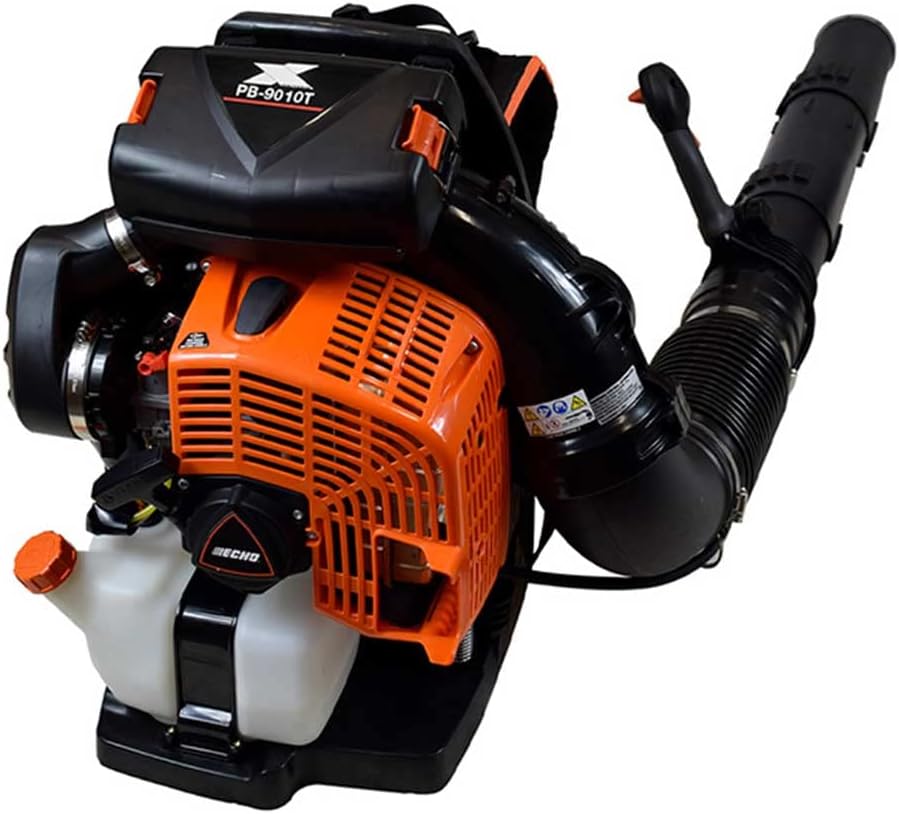
The box contains the blower unit with the backpack frame and straps already assembled, the flexible tube, the straight tube and nozzle, a small tool kit, and the owner’s manual. That is it. For anyone reading an Echo PB-9010T review and wondering about extras, the honest answer is that this box is sparse.
There is no fuel mixing bottle, no two-stroke oil, no ear protection, and no safety glasses. Those are not optional in my view — you will be buying them on the same trip. Budget another thirty to fifty dollars for a decent set of muffs, a mixing jug, and oil, and treat that as part of the purchase price.
Packaging is standard big-box cardboard with molded inserts. Nothing about the box says premium, but nothing about it says cheap either. What did make an impression was the unit itself: the housing is thick-walled, the tube connections lock with a firm quarter turn, and the harness padding is stitched rather than glued. The frame sits flat against your back without the hollow rattle you get from thinner plastic shells.
Two things surprised me on the first lift. First, the weight distribution — most of the mass sits low and close to your spine, which is why it carries better than it looks. Second, the tube clamp is plastic, and it is the one component that felt like a cost decision rather than an engineering one.
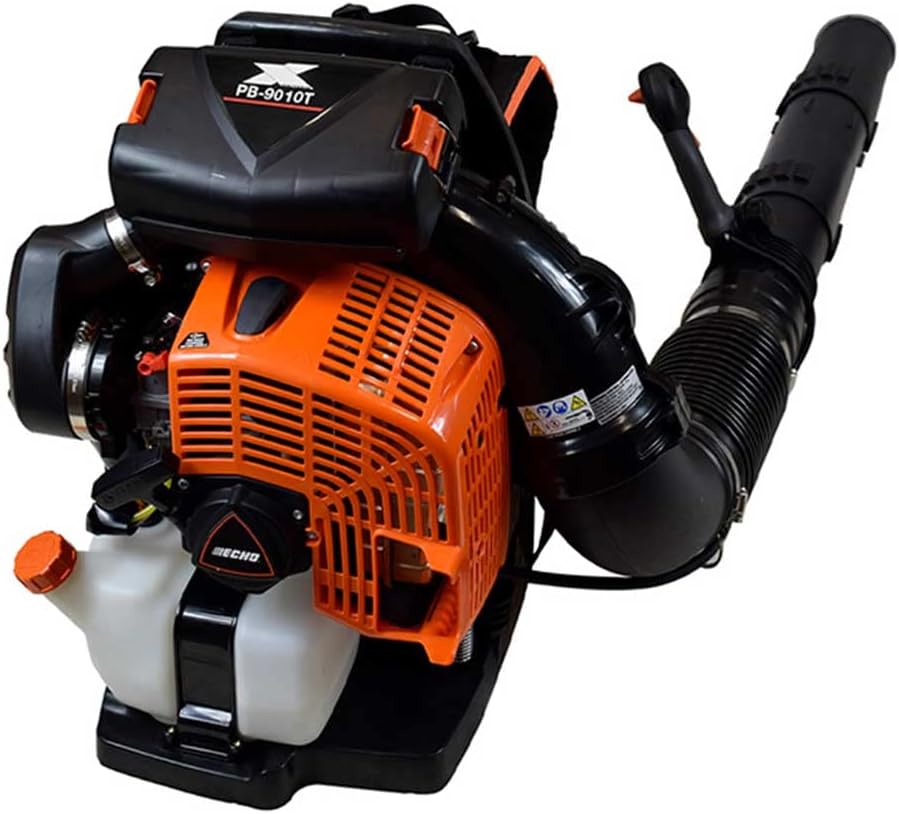
Assembly took me about fifteen minutes, and ten of those were spent reading the fuel and starting procedure rather than turning bolts. The tubes push together and lock with a quarter turn each, the frame comes pre-assembled, and the only genuinely fiddly part is routing the throttle cable so it does not catch on the harness. The manual is written in the flat, translated style Echo has used for years — accurate but not generous with explanation. Prior experience with two-stroke equipment helps more than prior experience with blowers.
The engine itself is not the learning curve. The technique is. A 1,110 CFM blower does not sweep leaves; it launches them, and my first passes sent a wave of debris over the lawn instead of down the driveway. It took three sessions before I stopped over-throttling and started using the throttle lock to hold a steady mid-range for open ground. Realistically, plan on two or three uses before the machine feels like an extension of your arm rather than a thing strapped to your back.
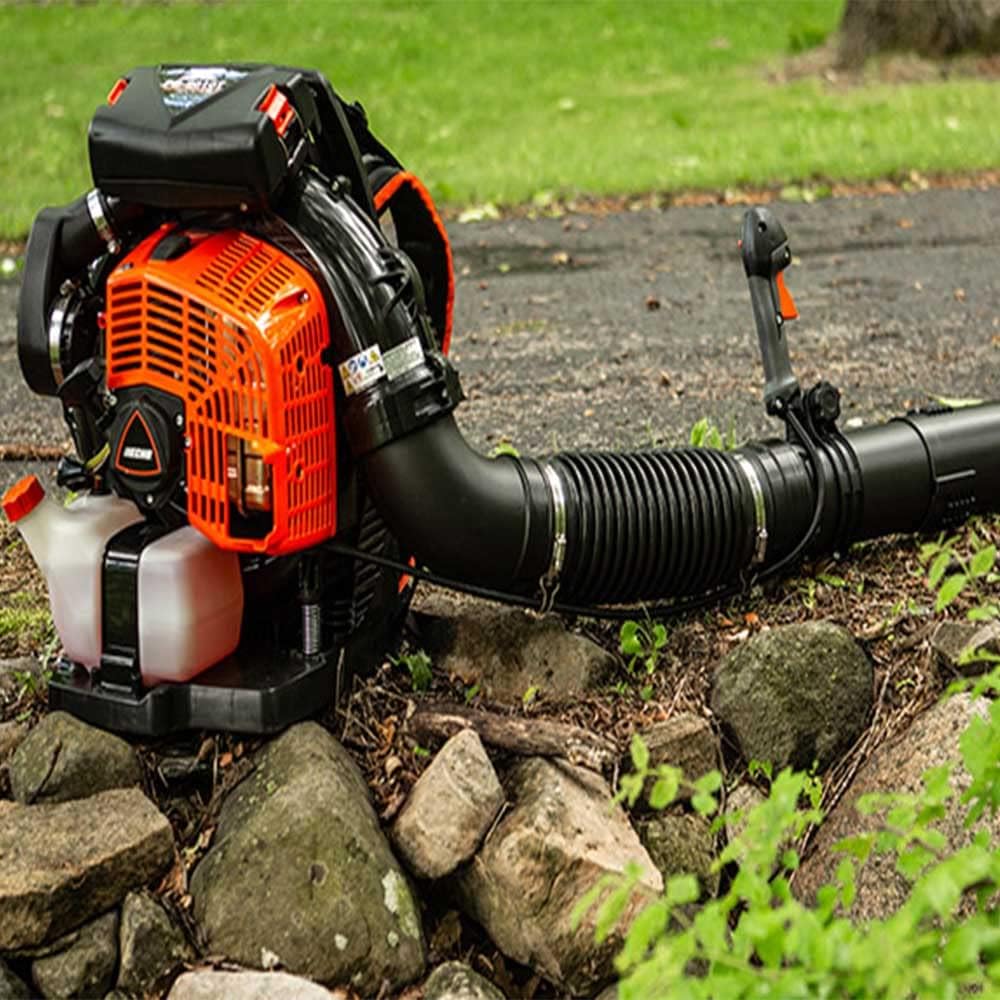
My first real job was 180 feet of asphalt covered in dry oak leaves. The handheld used to take two hours with a rake finish. This took twenty-two minutes, including a second pass to catch the edges. I did not touch a rake. That is the moment where an Echo PB-9010T review stops being theoretical — the tool did not just do the same job faster, it did a job my previous setup could not do at all. The wet-leaf scenario that started this whole search was finally solved. Where I would point a reader next is the is Echo PB-9010T worth buying breakdown from people who own it in different climates, because wet leaf performance is regional.
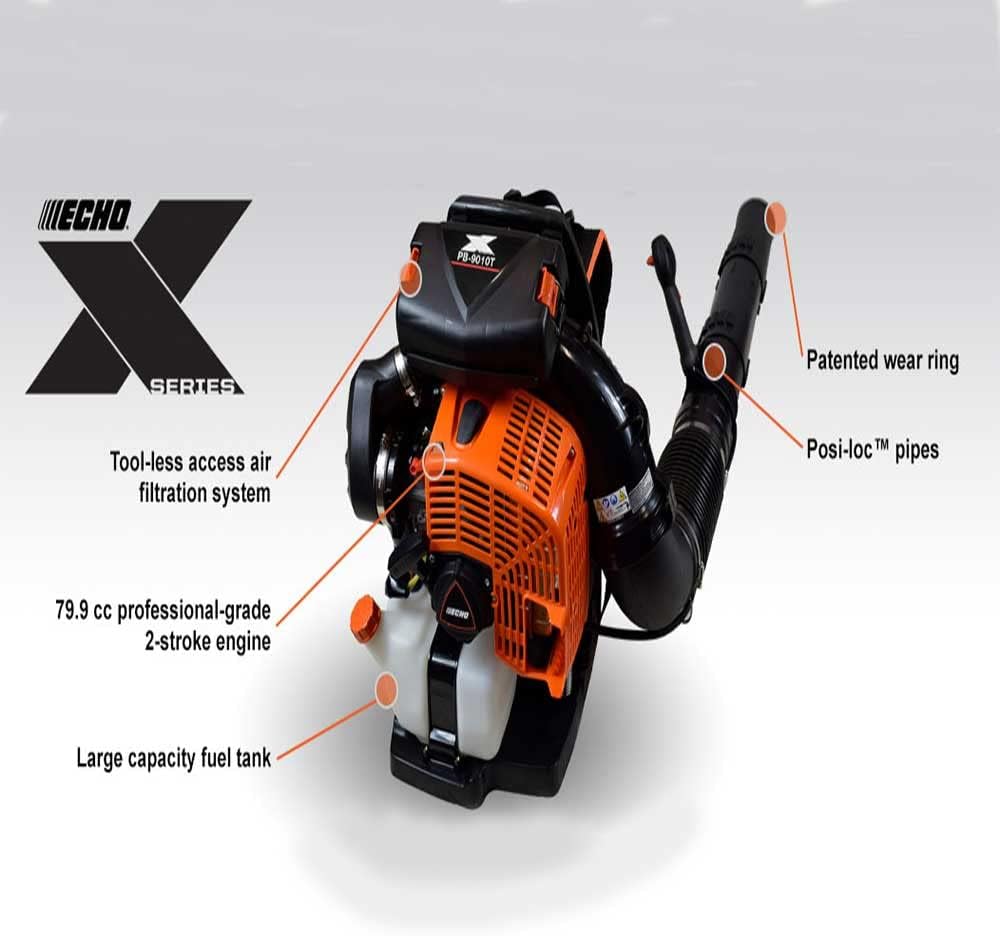
My technique improved more than the machine did. I learned to walk backward on long runs instead of turning around, which cut my driveway time by roughly a third. I learned that a lower throttle setting with a wider nozzle sweep moves wet leaves better than full throttle at point-blank range. The throttle lock became the feature I use most, because it lets me set a consistent speed and forget about my right thumb. Handling fatigue dropped noticeably once I stopped fighting the tube and let the harness carry the weight.
The engine has started on the third pull every cold morning for two seasons, with one exception I will get to below. Air output has not measurably drifted — I run the same route and get the same result. The straps have not stretched, the stitching has not pulled, and the tube locks have not loosened. The housing has taken two knocks against a fence post and a wheelbarrow with nothing worse than scuffs. Nothing on this machine has quietly degraded in a way I only noticed months later.
First, the weight is real and it accumulates. At thirty minutes it is comfortable. At ninety minutes, with a full tank, my shoulders know about it. Second, this machine empties a tank faster than you expect under sustained load, so a second fuel can is not optional for a big property. Third, and this is the one nobody mentions: you cannot use it near a parked car, an open garage, or a window screen without thinking about where the debris is going, because 1,110 CFM does not care what is in the way. An Echo PB-9010T review honest opinion has to include that the tool changes how you plan a job, not just how fast you finish it.
The one recurring annoyance is cold starting after the machine has sat for more than a month. It takes a specific choke sequence and a few extra pulls, and if you flood it you are waiting. The plastic tube clamp has developed a small amount of play, not enough to leak air meaningfully but enough that I check it before each use. Other than that, nothing has failed, cracked, or worn in a way that changed how the blower performs.
| Specification | Detail |
|---|---|
| Brand | ECHO (ECHO Incorporated) |
| Model | PB-9010T |
| Engine | 79.9 cc, two-stroke, gasoline |
| Maximum air speed | 220 MPH (manufacturer-listed) |
| Maximum air volume | 1,110 CFM (manufacturer-listed) |
| Form factor | Backpack with padded frame and hip belt |
| Throttle | Tube-mounted with throttle lock |
| Listed noise level | 48 dB (see note above) |
| Dimensions | 28 L x 20 W x 24 H inches |
| Weight | Not published in the listing data we pulled — plan on a two-hand lift onto the shoulders |
| Color | Solid black |
| Included components | Blower unit, tubes, tool kit, manual |
| UPC / ASIN | 743184023235 / B08PKYS9NG |
| Customer rating | 4.7 out of 5 from 922 ratings |
| Category rank | #10 in Leaf Blower & Vacuum Parts & Accessories |
If you want to see how we approach this kind of testing more broadly, our methodology notes explain how long we run equipment before writing anything up. Before buying, it is also worth understanding how noise exposure accumulates — the OSHA guidance on occupational noise is a useful reference point for anyone running a gas blower for hours at a time.
| What We Evaluated | Score | One-Line Note |
|---|---|---|
| Ease of setup | 4.5/5 | Fifteen minutes, no special tools, frame arrives assembled |
| Build quality | 4.5/5 | Thick housing and stitched harness; the plastic tube clamp is the weak point |
| Day-to-day usability | 3.5/5 | Excellent for forty minutes, demanding past the ninety-minute mark |
| Performance vs. claims | 4.5/5 | The CFM figure holds up in real debris; the noise figure does not |
| Value for money | 4/5 | Fair at this price for the air volume, assuming you use it hard |
| Noise and operator fatigue | 3/5 | Loud enough to require muffs and heavy enough to require pacing |
| Overall | 4/5 | A capable tool that rewards the buyer who has the land and the patience for gas equipment |
The performance and build numbers carried this score. What held it back was noise and fatigue — two things that never show up on a spec sheet but decide whether you reach for the blower or the rake on a cold Saturday. Anyone who tells you the Echo PB-9010T review verdict here should be a perfect five has not run one for two hours straight.
| Product | Price | Strongest At | Weakest At | Best For |
|---|---|---|---|---|
| Echo PB-9010T | 599USD | Raw air volume and tube-mounted throttle control | Weight over long sessions; noise | Large lots with heavy leaf fall and long hard surfaces |
| Stihl BR 800 C-E Magnum | Roughly 650–700 USD | Dealer network and shoulder-to-hip balance | Lower listed CFM at a higher price | Buyers who want a service counter within driving distance |
| Husqvarna 580BTS | Roughly 550–600 USD | Harness comfort and price-to-output ratio | Fittings feel lighter duty than Echo’s | Budget-conscious homeowners who still need big-air volume |
| Cordless handheld (18V–60V class) | Roughly 150–350 USD | Instant start, no fuel, near-silent | Run time and moving wet debris | Quarter-acre lots and quick touch-ups |
If your property has a long hard surface and a serious leaf drop, the CFM gap is the whole argument. The PB-9010T moves 1,110 cubic feet of air per minute; the Stihl BR 800 C-E Magnum lists in the low 900s and costs more. The tube-mounted throttle with a lock is also genuinely better for long passes than a body-mounted trigger, and it is the reason my driveway time dropped as much as it did. For a buyer who is going to run a blower for forty minutes at a stretch rather than four, this machine’s strengths land exactly where they need to. You can see the current Echo PB-9010T review pros cons from a much larger pool of owners if you want to pressure-test my impressions.
Buy the Stihl if dealer support matters more to you than spec sheets. If something goes wrong in year three and you want a person behind a counter to hand the machine to, Stihl’s network is deeper than Echo’s in most parts of the country, and the BR 800 C-E Magnum is a well-mannered tool that some people find easier to carry all day. Buy a cordless handheld instead if your lot is under a quarter acre, if you have neighbors within earshot, or if you have no interest in mixing fuel and maintaining a two-stroke. That is not a consolation prize — for a lot of readers it is simply the right answer, and no amount of CFM changes that.
This blower is for the homeowner with half an acre or more, mature trees, and at least one long stretch of driveway, patio, or gravel that collects debris every autumn. You are comfortable with gas equipment — you have owned a two-stroke trimmer or chainsaw and you do not find mixing fuel to be a burden. You are going to use this thing a dozen or more times a year, not twice, and you have somewhere to store it that is not a hallway closet. Budget sensitivity matters less than usage frequency here: at this price, the math only works if the machine saves you real hours every season. The Echo PB-9010T review and rating sits at 4.7 out of 5 from 922 buyers, and reading through those, the pattern matches what I found — people who use it hard tend to love it.
The wrong buyer is the person with a quarter-acre suburban lot and two ornamental trees. They will strap on a heavy two-stroke machine, mix fuel, put on hearing protection, and finish a job in eleven minutes that a cordless handheld would have handled in fourteen with no fuel can involved. If that is your situation, look at a battery blower in the 500–700 CFM class instead and put the difference toward a second battery. The other wrong buyer is anyone who will not wear ear protection. This is not a tool for that person, and it is not a close call.
At 599 USD, the PB-9010T sits at the upper end of the homeowner backpack category and just below the flagship models from Stihl and Husqvarna. For the air volume you are getting, that is a fair price rather than a bargain — you are paying for output, and the output is real. What makes it a good value is usage frequency. Run it forty times a season and the per-job cost is trivial. Run it four times and almost any price is too much, because the money is not the issue at that point; the storage space and the fuel maintenance are.
Buy from an authorized Echo dealer or a retailer that is explicitly listed as an authorized seller, because that is what keeps the warranty intact. Return windows matter more than usual on a purchase this size, so confirm the policy before you commit. On price history, this model does not tend to swing wildly, but it does move around major sale events — if you are not in a hurry and it is currently mid-season, waiting is not unreasonable. Watch for listings that bundle fuel or oil, since those can quietly shift the effective price by twenty or thirty dollars.
Price and availability change. Check current figures before deciding.
Echo backs its backpack blowers with a five-year consumer warranty, dropping to a shorter term for commercial use. Confirm the exact terms at the point of sale, because the clock and the coverage differ depending on how the machine is registered and used. The practical catch is that warranty service runs through authorized dealers, not the retailer you bought from — so if there is no Echo dealer near you, a warranty claim becomes a shipping problem. That is a real consideration and it is the strongest argument for the Stihl alternative in rural areas. Otherwise the support experience is unremarkable in the best way: parts are available, and the common wear items are inexpensive.
It is worth it if you have the land and the leaf volume to justify it. The value is not in the machine’s specs, it is in the hours it returns to you each autumn. If you are clearing a long driveway monthly from September through November, it pays for itself in a season and a half compared to paying someone. If you are clearing a small yard twice a year, the money is better spent elsewhere.
The Echo moves more air on paper — 1,110 CFM against the Stihl’s low-900s — and costs less. The Stihl counters with better balance on the back, a wider dealer network, and a slightly more refined feel at the handle. If you value a service counter you can drive to, the Stihl wins. If you value raw output per dollar, the Echo does. Neither is a mistake.
Fifteen minutes from opening the box, and most of that is reading the starting procedure rather than assembling anything. The frame arrives assembled, the tubes lock with a quarter turn, and the only real task is routing the throttle cable cleanly. Add another ten minutes if you have never mixed two-stroke fuel before, because getting the ratio right the first time matters.
Required: two-stroke oil, a fuel mixing container, ear protection, and safety glasses. Recommended: a second fuel can if your property is large, and a spare tube clamp given that it is the one plastic part I would keep an eye on. You can see what the current listing includes before ordering so you are not caught short on the accessories.
Two seasons in, nothing has failed. The recurring annoyance is cold starting after long storage — it wants a specific choke sequence and punishes you if you flood it. The plastic tube clamp has picked up a little play. Beyond that, the engine, harness, and housing have all held up without drama, which is the most you can reasonably ask at this stage.
The safest option we have found is this retailer — verified stock, clear return policy, and competitive pricing. Buying through a listing with a visible return window matters more than saving ten dollars, because a machine this size is not something you want to argue about if it arrives damaged.
It runs the standard 50:1 two-stroke mix, and Echo’s engines are rated for fuel containing up to about ten percent ethanol. In practice, I run ethanol-free fuel in mine because it stores better over winter and cold starts are noticeably easier in spring. If you only run pump gas, do not leave it sitting in the tank for six months — drain it or use a stabilizer.
Probably, yes. On a standard quarter-acre lot with a couple of trees, you will spend more time on fuel and hearing protection than on the actual work. The machine is not the problem — the mismatch is. A cordless handheld with a spare battery covers that property completely, and you will use it more often because there is no setup cost to starting it.
The moment I stopped raking. That is genuinely what decided it. Two autumns of wet oak leaves had convinced me that some jobs simply required manual labor, and one twenty-two minute pass down the driveway disproved that. The second thing was the tube-mounted throttle. It sounds like a small detail until you have held a blower tube for an hour with your other hand doing nothing useful. Those two things tipped it, and no amount of spec-sheet comparison would have moved me the same way.
Buy it if you have half an acre or more, heavy deciduous leaf fall, long hard surfaces, and a real willingness to maintain gas equipment. Do not buy it if your lot is small, if you want to start a blower at dawn, or if hearing protection and fuel mixing sound like chores you will not keep up with. As for whether I would buy it again at this price — yes, without hesitation, and I would go in knowing it is a heavy tool that demands respect rather than a convenient one. That is the Echo PB-9010T review verdict I would give a friend, and it is the same one I would give a stranger.
If you own a PB-9010T, I want to know whether the cold-start behavior I described matches your experience, and whether your tube clamp has developed the same play. Those are the two details I could not settle from a single machine. Leave it in the comments below. And if you have read enough and want to move, the Echo PB-9010T review pros cons and current pricing are one click away.
Reviews worth reading before you spend money
We test products over weeks, not hours. No sponsored rankings. No affiliate-first conclusions. Join readers who use our work to make better decisions.