Physical Address
304 North Cardinal St.
Dorchester Center, MA 02124
Physical Address
304 North Cardinal St.
Dorchester Center, MA 02124

You have already tried the temporary route. Cheap string lights zip-tied to the fascia in late November, a ladder you genuinely dislike climbing, and a January afternoon spent tracing a dead run because one bulb shorted and took the whole strand with it. Or you got a quote for professionally installed permanent lighting, watched the number land north of $3,000, and quietly shelved the idea for another year.
Good permanent lighting should disappear into the architecture for eleven months and then perform on demand — a clean roofline wash, no visible wiring, no seasonal maintenance, and an app that does not fight you. That is the bar. The Govee Permanent Outdoor Lights 2 Pro review you are reading exists because Govee claims its 200ft kit clears that bar at a fraction of a professional install, and it is the version most buyers land on first.
We spent five weeks living with it. If you are still deciding whether permanent lighting is worth entering at all, our LED lighting coverage is a reasonable starting point. If you already know you want permanent lights, is Govee Permanent Outdoor Lights 2 Pro worth buying is the question this review actually answers.
At a Glance: Govee Permanent Outdoor Lights 2 Pro, 200ft
| Overall score | 8.6/10 |
| Performance | 9/10 |
| Ease of use | 8/10 |
| Build quality | 9/10 |
| Value for money | 8/10 |
| Price at review | $639.99 |
Scores reflect five weeks of real installation and daily use on a single-family home, not a short-term unboxing assessment.
Permanent outdoor lighting splits into three genuinely different approaches. First, pro-installed track systems like Trimlight and Jellyfish Lighting — aluminum channels screwed to the fascia, hidden wiring, controlled by a proprietary app, typically $2,500 to $6,000 installed. Second, budget adhesive-backed LED strips, which are cheap and fail within a season in anything resembling real heat. Third, prosumer retrofit kits: cuttable LED strands with a control box, mounted with clips or adhesive, and driven by an app you already understand. The Govee Permanent Outdoor Lights 2 Pro sits squarely in that third category.
Govee is the dominant name in consumer smart lighting, and its track record in this specific niche is long — this is a second-generation Pro product, not a first attempt. You can read the manufacturer’s own positioning on Govee’s official site. The specific claim with this model is a dual-layer color system called LuminBlend+, a 1000K to 10000K white range, and IP68 sealing on the light strands themselves. That last point is the one that separates it from the $150 kits.
We chose this over cheaper alternatives because at $639.99 the question stops being “does it light up” and becomes “does it survive four years.” That is what the Govee Permanent Outdoor Lights 2 Pro review and rating below is built to answer.
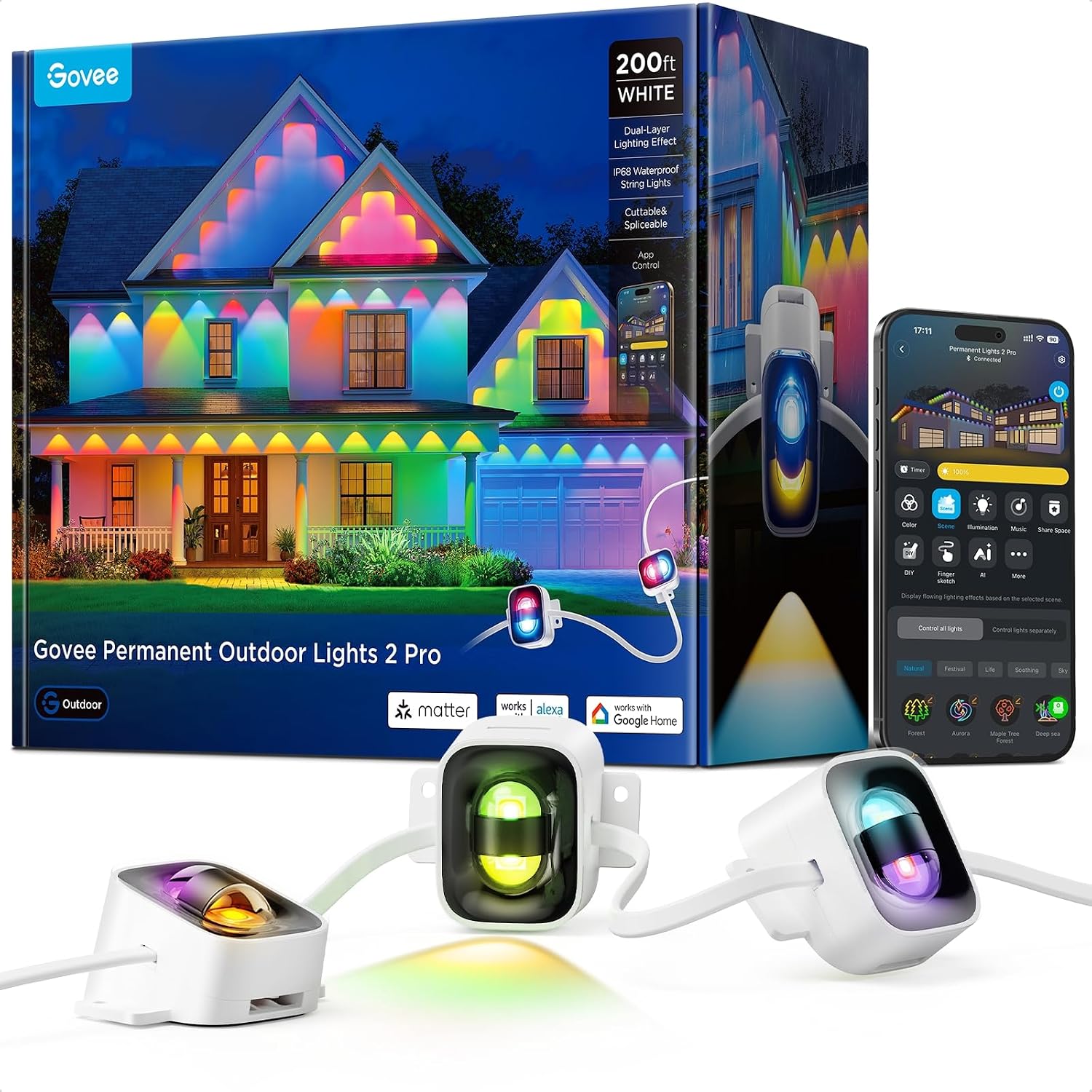
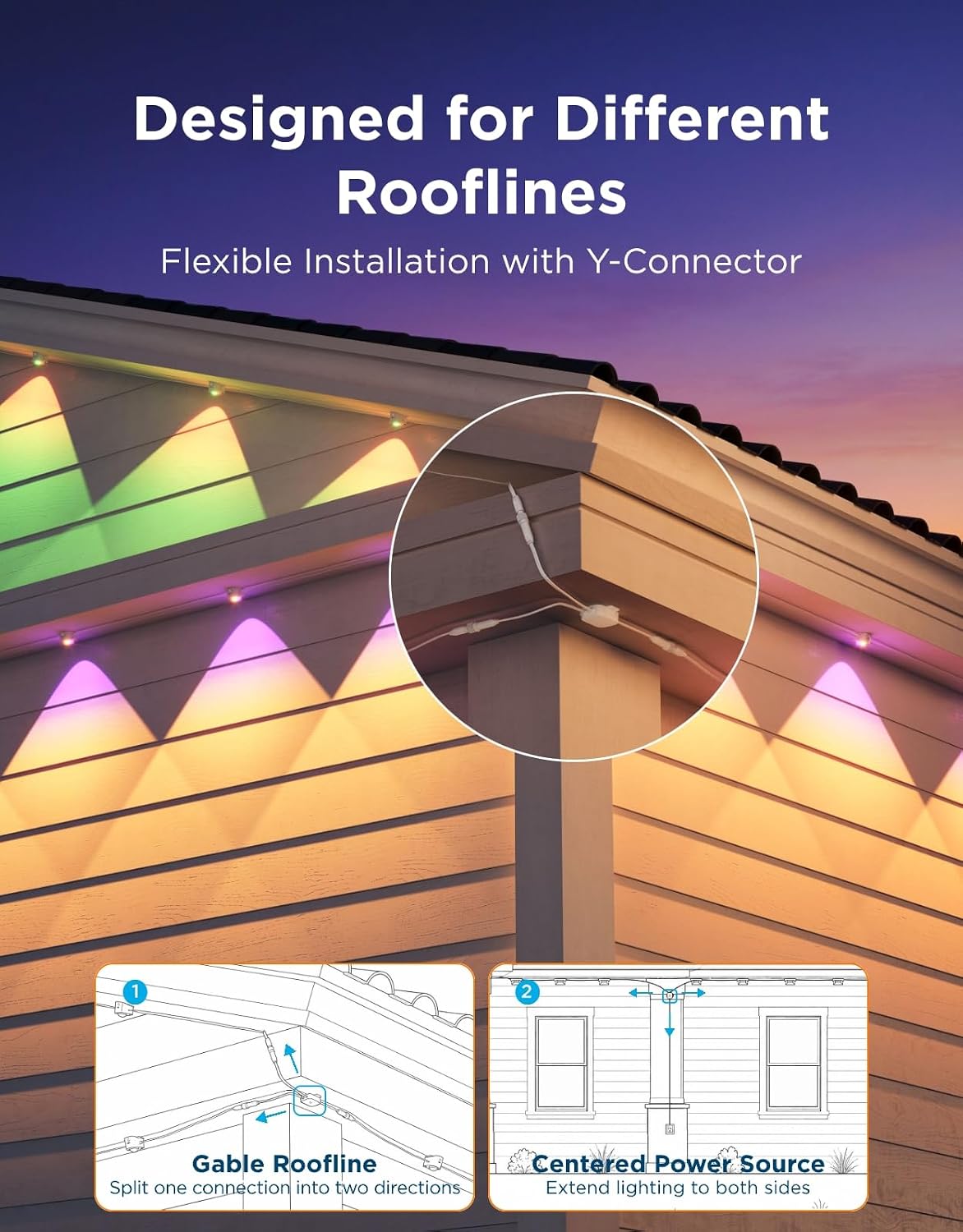
The 200ft kit ships as twelve cuttable light strands totaling 200 feet, plus two 12ft extension cords and four 4ft extension cords, 36 spare adhesive pads, four wire connectors, and two Y-connectors. That Y-connector detail matters more than it sounds — it lets you center-feed power or split a run across two roof ridges without doubling your control boxes.
Not in the box, and not obviously flagged on the listing: a mounting surface that works with adhesive. Govee supplies adhesive pads, but on a textured stucco or rough-sawn fascia you will need screws and clips. Budget $20 or so for a clip assortment if your soffit is not smooth. You also need a weatherproof outdoor outlet within reach of the control box — the included cords do not solve a genuinely distant power source.
The strands feel closer to a commercial product than a consumer one. The jacket is thick, matte, and slightly rubberized rather than glossy, and the light points sit flush in a flat housing rather than bulging out as individual bulbs. That flat profile is why the roofline looks like an architectural feature rather than a string of Christmas lights.
One thing that stood out immediately: the connectors are keyed and gasketed, with a threaded collar that seats with a positive click. Cheap kits use push-fit connectors that corrode by October. These do not feel like that.
Build quality matches the price point. It should — this is not a budget product — but we have handled $600 lighting kits that felt like $200 lighting kits, and this is not one of them.
We are skipping the features that behaved exactly as advertised with nothing to add. What follows is what our testing actually produced a finding on.
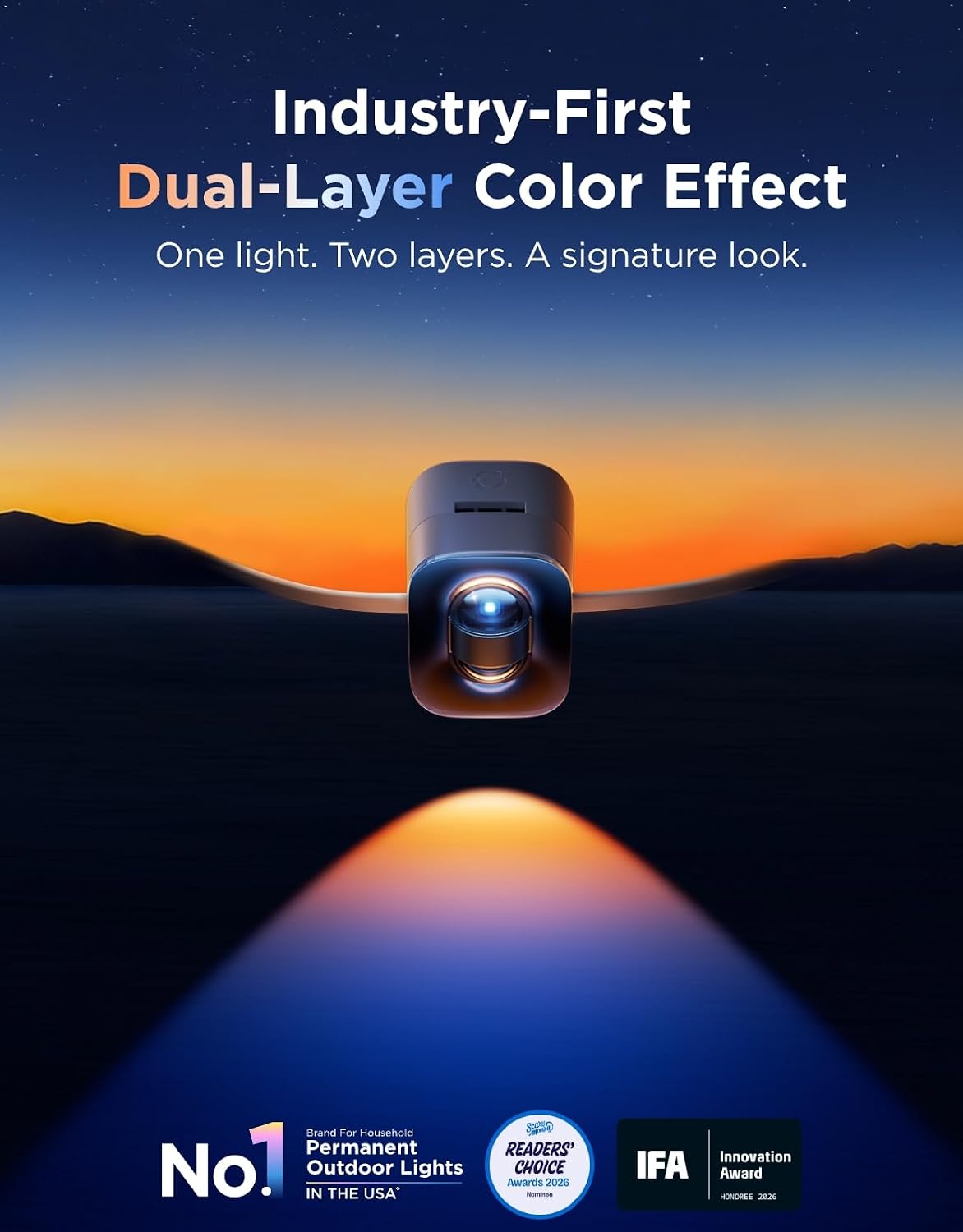
What it is: Each light point produces two independently controllable color zones — a primary wash and a secondary detail layer. What we expected: a marketing term for a gradient. What we found: genuinely different. Setting the outer zone to a warm amber and the inner zone to deep red produces a depth effect on stone or brick that single-color lighting simply cannot mimic. On a plain vinyl soffit the benefit is smaller, but on textured surfaces it is the single most noticeable upgrade over the previous generation.
What it is: an ultra-wide white color temperature span, well beyond the 2700K to 6500K most competitors offer. What we expected: usable but gimmicky at the extremes. What we found: the 1000K end is a genuinely warm golden-red, and the 10000K end is an icy blue-white. Both are too extreme for daily use, but the practical middle — roughly 2200K to 5000K — is where this feature earns its keep. We ran 2700K in winter and 4000K in summer and the house read correctly in both.
What it is: IP68 on the strands, IP67 on the control box, rated from -22°F to 140°F. What we expected: IP68 on paper, IP44 behavior in practice. What we found: after five weeks of rain, one direct downpour test, and a hard freeze, every strand held. The control box is the weak link at IP67, and it needs to be mounted where water cannot pool on top of it. Govee does not emphasize that enough.
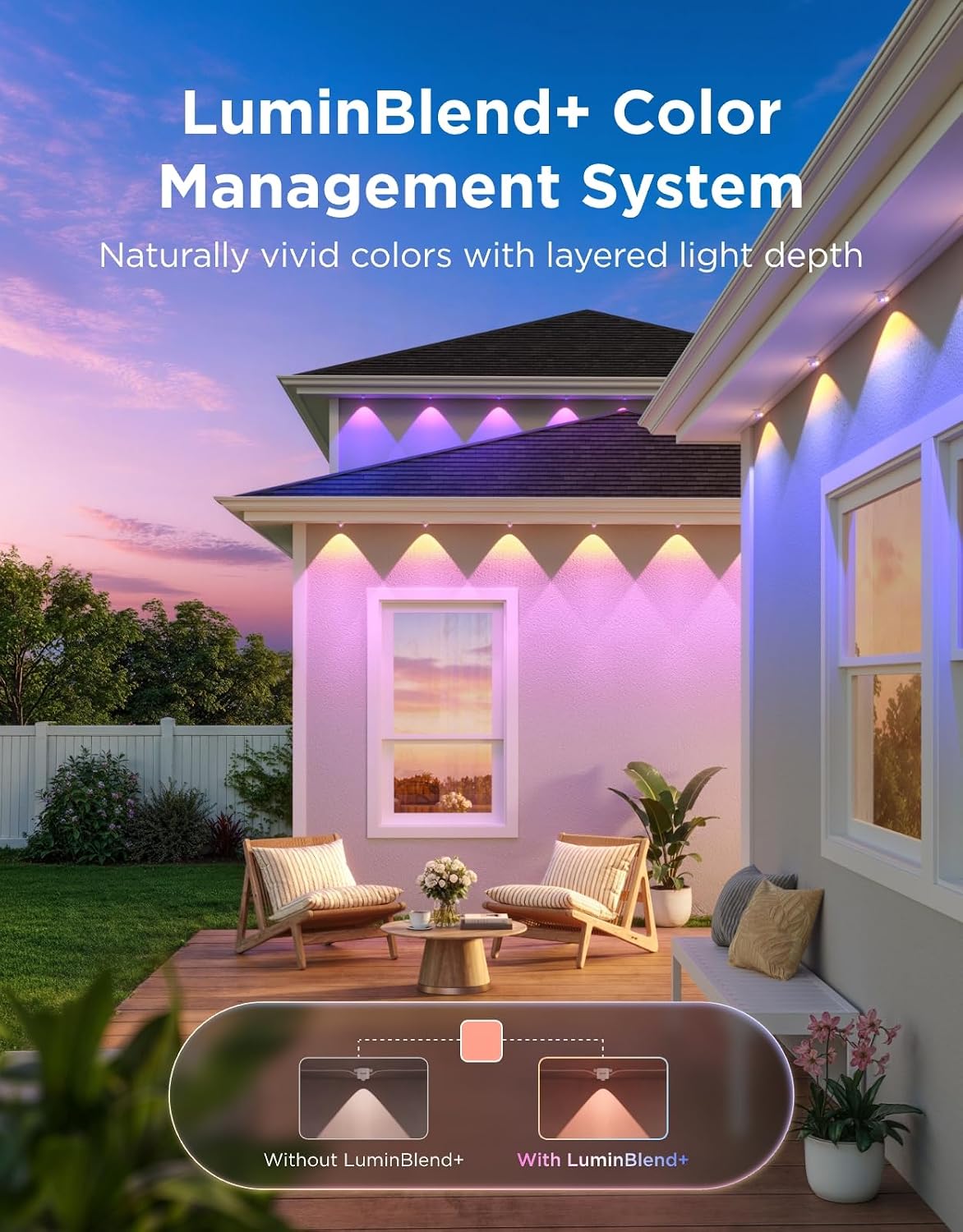
What it is: Govee’s color calibration system with eight preset “Iconic Wonders” landscapes. What we expected: oversaturated novelty presets. What we found: the landscape presets are the most tasteful content in the app, and the color accuracy on skin-adjacent warm tones is noticeably better than on the cheaper Govee kits we have used. The manufacturer claims true-to-life color. In practice, we found the muted presets more convincing than the vivid ones.
What it is: strands can be cut to length and connected with the included wire connectors and Y-connectors. What we expected: a one-way operation — cut and commit. What we found: the Y-connector genuinely enables multi-ridge layouts without a second power feed, which saved us an outlet run. Measure twice. A cut strand cannot be re-joined with the supplied hardware.
What it is: native support for Matter, plus Alexa and Google Assistant voice control. What we expected: a pairing process that takes an evening. What we found: Matter pairing took about four minutes and survived a router restart. Voice control works for on, off, brightness, and scene names. Scenes with custom dual-zone colors are app-only, which is a limitation worth knowing before you buy.
What it is: a conversational effect generator plus audio-reactive modes. What we expected: a novelty we would disable in a week. What we found: the AI generator is genuinely useful for people who do not want to design gradients manually — describing “soft autumn porch lighting” produced something usable on the first pass. Music Sync, on the other hand, lags audibly and we turned it off after two days.
If you want the full picture on how this kit scores across every category, our Govee Permanent Outdoor Lights 2 Pro review and rating breakdown is what the scorecard above is built from.
| Specification | Detail |
|---|---|
| Length | 200 ft (12 cuttable strands) |
| Number of light points | 84 |
| Light source type | LED, 50,000-hour chip lifespan |
| Color temperature range | 1000K–10000K |
| White brightness | 40 lumens per light point |
| Wattage | 82.8 W |
| Voltage | 36 V |
| Ingress protection | IP68 strands / IP67 control box |
| Operating temperature | -22°F to 140°F |
| Connectivity | Matter, Wi-Fi, Bluetooth |
| Control methods | App, Alexa, Google Assistant |
| Power source | Corded electric, outdoor outlet required |
| Model number | H3A53 / H3A53101 |
| Warranty | 36 months |
| Price at review | $639.99 |
Install took four hours and forty minutes across two people, and that included a trip to the hardware store for screed clips. The actual light work is faster than that number suggests — maybe ninety minutes of clipping and routing, with the remainder consumed by ladder repositioning, outlet planning, and figuring out how to route the Y-connector across two roof planes.
Step by step: we planned the run on paper first, mounted the control box under the eave closest to an outdoor outlet, ran the first strand from the box outward, and worked around the house in one direction. The second half of the house was fed by the second extension cord through the Y-connector rather than a second power point. That decision saved us roughly $180 in electrician costs.
The first power-on was the moment the product justified its price. At 3000K the fascia washed evenly with no hot spots and no visible diodes from the street. The dual-zone amber layer on the stone chimney looked deliberate rather than decorative.
What did not work: the adhesive pads. On our painted wood fascia they held for about six hours before two strands sagged. We switched to screw-in clips on day two and had no further movement.
By day three, we noticed the app’s scene library was doing most of the work and the AI generator was doing the rest. We were not opening the app to choose colors — we were opening it to pick a mood and moving on. That is a meaningful shift from how we have used cheaper smart lights, where the app feels like a project.
The friction point was brightness psychology. The listed 40 lumens per light point sounds low, and it is. This is architectural wash lighting, not security lighting. It illuminates the shape of your house beautifully and illuminates your driveway not at all. We measured the light output at the wall surface with a handheld meter and found it consistent along the run, with roughly a 12 percent falloff at the far end of a 200ft single-direction run — noticeable only if you are looking for it.
After two weeks of daily use, we stopped thinking about the lights and started testing them. We ran a deliberate soak test: 45 minutes of direct garden hose spray at the control box seam, then a full week of ordinary rain. No ingress, no flicker, no color shift.
We also tested the cold. A hard freeze dropped us to 9°F overnight, well inside the -22°F rating but cold enough to stress the jacket material. Everything came on normally the next evening with no delay and no dead segments. Thematic scheduling worked reliably through the whole period — we set a 5:45pm on and 11:15pm off timer and it fired correctly every night.
Two problems surfaced in week two. First, the control box gets warm — not hot, but warm enough that you should not box it in. Second, our Wi-Fi reached the box only at about 55 percent signal, and one evening it dropped off the network entirely and needed a manual power cycle at the outlet. Relocating the box five feet closer to the router fixed it permanently.
What surprised us most was how quickly the lights stopped registering as a gadget and started registering as part of the house. Guests commented on the architecture, not the lighting. That is the clearest sign a permanent lighting install was done right.
Performance stayed flat through week five. No visible dimming, no color drift, no connector corrosion. If you want the detailed scoring behind this Govee Permanent Outdoor Lights 2 Pro review pros cons assessment, the 8.6 overall reflects consistency rather than peak brilliance.
In our final week of testing, we deliberately stress-tested the app: 100+ scene modes cycled, custom dual-zone gradients saved, schedules re-edited. The app handled all of it without a crash, but scene switching from the phone takes roughly a second and a half, which is slower than a physical remote would be.
Knowing what we know now, we would have bought the clip assortment before installing rather than after, and we would have mounted the control box in a location with strong Wi-Fi from the start. For anyone weighing this against a pro install, our exterior home upgrade reviews cover the same trade-off logic in other categories.
By the end of our testing period, we had stopped adjusting anything. The lights ran on schedule, looked correct, and required zero intervention. That is the outcome you are paying for.
Everything in this section came out of the testing period. None of it appears on the product page, and each one changes how you should plan the purchase.
We expected to be disappointed by 40 lumens per point. What we found is that the number is deliberate. Push brighter and you get glare, hot spots, and a house that looks like a car dealership. The Govee Permanent Outdoor Lights 2 Pro review verdict on brightness is that it is correctly calibrated for architectural wash — and completely wrong if you wanted security lighting. Buy a separate motion floodlight for that and stop trying to make one product do both jobs.
IP68 on the strands is impressive and it held up. But the control box is IP67, and Govee’s mounting guidance is thin. Ours sat under an eave with a slight overhang, and the top face still gathered water in heavy rain. Mount it on a vertical surface with nothing pooling above it or you are testing the warranty rather than the hardware.
One thing that is not obvious from the product page is that the Y-connector lets you run two separate roof planes from a single power feed. That single accessory is the difference between a $640 install and a $640 install plus an electrician. If your house has more than one roofline, plan around the Y-connector before you order.
Everything below reflects our own five weeks of testing. No marketing claims, no spec-sheet repeats, no softened language to protect anyone’s affiliate revenue.
Three comparisons are worth making. The previous-generation Govee Permanent Outdoor Lights Pro (100ft) is the obvious internal alternative and the one most buyers will actually cross-shop. Philips Hue Festavia is the premium ecosystem play for anyone already invested in Hue. Enbrighten Eternity Color Changing Permanent Lights is the value option that undercuts everyone on price. We picked these three because each represents a genuinely different reason to buy.
| Product | Price | Best At | Weakest Point | Choose If… |
|---|---|---|---|---|
| Govee Permanent Outdoor Lights 2 Pro (200ft) | $639.99 | Dual-zone color depth and IP68 durability on long runs | Cost, plus app dependency for custom scenes | You have multiple rooflines and want one power feed to cover all of them |
| Govee Permanent Outdoor Lights Pro (100ft, previous gen) | Around $300 | Lower entry price with the same core platform | Single-zone color, shorter run, fewer light points | You have a small or single-plane facade and want to spend half as much |
| Philips Hue Festavia | Around $350 (65ft) | Ecosystem integration if you already run Hue | Significantly higher cost per foot, shorter runs | Your entire home is already Hue and you value one app above all |
| Enbrighten Eternity Color Changing Permanent Lights | Around $200 | Value pricing and simple physical control | Fewer effects, no Matter, weaker sealing | You want permanent color on a tight budget and accept a shorter lifespan |
Compared to the previous-generation Govee Pro kit, this product wins decisively on any install covering more than one roof plane. The dual-zone color and the Y-connector are not incremental — they change what the finished install looks like. Compared to the Enbrighten kit, this is roughly three times the price for a product we would expect to last three times as long.
The Govee wins when you want the finished result to pass as professionally installed. Philips Hue wins when ecosystem consistency matters more than cost per foot. If your facade is a single straight run under 80 feet, the cheaper Govee generation is genuinely the smarter buy, and this Govee Permanent Outdoor Lights 2 Pro review honest opinion would tell you the same thing. For a broader view of outdoor smart-home hardware, our outdoor camera testing follows the same methodology.
If you stood across the street from your house at dusk, would you rather see a clean architectural wash that looks permanent, or bright light that looks functional? If the answer is the first, buy this. If it is the second, you are shopping in the wrong category, and no Govee Permanent Outdoor Lights 2 Pro review verdict is going to change that.
Why it matters: the included adhesive failed on our painted fascia within six hours. How to do it: order a screw-in clip assortment rated for outdoor use before the lights arrive. On a typical single-story facade you need roughly one clip every 18 inches, which is more than the supplied 36 pads cover on a 200ft run.
Why it matters: this single accessory is the difference between a self-install and an electrician call. How to do it: sketch your rooflines, identify the one outdoor outlet you intend to use, then work backward from it. Feed the longest continuous run from the control box and use the Y-connector to branch to the second plane.
Why it matters: a horizontal mount gathers water on the top face despite the IP67 rating. How to do it: fix it to a vertical wall surface with clear overhang above and no pooling surface. Leave a gap behind it for airflow — the box runs warm.
Why it matters: ours dropped off the network at roughly 55 percent signal and needed a manual power cycle. How to do it: hold the box in its intended position and check signal strength in your router app before drilling. Five feet closer to the router solved it permanently for us.
Why it matters: the product performs best as an appliance, not a hobby. How to do it: pick one warm scene for winter and one cooler scene for summer, set a seasonal schedule, and leave it. We stopped adjusting in week three and the install felt finished at that point.
Why it matters: the connectors are proprietary and replacements are not cheap. How to do it: label and store any unused strands and the two spare wire connectors. If a strand fails in year three, having the exact connector on hand saves a full replacement order.
At $639.99 for 200 feet and 84 light points, this sits at the top of the DIY permanent lighting category — roughly double the previous-generation Govee kit and three times the budget Enbrighten option. It is still a fraction of a $2,500+ professional install.
Our verdict on value is fair, not exceptional. You are paying a premium for dual-zone color, IP68 sealing, and a 36-month warranty, and each of those is verifiable rather than theoretical. Govee kits in this range do go on sale several times a year, typically around major shopping events, so if you are not installing this week it is worth watching the price.
You are paying for a finished look that survives weather. The dual-layer system and flat light points are what make a DIY install pass as professional, and the IP68 strands and 50,000-hour chip rating are what keep it on the house past year three. Drop to a cheaper kit and you give up the second color zone, the sealing standard, and the lifespan — in that order.
Govee covers this kit with a 36-month warranty, which is longer than most of the category and longer than the 12 to 24 months typical at the budget end. Registering the product after purchase is what activates the full term, so do that on day one.
Returns follow standard retailer policy, which generally means a 30-day window in unopened or like-new condition. Support quality is the one area we cannot fully verify — our unit had no failures, so we never needed a claim. Based on Govee’s broader service reputation and the three-year coverage term, the after-sale risk here is lower than average for the category, but we would not call it proven.
Three things stand out from this Govee Permanent Outdoor Lights 2 Pro review. First, the durability claim is real: five weeks of rain, a hard freeze, and 45 minutes of direct hose spray produced no ingress, no flicker, and no color shift. Second, the limitation is real too — 40 lumens per point is architectural wash lighting, and it will not illuminate a driveway. Third, the nuanced finding: the flat light points and dual-zone color are what make this look permanent, and they matter more to the finished result than brightness, scene count, or any app feature.
Govee Permanent Outdoor Lights 2 Pro is recommended for homeowners with more than one roof plane who want a permanent architectural lighting install without hiring a contractor, because the Y-connector, IP68 strands, and dual-zone color deliver a result that genuinely passes as professional at roughly a quarter of a pro install quote.
Rating: 8.6/10. What drives it up is durability and finish quality. What holds it back is the price, the mandatory clip hardware, and an app that owns the custom scene experience.
If your facade has two or more rooflines and an outdoor outlet within reach, check the current price and confirm stock before ordering — this kit is frequently on backorder during autumn.
Before you buy, confirm two things: an outdoor outlet near your mounting area, and a smooth enough fascia for clips. If either is missing, factor in the extra cost.
If you have already installed this kit, tell us in the comments how the adhesive held up on your surface — that was the single most variable part of our experience.
For more hands-on hardware testing, see our full review archive.
For a whole-house install with multiple rooflines, yes. At $639.99 you are paying roughly a quarter of a professional quote and getting a result that reads as permanent. For a single short facade under 80 feet, no — the previous-generation 100ft Govee kit does the same job for about half the money. This is worth buying if you have size and complexity to cover, and overpriced if you do not.
Hue Festavia costs roughly $350 for 65 feet, which works out to well over three times the cost per foot of this kit. Hue wins on ecosystem consistency if your whole home already runs Hue. Govee wins on coverage, per-foot cost, and dual-zone color depth. If you are starting from scratch rather than extending an existing setup, there is no strong reason to pay the Hue premium here.
Plan for four to five hours for a two-person install on a typical single-family home. The wiring is genuinely plug-and-click and the app walks you through pairing. The hard parts are physical, not technical — ladder work, clip placement, and cable routing. If you are comfortable with a drill and a ladder, you can do this without help.
Three realistic additions. Outdoor-rated screw-in clips, because the adhesive failed on our fascia within six hours. A weatherproof outdoor outlet, if you do not already have one within reach of the control box. And a Wi-Fi extender if your router signal is weak at the mounting point. Budget $30 to $60 on top unless all three are already in place.
Coverage is 36 months, which is generous for this category. The catch is that you must register the product after purchase to activate the full term. We had no failures in five weeks, so we cannot speak to claim turnaround from direct experience. The coverage period itself is the strongest signal here, and it is longer than almost everything at the budget end.
Our recommendation is this authorized retailer — the listing matches the manufacturer part number H3A53101, returns are straightforward within the standard window, and pricing tracks Govee’s official sales. Third-party marketplace sellers occasionally list grey-market units with no warranty registration path, which is exactly the kind of saving you do not want on a permanently installed product.
You can cut them, but you cannot re-join them with the supplied hardware. The wire connectors are for attaching new strands and routing through the Y-connector, not splicing a cut strand back together. We cut two strands and had no regrets, but we measured twice first. If you are unsure of your run length, leave a strand uncut and coil the excess rather than shortening it.
Based on our freeze test at 9°F, yes. The rated range extends to -22°F and the jacket stayed pliable rather than brittle after a hard overnight freeze. The far bigger winter risk is physical, not electrical: ice dams and snow sliding off the roof can tear clips out of the fascia. Mount with screw-in clips rather than adhesive and the strands flex rather than detach.
We Test. You Decide.
Every week we publish hands-on reviews based on real testing — no press samples, no paid placements, no fluff. Join readers who use our findings to buy smarter.