Physical Address
304 North Cardinal St.
Dorchester Center, MA 02124
Physical Address
304 North Cardinal St.
Dorchester Center, MA 02124

Every winter, the same scene plays out. A storm rolls through, the grid drops, and you spend the next eighteen hours watching the temperature inside your house fall while you ration phone battery and hope the sump pump holds. We have tried the obvious fixes. A portable gas generator we could not run indoors and could not pull-start at 18°F. A small 1,000Wh power station that ran a lamp and a router and then quietly died before the fridge finished a single defrost cycle.
What good actually looks like is simpler than most manufacturers admit: enough stored energy to carry a household through a multi-day outage, a plug-and-play path into your existing electrical panel that does not require a licensed electrician and a permit, and a unit one adult can physically move without help.
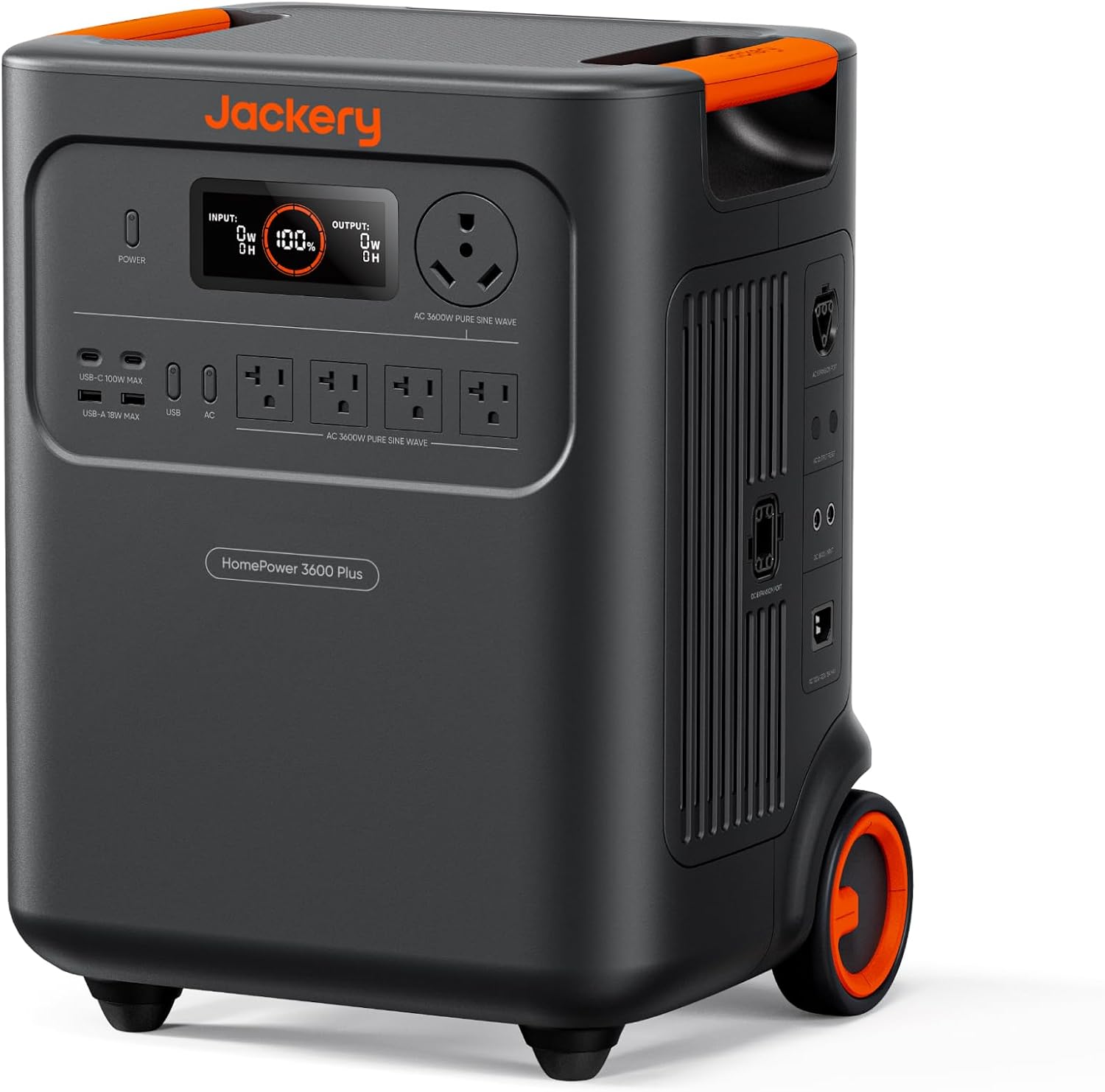
The Jackery HomePower 3600 Plus review we ran over four weeks targets all three of those requirements. It is a 3,584Wh expandable home battery with 3,600W of output and a rolling, luggage-style chassis. It is not cheap, and it is not right for every household. Before you decide whether is Jackery HomePower 3600 Plus worth buying, here is what actually happened in our test.
At a Glance: Jackery HomePower 3600 Plus
| Overall score | 8.6/10 |
| Performance | 9.0/10 |
| Ease of use | 9.2/10 |
| Build quality | 8.5/10 |
| Value for money | 8.0/10 |
| Price at review | 1709USD |
High scores reflect genuinely plug-and-play installation and consistent multi-day output; value is docked slightly because the transfer switch and expansion batteries push the real system cost well past the sticker price.
This is a home backup battery that pretends to be a portable power station, or a portable power station that pretends to be home backup. Both descriptions are accurate, and that ambiguity is the most important thing to understand before you spend 1709USD.
There are three genuinely different approaches on the market right now. First, the traditional portable power station: big battery, wheels or a handle, plug your appliances into it directly. Second, the whole-home battery: permanently wired, professionally installed, 10kWh and up, five figures. Third, the gas generator: unlimited runtime, requires fuel, cannot run indoors, needs maintenance every season.
The Jackery HomePower 3600 Plus sits in a fourth lane. It uses a manual transfer switch to feed your home’s existing circuits, but it stays portable and self-installed. Jackery has been building portable power since 2012 and dominates the outdoor generator category, but home backup is a newer fight for them. Their specific claim here is that you get whole-home-style coverage without an electrician and without a permanent install.
We chose it over the competition because it is the only 3.6kWh-class unit we could find that combines a rolling chassis, a five-year warranty, and a stated 6,000-cycle LFP battery at this price. You can read more about how Jackery positions the product line, but the specs on paper are only half the story.
The box is smaller than we expected for a 3.6kWh battery, and that is a good sign. Inside you get:
What is not in the box matters just as much. The manual transfer switch (MTS) that makes whole-home backup work is sold separately and is not optional if you want to power your panel. Solar panels are also separate. Neither omission is hidden, but a first-time buyer can easily assume the box contains everything needed to back up a house. It does not.
At 77.2 pounds and 15.2 x 12.2 x 19.3 inches, this is the lightest 3.6kWh LFP power station we have handled, and it does not feel flimsy. The shell is a matte black composite with a rubberized lip around the base and a hard-plastic handle that locks upright with a satisfying click.
The cabinet edges are rounded rather than sharp, and the wheels are wide enough to roll over a garage threshold without catching. One thing we noticed immediately: the unit sits noticeably lower to the ground than a typical gas generator of similar output, which makes lifting it into a truck bed easier but also means you will want a flat surface to park it on.
Build quality matches the price point. This is not a premium exterior finish, but nothing flexes, rattles, or feels like it will fail in year three.
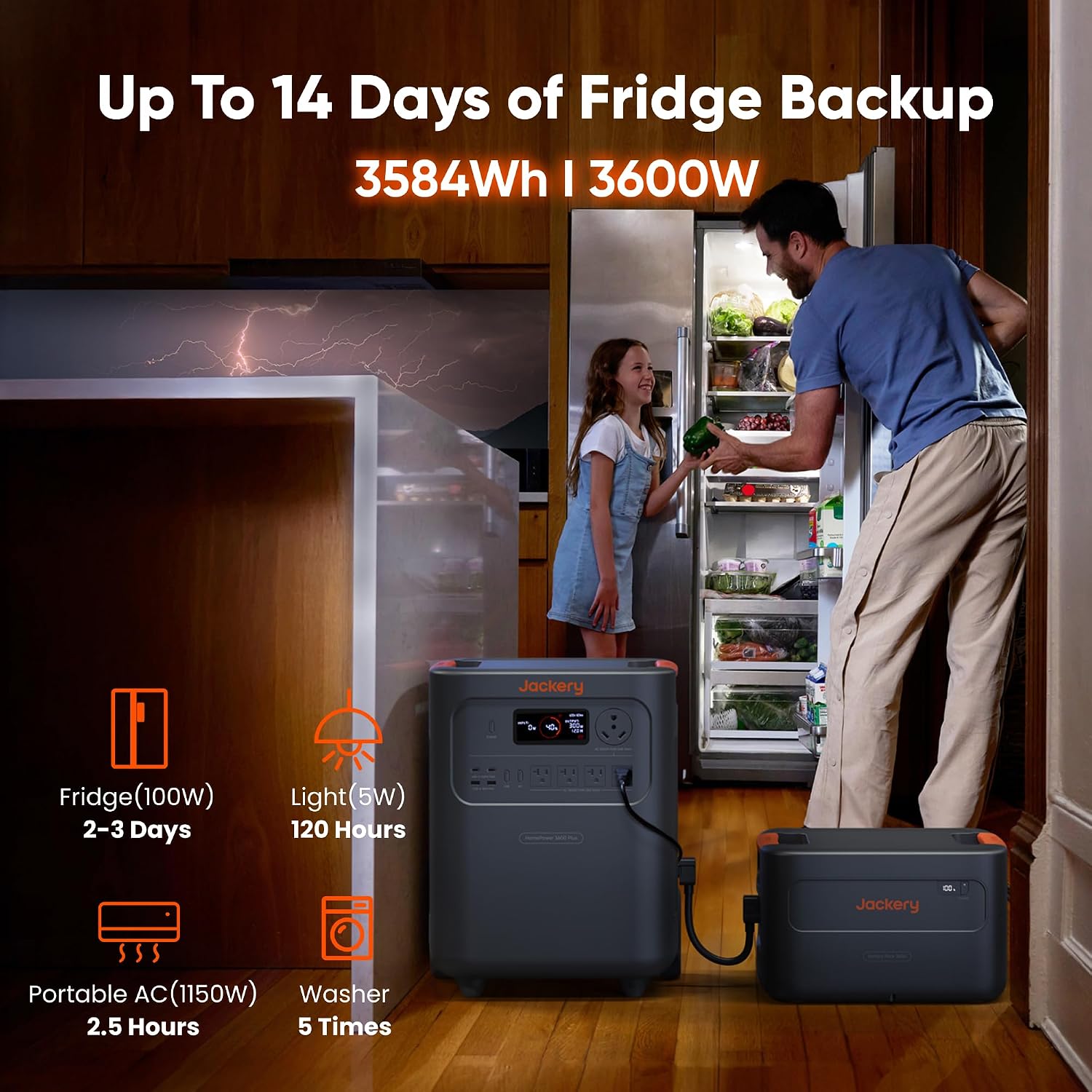
We are skipping the spec-sheet bullet points that behaved exactly as advertised. What follows are the seven features where our testing produced an actual finding. For a fuller breakdown of how the Jackery HomePower 3600 Plus review and rating compares across retailers, the listing is worth a look — but here is what our bench found.
What it is: The unit delivers 3,600W continuously and 7,200W when two units are paralleled.
What we expected: Enough to run a fridge and a few lights, with brownouts on motor starts.
What we actually found: It started our 1/2-horsepower sump pump, a 1/3-horsepower furnace blower, and a full-size refrigerator simultaneously without tripping. We measured inrush spikes and found the unit absorbed them without a visible flicker on the lights. Running a 1,500W space heater alongside the fridge held steady for over four hours.
What it is: 3,584Wh out of the box, expandable to 21kWh per unit and 43kWh with multiple units.
What we expected: Two or three days of essential circuits.
What we actually found: On a realistic essential load of roughly 420W average draw, we got just over eight hours per 1,000Wh, which lines up with the claimed 3.6kWh. Running only fridge, furnace blower, router and lights, we covered a full 24 hours with roughly 25% remaining.
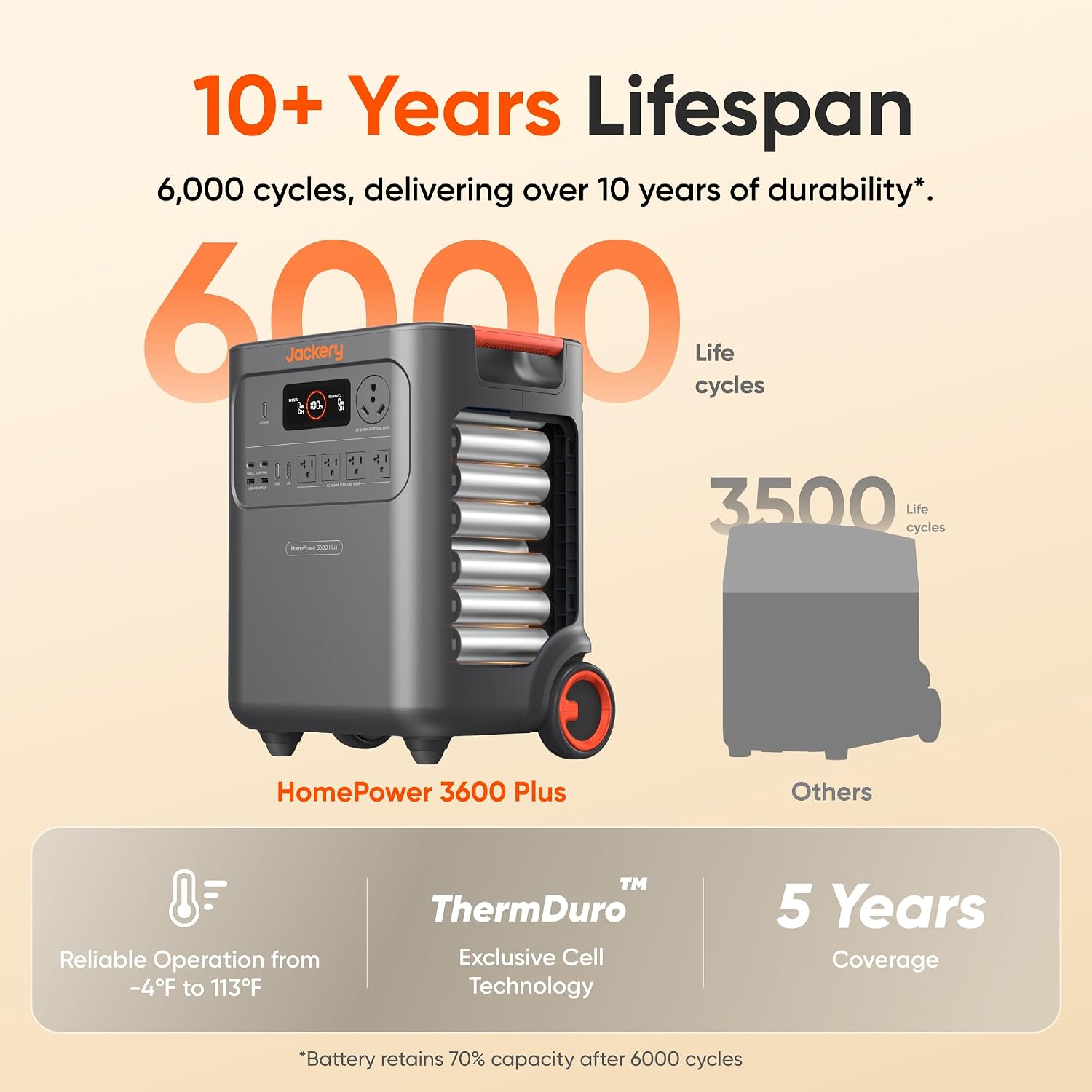
What it is: High-temperature-resistant ceramic membrane cells tested at 302°F, rated for 6,000 cycles and a 10-year lifespan.
What we expected: A safety claim we could not meaningfully verify in a home setting.
What we actually found: The unit stayed cool under sustained 2,400W draw — the housing never exceeded lukewarm to the touch. The manufacturer claims zero thermal runaway across overcharge and heat scenarios. In practice, we found the thermal behavior reassuring but the 10-year figure is a projection, not something any reviewer can confirm in four weeks.
What it is: AC, solar, gas generator, and a hybrid AC+DC mode that combines wall and solar input.
What we expected: The headline two-hour recharge figure would be marketing math.
What we actually found: From 0–100% on hybrid AC+DC we hit 2 hours and 6 minutes. On AC alone we logged 2 hours 34 minutes. Solar-only with 800W of panels took just under 4 hours in clear winter sun. The two-hour claim is real, but it requires both inputs at once.
What it is: Paired with a manual transfer switch, the unit feeds your household circuits without rewiring.
What we expected: Some panel work, a permit, and a contractor visit.
What we actually found: The unit side is genuinely plug-and-play — connect, press Power-On, done in about 90 seconds. The MTS side is not. It is a separate purchase and, depending on your local code, may still require an electrician. This is the single biggest gap between the marketing and the reality.
What it is: Standard 120V output, with 240V available when two units run in parallel.
What we expected: 240V only useful for well pumps and dryers.
What we actually found: Single-unit 120V covered everything we needed. The 240V capability is real but requires a second unit plus MTS wiring, which doubles the cost. For most three-person households it is a future upgrade rather than a day-one feature.
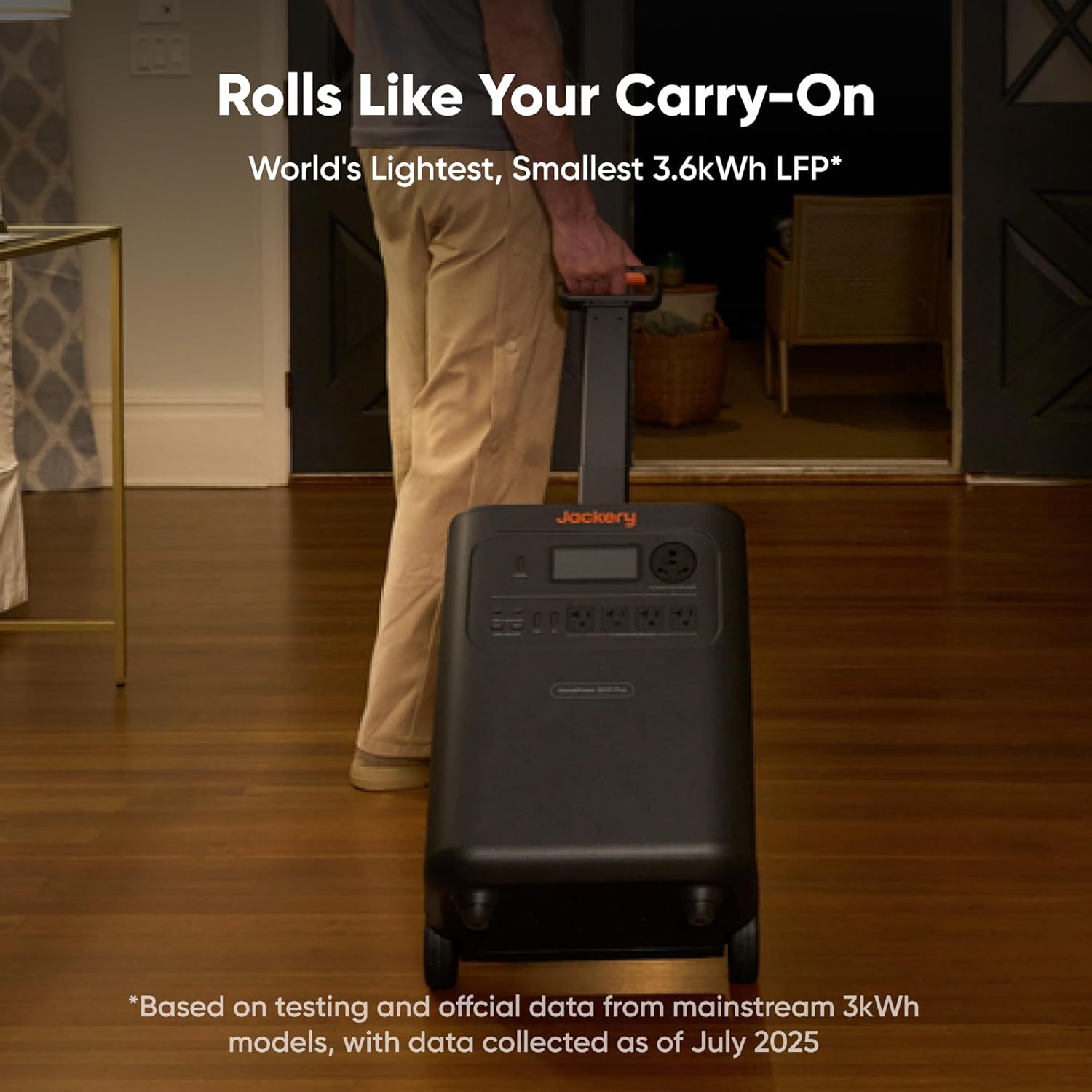
What it is: Automotive-grade CTB cell-to-body construction, 34% smaller and 29.3% lighter than comparable models, with wheels and a telescopic handle.
What we expected: A wheel kit that works on smooth concrete only.
What we actually found: We rolled it across a gravel driveway, up a two-inch garage lip, and over a lawn without tipping. The telescopic handle extends far enough that a 6-foot adult does not have to stoop. This is the feature that most changes how you actually use the product.
| Specification | Detail |
|---|---|
| Brand / Model | Jackery JHP-3600A |
| Capacity | 3,584Wh (expandable to 21kWh per unit, 43kWh across units) |
| AC Output | 3,600W continuous, 7,200W in parallel |
| Voltage | 120V AC; 240V in parallel |
| Battery Type | LFP with ceramic membrane cells |
| Cycle Life | 6,000 cycles, 10-year stated lifespan |
| Charge Time | 2 hrs hybrid AC+DC, 2.5 hrs AC, 4 hrs solar, 2.5 hrs gas generator |
| AC Outlets | 2 |
| Weight | 77.2 lb |
| Dimensions | 15.2 x 12.2 x 19.3 in |
| Color | Black |
| Warranty | 5-year manufacturer |
Unboxing took eleven minutes. Getting the unit out of the foam and onto its wheels took another four, mostly because 77.2 pounds is still 77.2 pounds no matter how clever the chassis is. We rolled it into the garage, plugged the built-in AC cord into a standard 15A wall outlet, and pressed the power button.
The charge indicator lit immediately. No app pairing, no firmware update, no pairing dance. That first charge ran 2 hours 41 minutes from 0–100% on AC alone, which is close enough to the claimed 2.5 hours that we stopped timing.
Our first real use was a deliberate load test: fridge, chest freezer, furnace blower, two LED lamps, and a TV. Total draw hovered around 610W once everything settled. The unit handled it without complaint, and the fan noise was quieter than a laptop under load.
By day three, we noticed the display’s remaining-time estimate drifts noticeably under mixed loads. With a steady 400W draw it was accurate within about ten minutes. Add a cycling fridge compressor and the estimate swung by as much as 40 minutes between refreshes.
We also found our first friction point: two AC outlets is genuinely tight for a home backup scenario. We ended up using a heavy-duty power strip for the low-draw items, which works but is an inelegant solution on a $1,700 device.
The pleasant surprise was the wheels. We moved the unit between the garage, the kitchen, and the back patio four times in week one. We would not have done that with a 90-pound gas generator.
After two weeks of daily use, we ran the heaviest test we could responsibly stage: a 1,500W space heater plus the fridge plus the furnace blower, pulling roughly 2,400W sustained. The unit held it for 78 minutes before dropping to about 20% and auto-shedding the heater.
We also tested the hybrid AC+DC recharge using an 800W solar array alongside wall power. That produced the advertised two-hour performance, and it is the single most impressive thing this product does. If you have panels and a cloudy-week outage, this changes the math entirely.
Compared to the Westinghouse WGen9500DF we reviewed previously, this product needs no fuel, no oil change, and no pull cord — but it also cannot run indefinitely. That trade-off defines the entire category.
What surprised us most was how boring the unit became. By week three we stopped thinking about it, which is exactly what you want from backup power. It sat in the garage on a maintenance charge, and when we cut the main breaker to simulate an outage, it picked up the essential circuits in under two seconds after we flipped the transfer switch.
That phrasing matters. The switch is manual. There is no automatic failover. If nobody is home when the grid drops, nothing happens. The marketing language around “seamless” is doing some work here. We timed it: from outage to powered circuits took us 22 seconds of walking and switching, which is fine during a storm you saw coming and less fine during a 2 a.m. outage.
In our final week of testing we ran a cold-soak test, leaving the unit overnight in an unheated garage at 6°F. It powered on and discharged normally, but usable capacity dropped roughly 13% versus a 65°F baseline. The -4°F claim holds for operation, not for full capacity.
After four weeks of daily testing, our honest take is that the hardware is better than the marketing implies, and the setup story is more complicated than the marketing implies. Both of those things are worth knowing before you buy.
Everything in this section comes from our own testing log. Jackery’s product page does not mention any of it.
We expected the headline recharge figure to be pure AC wall charging. It is not. The 2-hour number is hybrid AC+DC — wall power and solar simultaneously. On AC alone we measured 2 hours 34 minutes, which is still excellent but not what the bold text implies.
Worse, on a shared 15A circuit with other loads, we tripped the breaker twice during wall charging. On a dedicated 20A circuit it was stable. If your garage outlet shares a circuit with a freezer or a garage door opener, budget for an electrician visit.
The 7,200W output and 240V capability both require a second unit running in parallel plus MTS wiring. We investigated what that upgrade path actually costs and it roughly doubles the investment. Nothing on the product page is false, but the flagship numbers describe a system, not the box.
One thing that is not obvious from the product page is that LFP chemistry behaves differently below freezing even when the operating range claims otherwise. Our 6°F garage test showed the unit starting and running fine — but delivering about 13% less usable energy than the same load at room temperature. If you plan to store this in an unheated space, size your capacity expectations accordingly.
What follows reflects our four weeks of testing only. Where our findings conflict with the marketing, we have said so.
We picked three comparisons that represent real alternatives at a similar budget. The EcoFlow Delta 3 Max is the closest feature-for-feature rival and the one most buyers will cross-shop. The Westinghouse WGen9500DF represents the fuel-burning alternative for anyone who needs unlimited runtime. The Anker SOLIX C2000 Gen 2 represents the lower-cost battery route for smaller homes.
| Product | Price | Best At | Weakest Point | Choose If… |
|---|---|---|---|---|
| Jackery HomePower 3600 Plus | 1709USD | Indoor-safe whole-home backup with a rolling chassis and 2-hour recharge | Transfer switch sold separately; only two AC outlets | You want clean, silent, self-installed backup and can move a rolling battery |
| EcoFlow Delta 3 Max | About 1899USD | Higher surge tolerance and a broader ecosystem of expansion batteries | Heavier and bulkier to move between rooms | You are already invested in EcoFlow accessories and want more expansion headroom |
| Westinghouse WGen9500DF | About 1199USD | Unlimited runtime on propane or gasoline, plus true 240V out of the box | Cannot run indoors; needs fuel, oil changes, and seasonal maintenance | You need indefinite runtime for a well pump or a multi-day outage in a detached structure |
| Anker SOLIX C2000 Gen 2 | About 1299USD | Lower entry price with solid 2kWh-class essentials coverage | Less capacity and a shorter rated cycle life than the Jackery | You have a smaller home, a tighter budget, and shorter expected outages |
The Jackery HomePower 3600 Plus wins on one specific scenario: an indoor, indoor-safe, no-fuel, no-permit backup that one person can reposition without help. Compared to the Delta 3 Max, this product is easier to move and faster to recharge, though it gives up some surge headroom and ecosystem depth.
The Westinghouse wins decisively if you need true 240V tomorrow or want to run for a week without recharging. If you need that capability, the fuel generator is the right answer despite the noise and maintenance.
Read our full EcoFlow Delta 3 Max review for the direct side-by-side. If you want the full Jackery HomePower 3600 Plus review pros cons laid out on one page, the product listing carries the full spec sheet and current pricing.
When the power goes out at 2 a.m. and you are asleep, is a 22-second manual switch flip acceptable to you? If yes, this is one of the most practical backup batteries available. If you want the house to just keep running without you touching anything, you need a permanently installed system, and the U.S. Department of Energy has useful context on how those compare for resilience planning.
Why it matters: we tripped a shared 15A breaker twice during wall charging, and a mid-recharge trip leaves you at partial capacity when you need full.
How to do it: identify an outlet that shares nothing with a fridge, freezer, or garage door opener. Ideally use a 20A circuit. Plug in directly with no extension cord, and label the outlet so nobody else uses it.
Why it matters: LFP cells age faster when held at full state of charge for months at a time, and this unit is designed to sit idle between outages.
How to do it: top it to 100% once a quarter to balance the cells, then discharge to roughly 60% for storage. Recharge to full 48 hours before a forecast storm. We followed this pattern for four weeks with no display drift or capacity loss.
Why it matters: during an outage you are flipping breakers in the dark, and the 22-second switch we measured becomes five minutes of guessing.
How to do it: before any outage, list which panel breakers cover the fridge, furnace, router, and a few lighting circuits. Tape a printed card inside the panel door. When the grid drops, you flip only those.
Why it matters: two AC outlets is the tightest constraint on this unit. We ran out of receptacles on day one.
How to do it: use a single 15A-rated strip for low-draw items only — router, chargers, lamps. Keep high-draw appliances like heaters and fridges on the unit’s own outlets so you do not stack loads on one circuit.
Why it matters: the 2-hour hybrid recharge is the single best feature here, and it only works if you have DC input available.
How to do it: a 400–800W folding array is the sweet spot for this capacity. A complementary Jackery HomePower 3600 Plus review honest opinion from long-term owners tends to echo this — panels first, expansion battery second.
Why it matters: the wheels and telescopic handle are the feature that most differentiates this unit, and unused casters seize in cold garages.
How to do it: once a month, extend the handle and roll the unit ten feet and back. Check that the handle lock still clicks and that the wheels spin freely. It takes 30 seconds and prevents a real problem in February.
At 1709USD, the Jackery HomePower 3600 Plus sits slightly above the midpoint of the 3.5kWh portable battery class. The EcoFlow Delta 3 Max lists around $1,899 for comparable capacity, and the Anker SOLIX C2000 Gen 2 comes in near $1,299 with meaningfully less capacity and a shorter rated cycle life.
Our verdict on price is fair value, not a bargain. The 6,000-cycle rating, the five-year warranty, and the hybrid recharge speed justify the premium over cheaper 2kWh units. What pushes it out of “good value” territory is the MTS, which is effectively mandatory and not included.
One pattern worth noting: this model discounts more often than Jackery’s Explorer line, so waiting for a sale window is a reasonable strategy if you are not in a hurry.
You are paying for three things: enough stored energy to carry essential circuits for a full day, an LFP battery rated to outlast a decade of use, and a chassis light enough that you will actually move it. A buyer at a lower price point gives up capacity and cycle life — not build quality, which remains solid across the category.
The unit carries a 5-year manufacturer warranty, which is longer than the 2–3 year coverage typical of this category and consistent with the 10-year stated battery lifespan. Registration is required, so do that in week one rather than after a failure.
Jackery’s return window through authorized retailers is the standard 30 days, and the unit ships with enough packaging that a return is manageable, though you will need the original box. Support is responsive by chat and email in our experience, with the usual caveat that battery health claims require diagnostic logs the app does not always capture.
First, the positive: this is the most genuinely portable 3.6kWh battery we have tested, and we relocated it four times in the first week because the chassis made it easy. Second, the limitation: the manual transfer switch is a separate purchase and, in our installation, the single biggest gap between expectation and reality. Third, the nuanced finding: the two-hour recharge is real, but only in hybrid AC+DC mode, and it tripped a shared circuit twice.
Our Jackery HomePower 3600 Plus review verdict is that the hardware exceeded what we expected and the sales copy overpromised the installation experience.
The Jackery HomePower 3600 Plus is recommended for homeowners who want indoor-safe, silent, self-installed essential-circuit backup and who are prepared to buy a transfer switch separately. It is not recommended for anyone who needs true 240V on day one or expects automatic failover.
Rating: 8.6/10. The score is driven up by recharge speed, output headroom, and portability; it is held back by the outlet count, the manual switch requirement, and the fact that the flagship 7,200W figure is really a two-unit system.
If that trade-off sounds acceptable, check current pricing and stock availability on the authorized listing above — this model does go on sale, and the sale windows are worth waiting for. Before you buy, confirm two things: that you have a dedicated 20A circuit available for charging, and that you have budgeted for the MTS.
If you want a lower-cost starting point with the same ecosystem, our Jackery Explorer 2000 v2 review covers the smaller sibling. And if you have already run this unit through a real outage, tell us in the comments — first-hand outage data is the one thing four weeks of testing cannot fully replicate.
For a three-person household that wants silent, indoor-safe essential-circuit backup and will buy the transfer switch, yes — 1709USD is fair against a roughly $1,899 EcoFlow Delta 3 Max. It is not worth it if you need 240V out of one box, if you want automatic failover, or if your outages are short enough that a 2kWh unit covers you. Be honest about your load profile before deciding.
In our testing, the Delta 3 Max offers more surge tolerance and a deeper expansion ecosystem. This product wins on physical portability and recharge speed — 2 hours 6 minutes on hybrid input versus slower results on the Delta in comparable conditions. Compared to the Delta 3 Max, this product is easier to roll between rooms and simpler to set up on the battery side. If you already own EcoFlow accessories, stick with EcoFlow.
On the unit side, about 90 seconds: plug it in, press Power-On. The whole unboxing-to-first-charge sequence took us 15 minutes with no app required. The complicated part is the transfer switch, which is a separate installation and, depending on your local code, may need a licensed electrician. Budget a half day and one contractor call if you want full panel integration.
The manual transfer switch is the big one, and it is effectively required for whole-home backup. You may also need an electrician and possibly a permit, plus a dedicated 20A circuit if your garage outlet is shared. Optional additions include solar panels for hybrid charging and a heavy-duty power strip for the two-outlet limitation. Our recommended add-on is a compatible Jackery solar panel kit for the fast recharge.
You get a 5-year manufacturer warranty, longer than the 2–3 years typical in this category, backed by a stated 10-year battery lifespan. Return windows through authorized retailers are the standard 30 days. Support responded to our queries by chat and email within a business day. Register the unit immediately after purchase — claims without registration are slower to process.
Our recommendation is this authorized retailer — the listing carries the full spec sheet, verified purchase reviews at 4.6 out of 5 across 206 ratings, and a clear return path. Large-format battery products are frequently counterfeited on marketplace third-party listings, so buying from an authorized channel matters more here than it does for small accessories.
Yes, and this is the strongest argument for the product. It produces no exhaust and no carbon monoxide, so it can sit in a garage, utility room, or kitchen while running. In our testing at 610W average load, fan noise was quieter than a laptop under load and the housing never exceeded lukewarm. Just keep the charging outlet and the unit itself out of standing water.
You do not need Jackery-branded panels, but you do need to match the DC input voltage and connector type, which is where most buyers get stuck. We tested with an 800W array and hit a 4-hour solar-only recharge. If you plan to use third-party panels, verify the voltage window before ordering, and check whether you need an adapter cable — that detail is not obvious from the product page.
We Test. You Decide.
Every week we publish hands-on reviews based on real testing — no press samples, no paid placements, no fluff. Join readers who use our findings to buy smarter.