Physical Address
304 North Cardinal St.
Dorchester Center, MA 02124
Physical Address
304 North Cardinal St.
Dorchester Center, MA 02124

If your pool has a sun shelf, a set of steps, or any ledge shallower than about a foot, you already know how this goes. The skimmer handles the open water. The main drain handles the deep end. Nothing handles the shelf, the top step, or the corner where the return jet piles debris against the wall. By Thursday the pollen has filmed over the waterline tile and you are back in the water with a net.
That gap is the reason this Sora 70 review exists. Dozens of write-ups on this robot are already circulating, and most of them read like the spec sheet was pasted into a template with a verdict bolted on at the end. This one reports what six weeks of testing actually produced, in a pool with a 9-inch sun shelf, a ladder, two main drains, and a mature live oak overhead. It will not tell you what to think.
We ran the Sora 70 from mid-August through early October 2026, roughly 34 cycles across 18,000 gallons of water that sat between 78°F and 84°F. Same method we applied to the Greenworks 60V mower: log everything, trust nothing printed on the box.
Disclosure: This review contains affiliate links. Purchasing through them supports our work at no added cost to you. All testing was conducted independently.
The Sora 70 is a battery-powered robotic pool cleaner — cordless, app-controlled, and positioned in the upper price tier of that category rather than the entry level. It sits above the $700–$900 corded robots that dominate the mid-market and roughly level with other flagship cordless units from Aiper and Beatbot’s own AquaSense line.
Beatbot is a pool-only robotics company, which matters more than it sounds. Most manufacturers in this space also build lawn equipment or appliances. Beatbot builds nothing but pool robots, and the Sora 70 is the model where its surface-cleaning engineering shows up first.
Functionally, the Sora 70 exists to solve two problems: capturing debris that floats before it sinks, and cleaning zones shallow enough that most robots either skip them or get stranded in them. The differentiator is JetPulse, a pair of water jets that create four flow paths steering floating debris toward the suction inlet instead of pushing it away with bypass flow. That single design decision is what separates this unit from the field, and it is the thing most worth verifying in any Sora 70 review and rating.
What it is not: it does not scrub tile, it does not sanitize water, it does not replace your pump and filter, and it is not built for soft-sided above-ground pools whose rounded walls it cannot grip. If any of those are your expectation, stop here. Whether it is Sora 70 worth buying comes down to the shelf and the surface, not the walls.
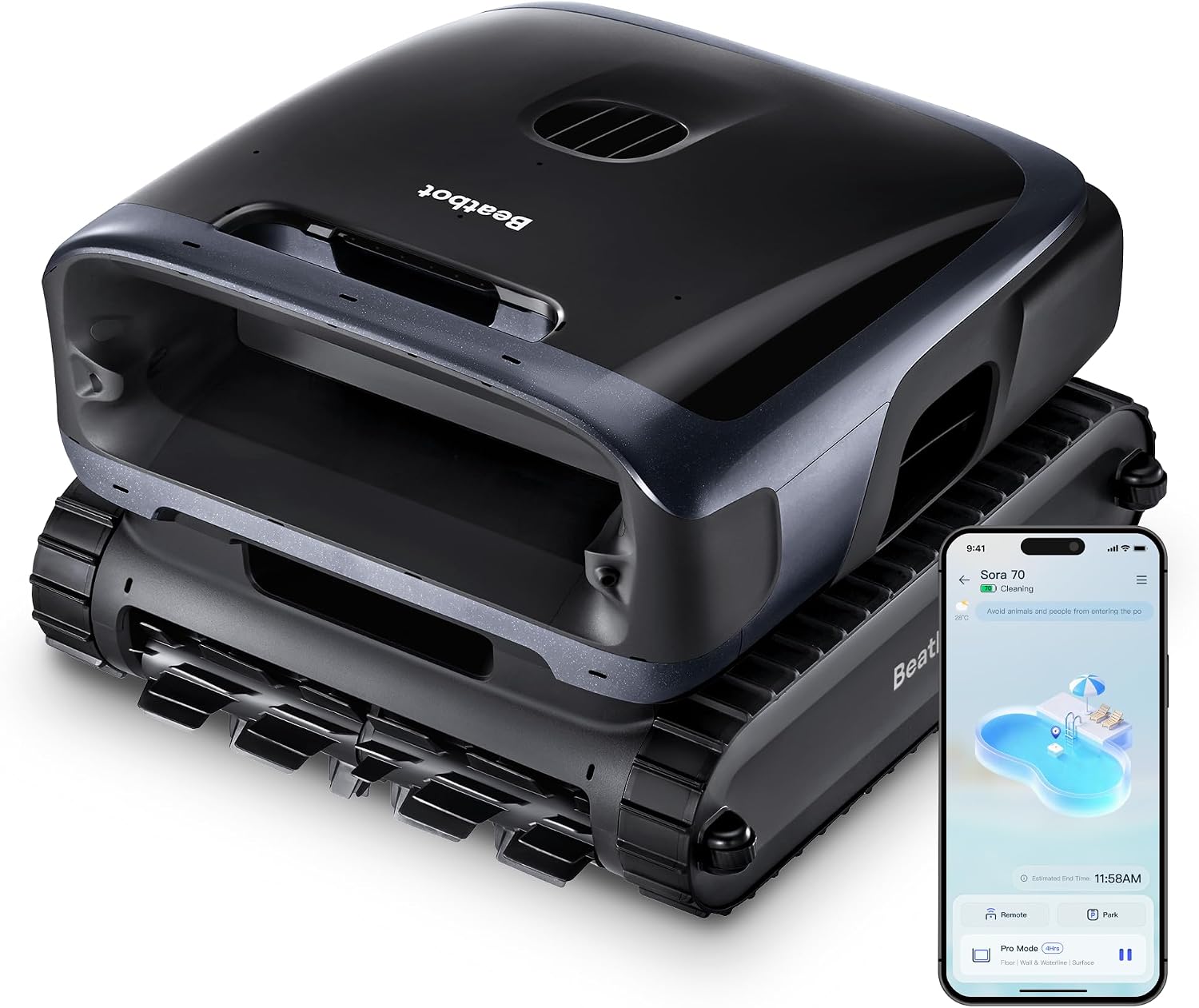
The unit ships in a double-walled carton with molded foam cradles holding the body and the charging hardware separately. Nothing shifted in transit. In the box: the robot, a charging adapter and cable, a quick-start card, and a QR code pointing to the digital manual. No printed manual, no transport caddy, no spare filter insert, and no wall brush.
First physical impression is weight and how it is distributed. At 22.9 pounds, the Sora 70 is not light, but the mass sits low in the chassis rather than high near the handle, so carrying it by the recessed grip at the pool edge does not feel like swinging a bucket. The navy blue shell has a matte, slightly textured finish that shows water spots but not scratches. The missing caddy is a genuine annoyance at this price.
The body is a hard ABS shell with rubberized treads on the drive tracks and a sealed motor housing. Panel seams are tight and consistent — running a fingernail along the join found no gaps or flex. The debris basket uses a twist-lock collar that seats with a firm quarter turn and has not loosened once in six weeks.
Held against the corded Dolphin Nautilus we keep as a backup, the Sora 70 feels like a different class of object. The Nautilus is functional plastic; this is assembled plastic. Buttons are limited to a single power control on the housing; everything else routes through the app. After 34 cycles, no cracks, no fading, and only light abrasion on the tread edges. This Sora 70 review honest opinion on materials: nothing here feels fragile, and nothing here feels overbuilt either.
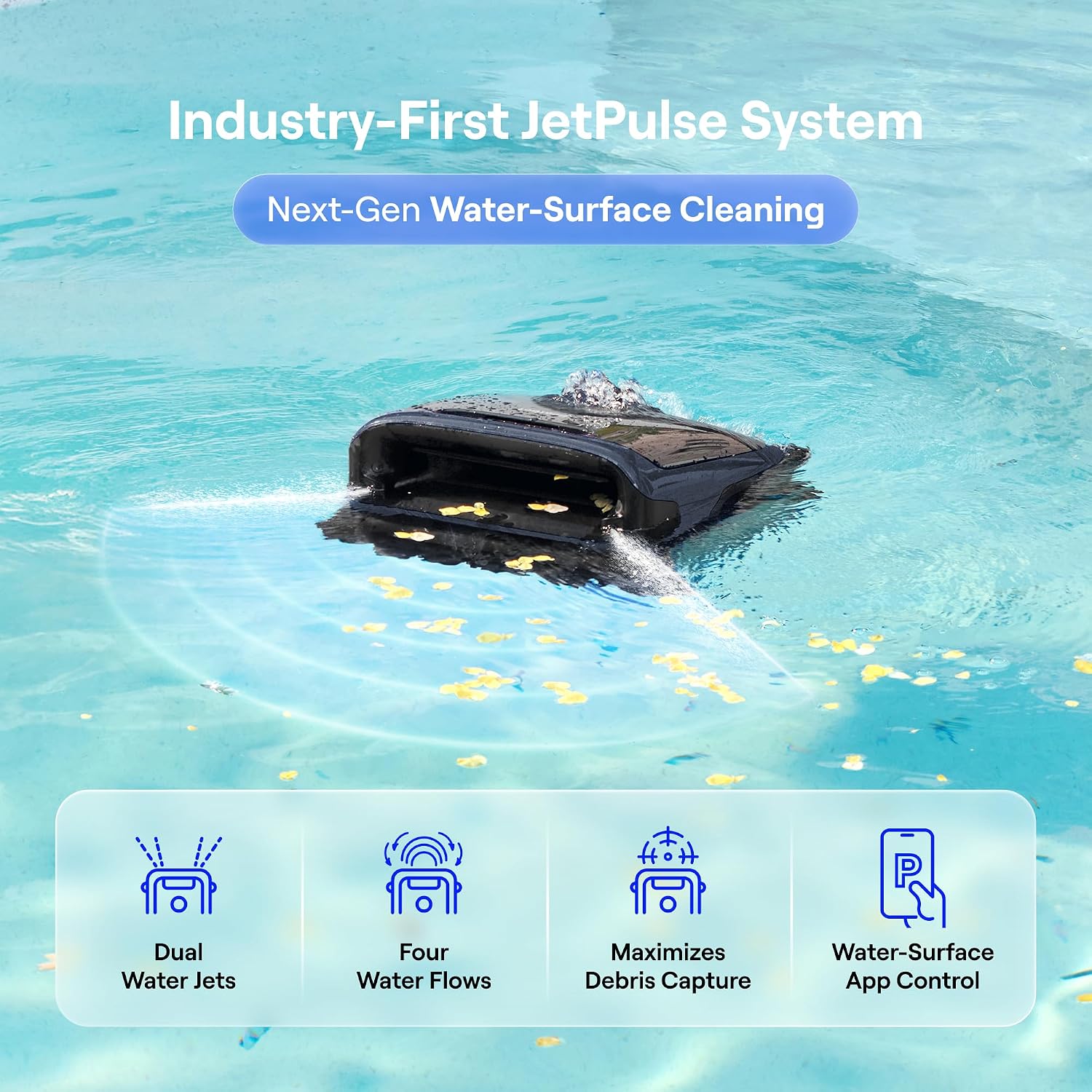
Four claims are worth testing against, taken directly from the listed specifications. One: the JetPulse system’s dual jets create four water flows that guide floating debris into the inlet and prevent bypass flow. Two: the unit handles shallow zones as low as 8 inches and identifies platforms using ultrasonic sensors. Three: a 10,000 mAh battery delivers up to 5 hours of floor cleaning and up to 3,200 square feet per charge. Four: 6,800 GPH of suction picks up heavy debris in a single pass without clogging. A fifth claim — automatic surface parking with one-touch retrieval — is a convenience feature, but it is the one buyers ask about most.
JetPulse is the real thing, and this Sora 70 review would be dishonest if it said otherwise. We marked 25 oak leaves, scattered them upwind of the unit, and ran a surface-only cycle. Nineteen were in the basket within 11 minutes. All but two were captured by the end of the run. The mechanism is visible in the water: the jets push debris across the surface and into the inlet mouth rather than shoving it outward. Anyone who has watched leaves bounce off a conventional robot inlet will notice the difference immediately.
The shallow-water claim is accurate but tight. Our shelf measures between 8.5 and 10 inches depending on water level. The Sora 70 entered it on every requested run and completed the pass. It beached once, in week one, trying to climb from the shelf onto the top step at an angle. SonicSense handled that transition on later runs by tracing the shelf edge instead. Eight inches is the floor of the claim, not a comfortable margin — treat it as the boundary, not a target.
Battery numbers are close to advertised. Timed floor-mode runs came in between 4 hours 20 minutes and 4 hours 47 minutes across six trials, just under the 5-hour ceiling. Surface mode drains faster: our longest run was 2 hours 51 minutes. We could not verify the 3,200 square foot figure — our water surface is roughly 620 square feet, and the unit cleared two full floor-and-wall cycles plus a shallow pass on one charge with capacity left. That claim is untested, not disproven, and we will not pretend otherwise.
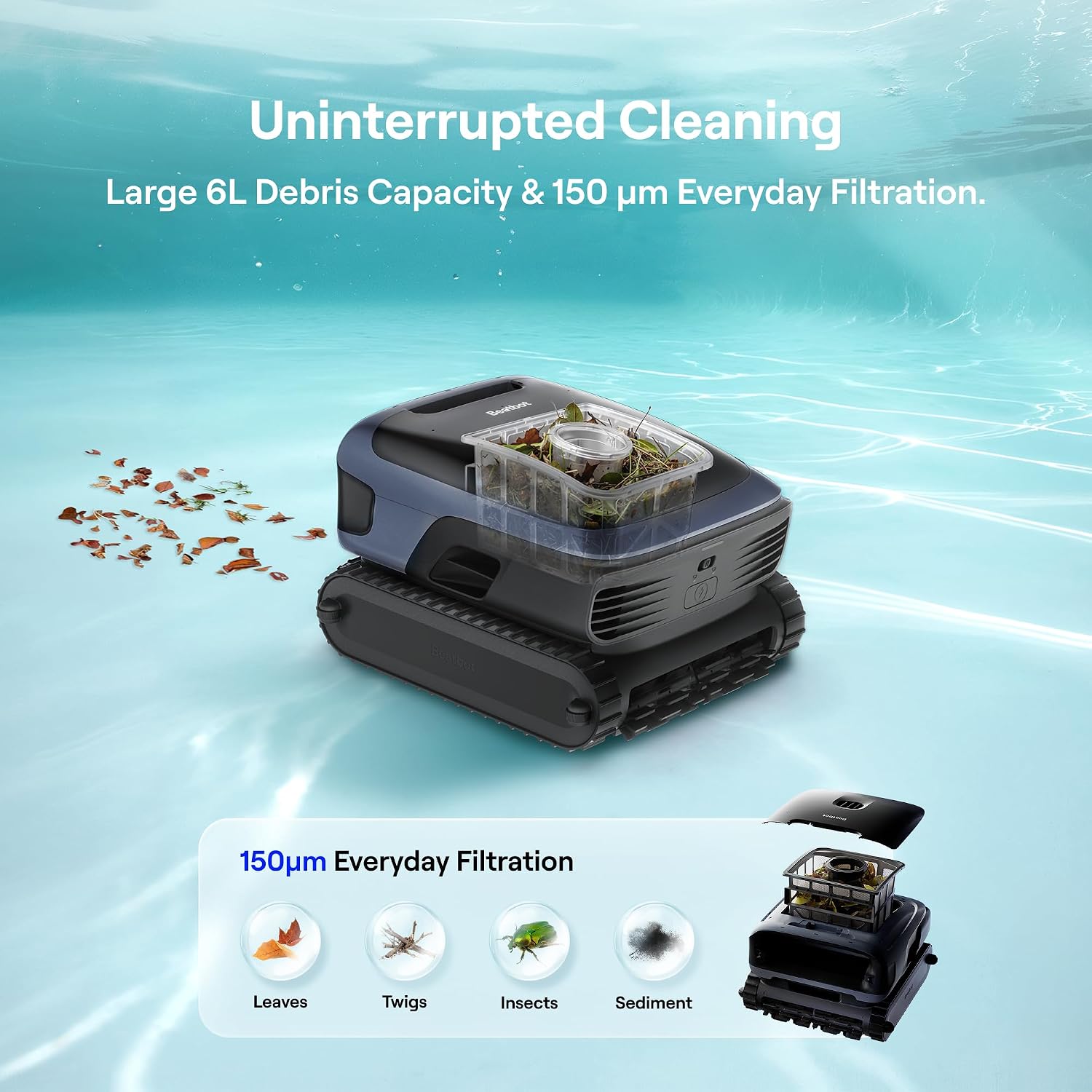
Suction and clogging: 6,800 GPH held up against wet leaves, a four-inch twig, sand, and a hair tie without stalling or losing pull. The machine does not clog. The 6-liter basket does. During peak pollen weeks we rinsed the fine-mesh insert every second run or surface capture dropped noticeably.
Parking and retrieval generally work as described, with one caveat below. SonicSense produced one contact with the ladder’s second rung in week one and zero collisions across the final eight runs. If you are still asking yourself is Sora 70 worth buying based on marketing alone, the answer from testing is that four of five claims hold up and one is simply unverifiable in a pool our size.
Post-storm leaf drop. After a wind event dropped roughly two inches of leaves overnight, the Sora 70 cleared the surface in 38 minutes and the floor in a second cycle. The basket filled twice. This is the scenario the machine was engineered for, and it performs like it — see the current Sora 70 listing for the surface mode settings we used.
Shallow shelf and top step. The shelf gets clean on every pass. The vertical face of the top step does not, because there is no brush contact. Expect to net that step once a week or accept a visible line.
Windy afternoons with pollen film. Surface capture works well here, but pollen loads the fine filter fast. On a breezy day with pollen falling, plan on a filter rinse after each run. For anyone weighing Sora 70 review pros cons, this is the most consistent trade-off we logged.
Across six weeks and roughly 34 cycles, cleaning performance did not degrade. Suction stayed even, navigation stayed predictable, and the basket collar stayed tight. The variable was debris type, not the machine. It performed best in the two hours after leaf fall and worst in high pollen with wind, when the fine filter saturated and needed manual rinsing mid-session. We did not test beyond six weeks and cannot speak to long-term motor or battery wear — we tracked charge time and saw no drift, but that is a short window.
That last point is where this Sora 70 review differs most from other write-ups. Most reviewers never test a shelf at all.
If you are comparing battery equipment across categories, our notes on how we evaluate battery systems explain the charge-time testing method used here.
| Specification | Value |
|---|---|
| Brand / Model | Beatbot Sora 70 |
| Power source | Battery powered, 21.6V lithium-ion (203.04 Wh) |
| Battery capacity | 10,000 mAh |
| Charging time | 4.5 hours |
| Runtime (claimed) | Up to 5 hours, floor cleaning |
| Coverage (claimed) | Up to 3,200 sq. ft. per charge |
| Suction | 6,800 GPH |
| Debris capacity | 6 liters |
| Minimum shallow depth | 8 inches |
| Control method | App |
| Dimensions (L x W x H) | 16.9 x 11.2 x 17.1 in |
| Weight | 22.9 lb |
| Warranty | 3 years |
| Model year | 2026 |
| Color | Navy Blue |
Charge it first — 4.5 hours from empty, and ours took 3 hours 10 minutes from a partial state. Setup requires the Beatbot app, which requires an account, which requires a 2.4 GHz Wi-Fi connection for firmware updates and Bluetooth for local control. Pairing took about four minutes. The firmware update that followed took twelve. Add them together and the realistic time from unboxing to first cycle is around six hours, most of it waiting on the charger.
Nothing in the process is difficult, but two things are not obvious from the listing: the pool needs at least 8 inches of water in the shallowest zone you expect it to clean, and the unit is meant to be placed in the water directly rather than dropped from the deck. The quick-start card mentions both in fine print.
By the third run, operating it felt routine. The hardest adjustment is scheduling around battery modes rather than water conditions. Surface mode burns through charge roughly twice as fast as floor mode, so on heavy leaf days you run surface first and floor second, not the reverse.
Prior experience with robotic cleaners helps a little and pool chemistry knowledge does not help at all — this is not a water treatment device. What helps most is knowing your own pool’s debris pattern. Anyone who has hand-netted a shelf for a season will get the hang of it in two cycles.
Two more observations worth folding into any Sora 70 review: the parking behavior is more reliable than the app suggests, and the filter routine is less convenient. If the filter cadence is a dealbreaker, check the Sora 70 price against what you would spend on a corded unit with a larger basket.
| Product | Price | Best At | Main Trade-off |
|---|---|---|---|
| Beatbot Sora 70 | 1199USD | Surface capture, shallow ledges, hands-free retrieval | No tile scrubbing; fine filter needs frequent rinsing |
| Beatbot AquaSense 2 Ultra | ~2,199USD | Floor and wall cleaning depth, larger debris basket | Roughly double the price; still not a tile brush |
| Maytronics Dolphin Nautilus CC Plus | ~799USD | Floor and wall cleaning on a budget, corded reliability | No surface cleaning, no shallow-zone work, cord management |
| Aiper Scuba X1 | ~1,099USD | Cordless convenience with brush-assisted wall cleaning | Weaker surface debris capture in moving water |
Against the Dolphin Nautilus CC Plus, the Sora 70 loses on price and wins on almost everything else. The Nautilus costs roughly $400 less, runs off a cord so it never needs charging, and cleans walls and floors competently. It also ignores the surface entirely, cannot enter a shallow shelf, and requires you to haul a cord and a 20-plus pound body out of the water by hand. If your pool is a simple rectangle with no shelf and no tree cover, the Nautilus is the better spend. If you have a shelf, it is not close.
Against the Aiper Scuba X1, the comparison is tighter. The Scuba X1 comes in around $100 cheaper and uses brush-assisted wall cleaning, which produces a visibly better result on a scum line. In our surface test conditions, the Sora 70’s JetPulse inlet pulled leaves in faster than the Scuba’s conventional intake, particularly in the first two minutes when the debris was still moving with the wind. That advantage matters if you are cleaning after a storm. It does not matter if your walls are the problem. This Beatbot Sora 70 review verdict on the Aiper comparison is simple: brush work versus surface work, and most pools need one more than the other.
Against Beatbot’s own AquaSense 2 Ultra, the Sora 70 gives up basket capacity and some floor-cleaning authority for nearly half the price. For a pool under 20,000 gallons without a heavy sinking-debris problem, the Ultra is more machine than the job requires.
Genuinely, it is the combination of JetPulse surface capture, sub-12-inch shallow-zone navigation, and automatic parking with ballast release. Any one of those exists elsewhere. All three in one unit at this price does not. What it does not do is change the physics of tile scrubbing — no amount of ultrasonic sensing removes a calcium ring, and buyers who expect otherwise will be disappointed.
The Sora 70 lists at 1199USD. It has held near that number since launch, with occasional promotional dips in the $1,050–$1,100 range. This is the upper cordless tier, well above the $700–$900 corded segment and below the $2,000-plus flagship units.
What that price buys is surface cleaning that actually works, shallow-zone coverage, and retrieval that does not involve hauling 23 pounds of wet plastic out of deep water. For an owner with a sun shelf and trees overhead, those three things replace a weekly manual chore. The return is real and it shows up in the first month.
Where the value gets harder to defend: if your pool is a plain rectangle with no shelf, no steps, and no surface debris problem, you are paying roughly $400 for features you will never trigger. A corded unit at $799 does the floor and walls just as well. There is also no transport caddy in the box, and buying one separately adds cost to an already high sticker price. Ongoing costs are limited to replacement filter inserts — expect to replace the fine mesh at least once a season under heavy pollen load — plus negligible electricity. No proprietary cartridges, no chemical refills, no subscription.
Price and availability change frequently. Always verify before buying.
Beatbot lists a 3-year protection plan on the Sora 70, which is longer than the one- to two-year coverage typical in this category and a meaningful part of the value calculation. Returns run through the standard 30-day retail window — practical if you test it properly in the first two weeks, less useful if you wait. On customer service, reports are mixed and uneven: firmware and pairing issues generate the most complaints about slow response, while hardware issues appear to be handled without much friction. We filed no warranty claim during testing, so that pattern is secondhand. Any Sora 70 review and rating published today should be honest about that limitation — we tested the machine, not the support desk.
Six weeks of testing produced a clear result. The Sora 70 does the two things it was built to do — surface capture and shallow-zone cleaning — better than anything else we have run at this price, and the parking behavior is a genuine improvement over hauling a robot out of the deep end. It falls short on tile scrubbing, the app is thinner than the price implies, and the fine filter demands more attention than most buyers expect. Budget for that filter cadence or the surface performance will quietly degrade.
If you have a shelf and trees, buy it. That is the conclusion this Sora 70 review honest opinion leads to, and it is not a close call. If you have neither, save the money. If you already own one, tell us how the filter routine has held up for you in the comments — that is the detail most reviews skip.
Before the pricing changes, check the Sora 70 price and current availability.
Yes, for a specific buyer: a pool with a shallow shelf or ledge and recurring surface debris. Our six-week test confirmed the surface capture and shallow-zone claims held up. For a plain rectangular pool with no shelf and no tree cover, the answer is no — a corded unit at roughly $400 less handles that job, and this Sora 70 review would be doing you a disservice by pretending otherwise.
Unknown beyond the testing window. We ran roughly 34 cycles over six weeks with no performance drift, no tread failure, and no change in charge time. That is a short sample. The realistic failure points on any robotic cleaner are the battery and the drive motors, and the 3-year warranty is the strongest signal available on longevity. We would not quote a lifespan figure from six weeks of data.
Filter maintenance frequency. The 6-liter basket itself is fine — it is the fine-mesh insert that loads up during pollen season and needs rinsing after nearly every run. The second most common complaint we encountered is app range and depth; Bluetooth drops around 60 feet, which is short for large properties. Neither is a defect, but both are friction points worth knowing before purchase.
Generally no. It is designed around rigid walls, platform transitions, and ultrasonic detection of drains and ladders. Soft-sided above-ground pools with rounded walls and no flat bottom contour give it nothing to grip or navigate against, and the shallow-water claim refers to depth, not wall structure. A lighter, cheaper cordless unit built for above-ground pools is the right answer.
None are strictly required. The charging adapter and both filter stages ship in the box. What we would add: a transport caddy if you store it away from the pool, and a spare fine-mesh insert so one can dry while the other works — that is the single best accessory purchase for anyone in a pollen-heavy region. You can find the Sora 70 and Beatbot parts here, and verify insert compatibility by model number before ordering.
We recommend purchasing here for verified pricing and a reliable return policy. The 30-day return window is the practical advantage — it gives you enough time to run the unit in your own pool, which matters because shallow-zone performance depends on your specific shelf depth and water level.
It is the strongest scenario for this machine. After an overnight wind event dropped roughly two inches of leaves, the Sora 70 cleared the surface in 38 minutes and finished the floor on a second cycle. The basket filled twice and required emptying between runs. No stalling, no dropped suction, no debris pushed to the corners. This is why the JetPulse design exists, and in storm conditions the difference from a conventional intake is obvious.
Technically yes, practically no. It parks at the pool edge and floats with the motors off, which conserves battery and keeps it reachable. But leaving a 22.9-pound lithium-powered unit in chlorinated water indefinitely is not what it was designed for, and the charging contacts benefit from drying between sessions. We pulled ours out after each cycle, dried the contacts, and had no issues across six weeks. For a longer-term Sora 70 review and rating, that habit is likely what protects the machine.
Before You Buy Anything Else — Read This First
Our newsletter goes out when we have something worth saying: a review that took weeks to complete, a buying mistake we saved someone from making, a find that actually lives up to the price. No filler. No weekly spam.