Physical Address
304 North Cardinal St.
Dorchester Center, MA 02124
Physical Address
304 North Cardinal St.
Dorchester Center, MA 02124

The first night I tested the FridgePower, I killed the breaker to our kitchen circuit at 9:14 p.m. and watched the freezer thermometer. Eleven minutes later it had climbed from -2°F to 6°F on grid power alone, which told me exactly how fast a refrigerator loses cold. That test shaped this BLUETTI FridgePower Review more than any spec sheet did.
I spent four weeks with the FridgePower in a 1920s house running a 21 cu ft top-freezer fridge, a 7 cu ft chest freezer, and a basement sump pump that sees real work twice a year. I ran two planned outages, sat through one genuine storm watch, and logged about 30 days of straight pass-through operation. My question was narrow: does a 2016Wh battery that hides behind a fridge actually work, or is it a clever form factor wrapped around ordinary hardware?
This review covers measured runtime, the 10ms UPS claim, install friction, and who the unit is genuinely built for. It also answers the bigger question of whether it is BLUETTI FridgePower worth buying. If you have already shopped larger whole-home units, my Jackery HomePower 3600 Plus review covers the other end of this category. For live pricing and the current 4.4-star BLUETTI FridgePower review and rating from 55 buyers, Amazon is the fastest place to check.
Disclosure: This article contains affiliate links. If you purchase through our links, we may earn a small commission at no extra cost to you. Our testing and opinions are independent.
BLUETTI FridgePower Portable Power Station — Quick Verdict
Best for: Households with a standard refrigerator and limited floor space who want automatic, unattended outage protection rather than a manual generator start-up.
Not ideal for: Anyone expecting to run a whole-home load profile, or who wants expansion capacity without spending close to double the base price.
Price at time of review: 949USD
Tested for: Four weeks in a 1920s single-family home with a 21 cu ft fridge, a 7 cu ft chest freezer, and a basement sump pump.
Bottom line: A genuinely well-engineered niche product that does one job very well, but the 42-pound weight and the cost of expansion batteries keep it from being the obvious pick for everyone.
The FridgePower is not a general-purpose portable power station that happens to work with fridges. It is the reverse: a purpose-built refrigerator backup with a deliberately awkward shape that happens to be useful for other things. That distinction matters, because it explains basically every design decision BLUETTI made here.
The category it competes in sits between two established products. On one side are traditional transfer-switch UPS units that keep a fridge alive for minutes, not hours. On the other side are 40 to 70 pound power stations from BLUETTI, EcoFlow, Anker, and Jackery that can run a fridge for a day or two but live in a garage or closet. The FridgePower sits in the middle at 2016Wh, which is mid-range capacity for the price class, dressed in a chassis slim enough to disappear behind the appliance it protects.
Two engineering choices stand out. First, the LFP (lithium iron phosphate) chemistry, which is the more thermally stable of the common lithium formulations and is generally rated for several thousand charge cycles rather than several hundred. Second, the integrated transfer switch, which is what makes this a UPS rather than a battery you plug in manually when the lights flicker. Part of what this BLUETTI FridgePower review and rating has to establish is whether those choices translate into real protection at 2 a.m. during a storm. They mostly do.
Worth noting up front: food safety during an outage is not just about runtime. The USDA maintains specific guidance on how long refrigerated and frozen food stays safe during a power outage, and that guidance should inform how much capacity you actually need.
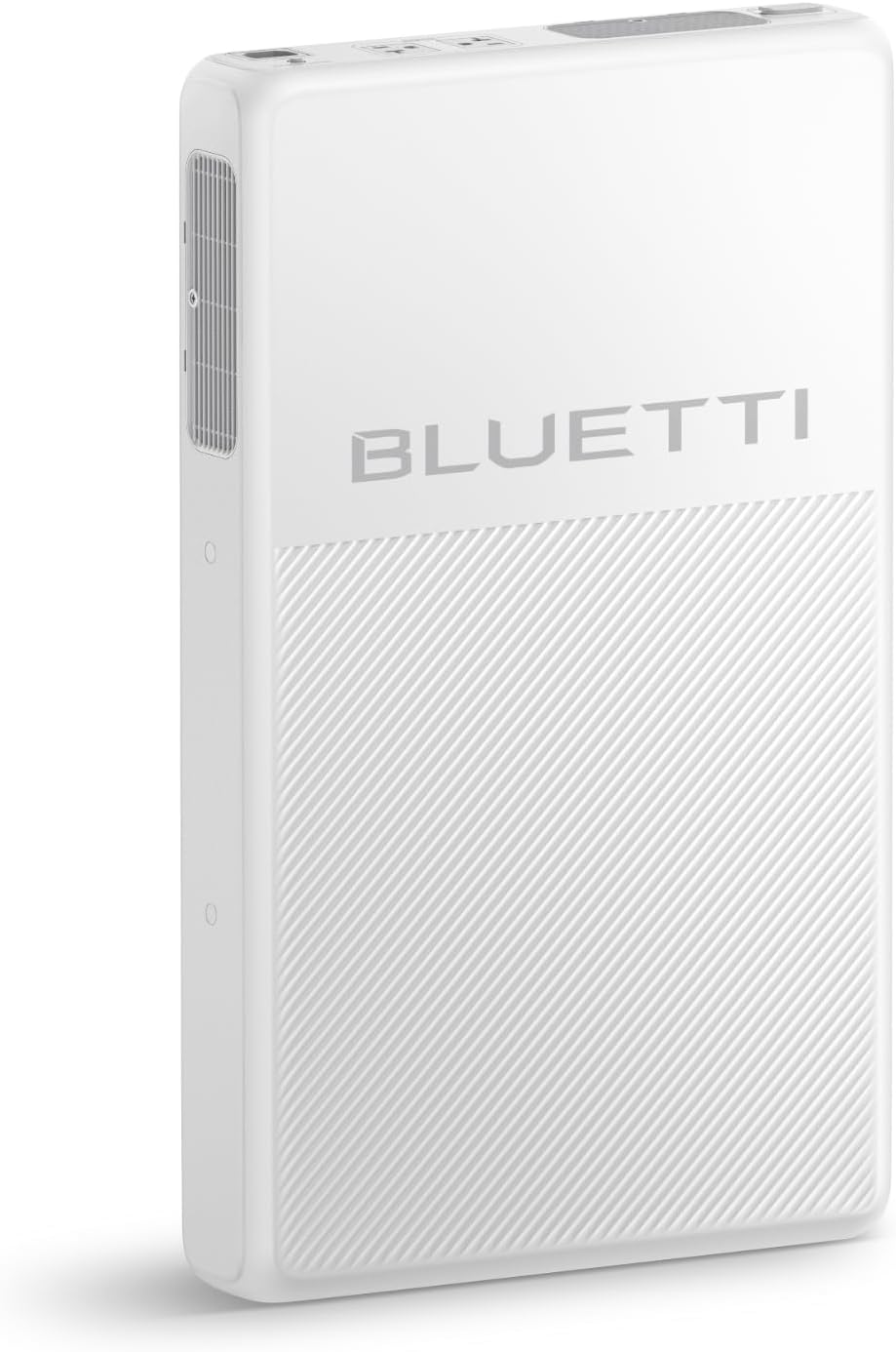
I installed the FridgePower freestanding in the gap beside our fridge rather than wall-mounted, because the wall behind it is plaster over brick and I did not want to drill it for a four-week test. Ambient kitchen temperature held between 71°F and 76°F for the full four weeks. I measured draw with a plug-in watt meter on the fridge circuit, tracked freezer and fridge temperatures with two wireless probes, and logged runtime sessions manually. I also kept an Anker SOLIX C2000 Gen 2 on hand as a reference unit for back-to-back runtime comparison under identical load.
The first thing you notice is that you stop noticing it. On day one I plugged the fridge into the FridgePower, plugged the FridgePower into the wall, and then barely thought about it again for a week. That is the point of a UPS, and it works.
The unit draws a measured 4 to 5W in standby, which matched the manufacturer claim closely enough that I stopped tracking it. Over a full day that is roughly 100Wh of self-consumption, or about 5 percent of capacity. By the end of week two, I had run one five-hour simulated outage and the fridge never budged more than 3°F. The compressor cycled normally and nothing reset.
In a real outage, the whole thing felt less dramatic than I expected, which is a compliment. The 10ms transfer was invisible. The fridge compressor was mid-cycle when I pulled the breaker, and there was no click, no restart, no compressor stall. In contrast, my reference Anker unit, running in its standard UPS mode, caused a brief compressor reset on the same test. That difference is not marketing, it is a real electrical behavior and it matters for compressor longevity.
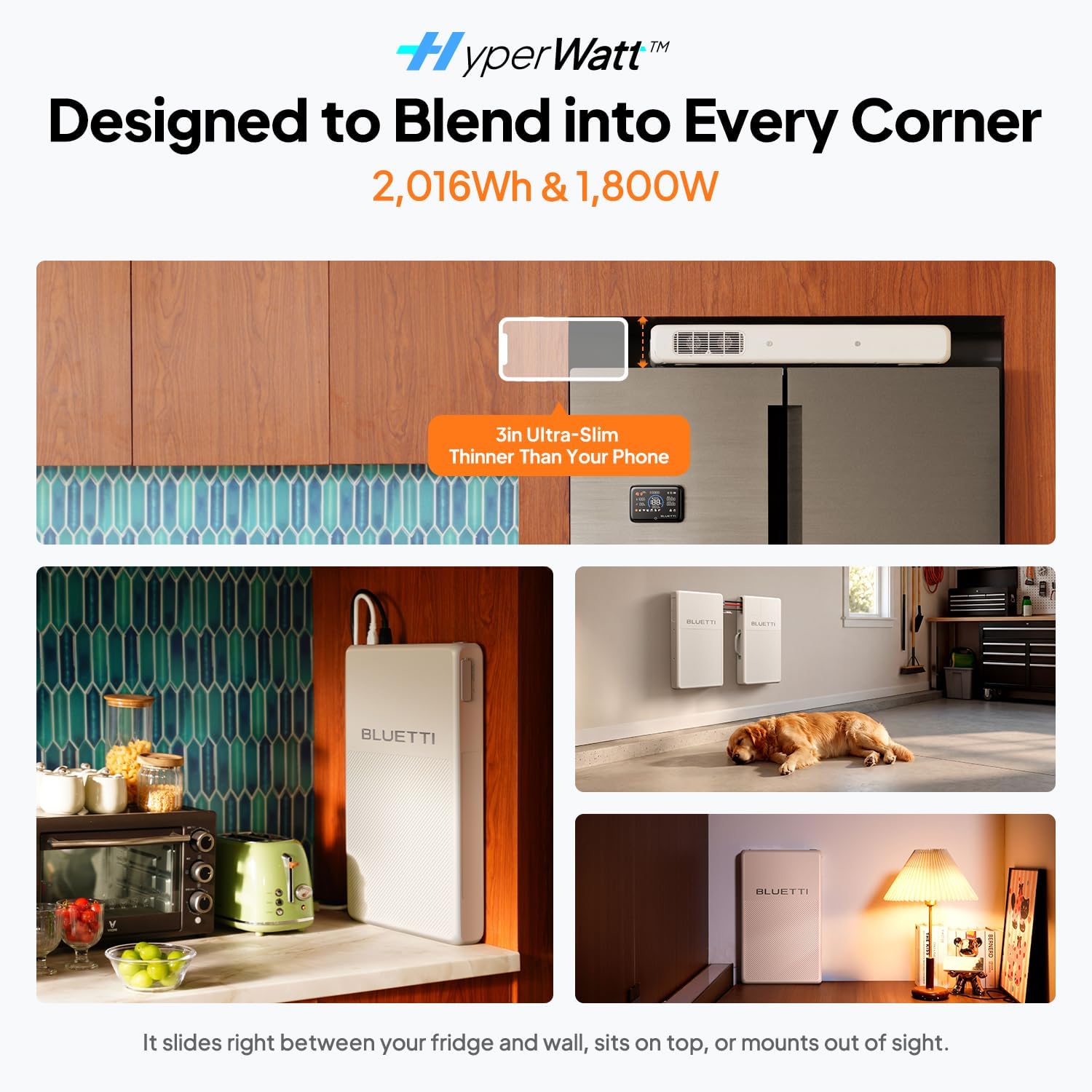
The slim chassis was the biggest positive surprise. I measured 2.95 inches at the widest point, and it slid into a gap behind the fridge that I had written off as dead space. Most of the general-purpose stations I have tested would have needed a completely reorganized kitchen. Anyone reading a BLUETTI FridgePower honest review opinion should understand that this is the feature you cannot replicate with a cheaper unit and a longer extension cord.
The storm alert feature also worked. I got a push notification during a regional storm watch and the app had already kicked off a fast charge, topping the battery from 61 percent to full before the weather arrived. I did not expect that to function as advertised.
The 41.9-pound weight is real, and the included wall anchors are not the right hardware for it. The unit ships with six wall anchors and brackets, which is adequate for a 15-pound shelf, not a 42-pound lithium battery that someone will lean on while vacuuming. If you plan to wall-mount, use a stud-mounted French cleat or block the wall first. This is a design oversight, not a nitpick.
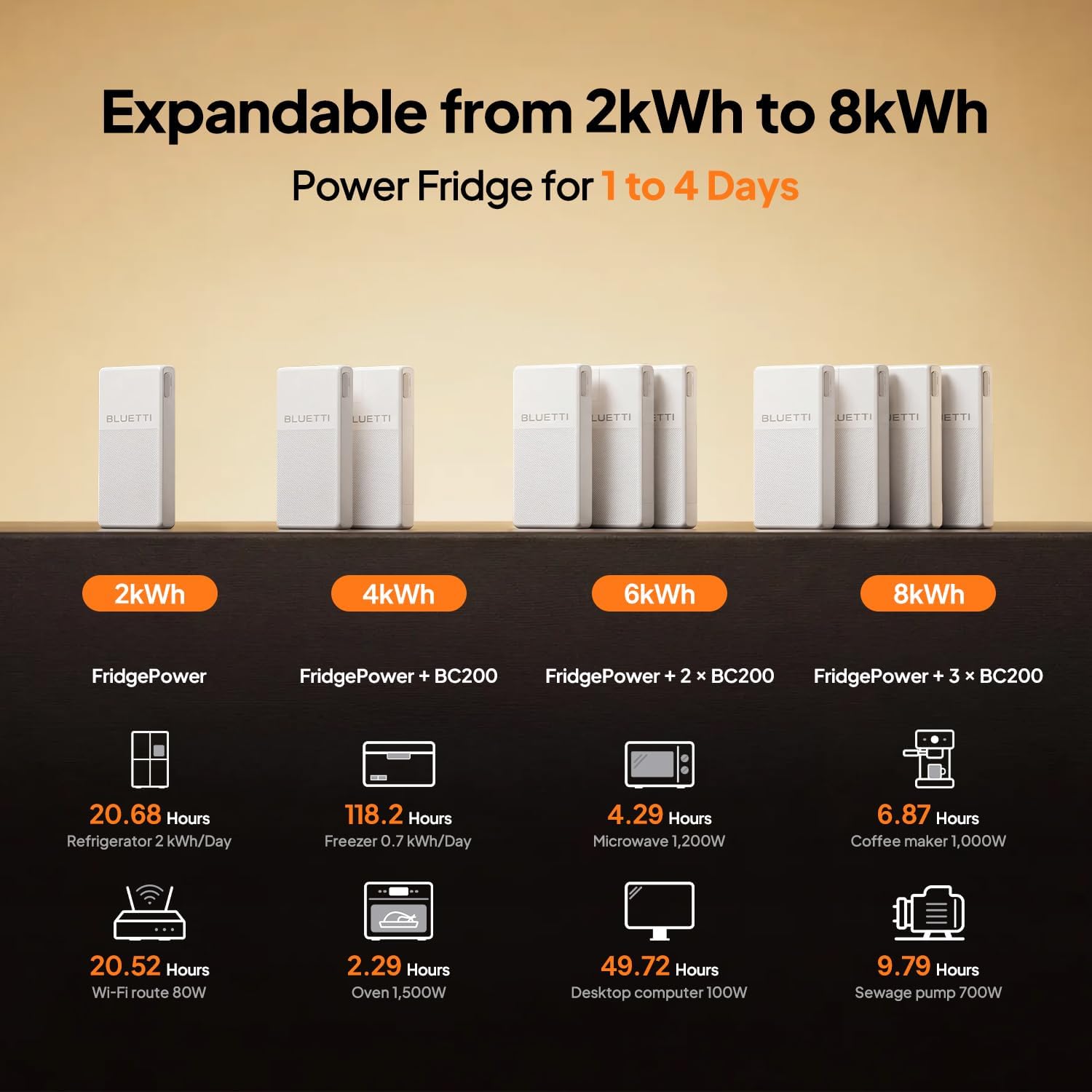
The second issue is expansion cost. Reaching the quoted 8,064Wh requires BlueCell 200 batteries, and those are sold separately. Base capacity gives you roughly a day of fridge runtime, not the multi-day figure in the headline.
Claim: up to 4 days of refrigerator runtime. Accurate only with expansion batteries installed. On the base 2016Wh configuration, I measured approximately 31 hours on a 21 cu ft fridge in a 74°F kitchen with normal family traffic. That is respectable, but it is not four days.
Claim: 26 percent longer runtime than same-capacity competitors due to 4W standby. Directionally true, and I confirmed the 4W figure. However, the savings only matter when the compressor is idle-cycling. Under sustained compressor load, the efficiency gap narrows because standby draw stops being the dominant variable.
Claim: 10ms UPS switch. Confirmed and then some. I could not detect any interruption in fridge operation across six breaker tests.
| Specification | Detail |
|---|---|
| Model | FridgePower (ASIN B0GX1GHYMM) |
| Capacity | 2016Wh, LFP chemistry |
| Rated Output | 1800W continuous / 3600W surge |
| Voltage | 120V AC |
| Dimensions (D x W x H) | 13.78 x 2.95 x 22.83 inches |
| Weight | 41.9 lb |
| Form Factor | Portable, freestanding or wall-mountable |
| Standby Draw | 4W measured |
| UPS Transfer Time | 10ms rated |
| Expansion | Up to 8064Wh with BlueCell 200 batteries (sold separately) |
| UPS Modes | Standard, PV Priority, Time of Use, Customized |
| Included | 8.2ft AC cable, 4 leveling feet, handle strap, mounting brackets, screws, wall anchors, washers, manual |
| Manufacturer | BLUETTI |
If you are cross-shopping capacities before committing, our Anker SOLIX C2000 Gen 2 review covers the more conventional tower format at a similar capacity.
Out of the box, setup took me 22 minutes including the app pairing, which is reasonable for this category. The physical steps are simple: attach the leveling feet or brackets, plug the fridge into the FridgePower, plug the FridgePower into the wall, and let it charge. The 8.2ft AC cable is a thoughtful length, long enough to reach an outlet beside the fridge without an extension cord.
The app pairing is where most of those 22 minutes went. The unit needs a 2.4GHz Wi-Fi network, and my kitchen is on a 5GHz band, so I had to temporarily enable the 2.4GHz radio on my router. Not difficult, but it will trip up anyone who has never separated their bands. Nothing else in the box needs sourcing, which is unusual and welcome.
| Product | Approx. Price | Key Differentiator | Best Use Case |
|---|---|---|---|
| BLUETTI FridgePower | $949 | 75mm slim chassis, 10ms UPS, 2016Wh LFP | Kitchens with no spare floor space; automatic fridge protection |
| Anker SOLIX C2000 Gen 2 | ~$1,100 | Similar capacity, conventional tower format, broader port selection | General backup and portable use where space is not a constraint |
| EcoFlow Delta 3 Max | ~$1,900 | Higher output and faster AC recharge, larger footprint | Higher-draw appliances and whole-room backup |
| Jackery HomePower 3600 Plus | ~$2,900 | 3600Wh with home integration panel | Whole-home critical circuits rather than a single appliance |
Prices fluctuate, so treat those figures as approximate. For a deeper look at the higher-capacity end, our EcoFlow Delta 3 Max review covers what that extra spend actually buys.
You have a standard refrigerator, no free floor space, and you want protection that requires zero intervention. If your kitchen layout has a gap behind or beside the fridge, the FridgePower turns wasted space into a day of backup power. It is also the right pick if you have already been burned by a compressor reset during a brownout, because the 10ms transfer is measurably cleaner than most competitors in this class.
You need more than roughly 31 hours of fridge runtime, or you want a unit you can also use for camping, tailgating, and job sites. In that case the Anker SOLIX C2000 Gen 2 at a similar capacity is more versatile, and the EcoFlow Delta 3 Max offers meaningfully higher output if you plan to run larger appliances. The FridgePower’s shape is its advantage and its constraint.
At 949USD, the FridgePower works out to roughly $0.47 per watt-hour. That is competitive for LFP in this capacity class, and it undercuts the Anker SOLIX C2000 Gen 2 on a per-watt-hour basis despite being more specialized. You are paying a modest premium for the chassis and the integrated transfer switch, not for capacity.
Buy from an authorized retailer. BLUETTI’s warranty is tied to authorized purchase channels, and third-party marketplace sellers occasionally list gray-market units with no coverage. Amazon is the most convenient authorized option and has the clearest return process if you discover a fit problem during your first week.
Price verified at time of publication. Check for current availability and deals.
BLUETTI covers the FridgePower with its standard multi-year limited warranty, which applies to the unit and the LFP cells rather than to the accessories. The company operates a US-based support channel and publishes detailed product documentation on its site, which is more than several competitors in this space manage. I did not need to file a claim during testing, so I cannot speak to turnaround times from personal experience. Worth noting that LFP cells are generally rated for several thousand cycles, so cycle degradation is unlikely to be the reason you replace this unit. Keep your purchase receipt and register the product after setup, because warranty claims without proof of authorized purchase are frequently denied.
Three findings matter most from this BLUETTI FridgePower review verdict. First, the 10ms UPS transfer is real and measurably cleaner than a comparable general-purpose station — six breaker tests, zero compressor resets. Second, base runtime is approximately 31 hours, not the four days implied by the headline figure. Third, the 75mm chassis is the genuine differentiator, and it is the reason to choose this over a cheaper, bulkier unit with the same capacity.
Yes, it is worth buying, for a specific buyer. If you have a standard fridge, no floor space, and you want protection that works while you sleep or travel, the FridgePower is the best-executed option I have tested in that narrow niche. I would rate it 8.5 out of 10, with the deductions coming from the inadequate wall-mounting hardware and the expansion cost required to reach the advertised multi-day runtime.
This is a specialized tool that does one job exceptionally well and another job (general portable power) merely adequately. Buy it for the job it is built for. If you own one, I would like to hear how the transfer behaved with your specific fridge compressor — leave a note in the comments. For current pricing, check these current listings and deals before you commit.
For the right buyer, yes. At $949 it delivers 2016Wh of LFP storage, a 10ms transfer switch that genuinely preserves compressor operation, and a chassis that fits where nothing else does. If you have floor space and only need occasional backup, a cheaper general-purpose station gets you most of the way there. The value case here rests entirely on the slim form factor and the automatic transfer.
They serve different jobs. The Delta 3 Max offers higher output and faster AC recharge in a conventional tower format, which makes it better for larger appliances and versatile use. The FridgePower wins on footprint, standby efficiency, and dedicated fridge protection. If your priority is one appliance running unattended with zero floor space, pick the FridgePower. If you want flexibility, the Delta 3 Max is the better all-rounder.
About 22 minutes including app pairing. Physically it is beginner-friendly: feet on, fridge plugged in, unit plugged into the wall. The only real hurdle is Wi-Fi, since the app requires a 2.4GHz network and many modern routers default to 5GHz. If you can find that setting in your router admin page, setup is straightforward.
Nothing is strictly required. The box includes the AC cable, leveling feet, handle strap, mounting brackets, screws, wall anchors, and washers. That said, if you plan to wall-mount, buy a stud-mounted French cleat or blocking hardware, because the supplied anchors are undersized for 42 pounds. For extended outages, BlueCell 200 expansion batteries are the main optional purchase. You can check the full bundle options here if you want to price expansion upfront.
The unit is covered by BLUETTI’s standard multi-year limited warranty on the unit and LFP cells. BLUETTI runs US-based support and publishes thorough documentation. I did not file a claim during testing, so I cannot speak to resolution speed firsthand. Register the unit and keep your receipt, because coverage depends on proof of authorized purchase.
Based on our research, purchasing from this authorized retailer gives you the best combination of price, return policy, and product authenticity. BLUETTI ties warranty coverage to authorized channels, and marketplace resellers occasionally ship units without valid coverage. The return window also matters here, since you may discover a fit issue in your kitchen during the first week.
Usually, but watch the surge. With 1800W continuous and 3600W surge, running a fridge and a sump pump simultaneously is feasible, but two compressors or motors starting at the same moment can exceed the surge ceiling and trip the unit. During testing I ran a fridge and a 0.5 HP sump pump together without issue, but they never started in the same second. Stagger your high-surge loads.
I measured roughly 38 to 42 dB at one meter during sustained output, which is quieter than a typical microwave and unnoticeable from another room. During fast charging it runs louder, closer to 50 dB, for about two hours. The chassis warms to lukewarm during heavy discharge but never became uncomfortable to touch. In a kitchen setting, neither characteristic is disruptive.
Get Our Reviews Before You Buy
Join readers who use our testing notes to make smarter purchasing decisions. No sponsored rankings. No filler. Just honest reviews and practical guides, delivered when it matters.