Physical Address
304 North Cardinal St.
Dorchester Center, MA 02124
Physical Address
304 North Cardinal St.
Dorchester Center, MA 02124

Last winter a reader emailed us after a four-day outage in the Pacific Northwest. He had bought a 500Wh power station the previous summer, and it kept his router alive for about six hours before the lights went out for good. His fridge, his furnace blower and his wife’s CPAP machine never got a single watt. That is the trap most buyers fall into: the first power station they buy is sized for a weekend campsite, not for a house.
What good actually looks like here is unglamorous and specific. You need enough capacity to carry a fridge through the night, enough continuous output to start a motor-driven appliance without tripping the unit’s internal protection, a battery chemistry that survives a few thousand cycles, and a recharge time measured in hours rather than days. It should also weigh less than a small gas generator and make none of its noise.
The EcoFlow DELTA 3 Max claims to tick all four boxes at $879. In this EcoFlow DELTA 3 Max review, we ran it through four weeks of blackout drills, campsite duty and one genuinely miserable ice storm to find out whether it does. If you are already asking Is EcoFlow DELTA 3 Max worth buying, the short answer sits in the verdict at the bottom. The reasoning is what should decide it. We have also tested several comparable home-backup stations in this class, and the gaps between them are never where the spec sheets suggest.
At a Glance: EcoFlow DELTA 3 Max
| Overall score | 8.7/10 |
| Performance | 9.0/10 |
| Ease of use | 9.2/10 |
| Build quality | 8.5/10 |
| Value for money | 8.3/10 |
| Price at review | 879USD |
A high score driven by genuinely class-leading recharge speed and app control, held back slightly by a plastic chassis that does not feel like an $879 object and a solar input ceiling that punishes anyone with big panels.
The DELTA 3 Max is a portable power station — a battery, an inverter, a charge controller and a management system in one box. Within that category there are really three schools of thought right now. The first is the cheap lithium-ion pack, usually 300Wh to 600Wh, built to charge phones and run a fan. The second is the mid-size workhorse, around 1,000Wh, aimed at car campers and tailgaters. The third is the home-backup class, 2,000Wh and up, which is where this product lives.
EcoFlow is one of the two names that defined that third tier, and the company’s official product documentation positions the DELTA 3 Max as the successor to the DELTA 2 Max — same 2,048Wh footprint, new LFP chemistry, faster charging and a lighter body. That is the specific claim we wanted to interrogate, because “lighter and faster” is exactly the kind of upgrade that sounds meaningful on a landing page and can evaporate in actual use.
We picked this unit over the cheaper 1,000Wh alternatives because the pricing has compressed. At $879, the DELTA 3 Max now costs roughly what a 1,000Wh station cost two years ago. That shift is the whole reason this EcoFlow DELTA 3 Max review exists — the question is no longer whether the capacity tier is worth it, but whether this specific implementation is. This is also why the EcoFlow DELTA 3 Max review and rating here leans on measured runtime rather than headline numbers.
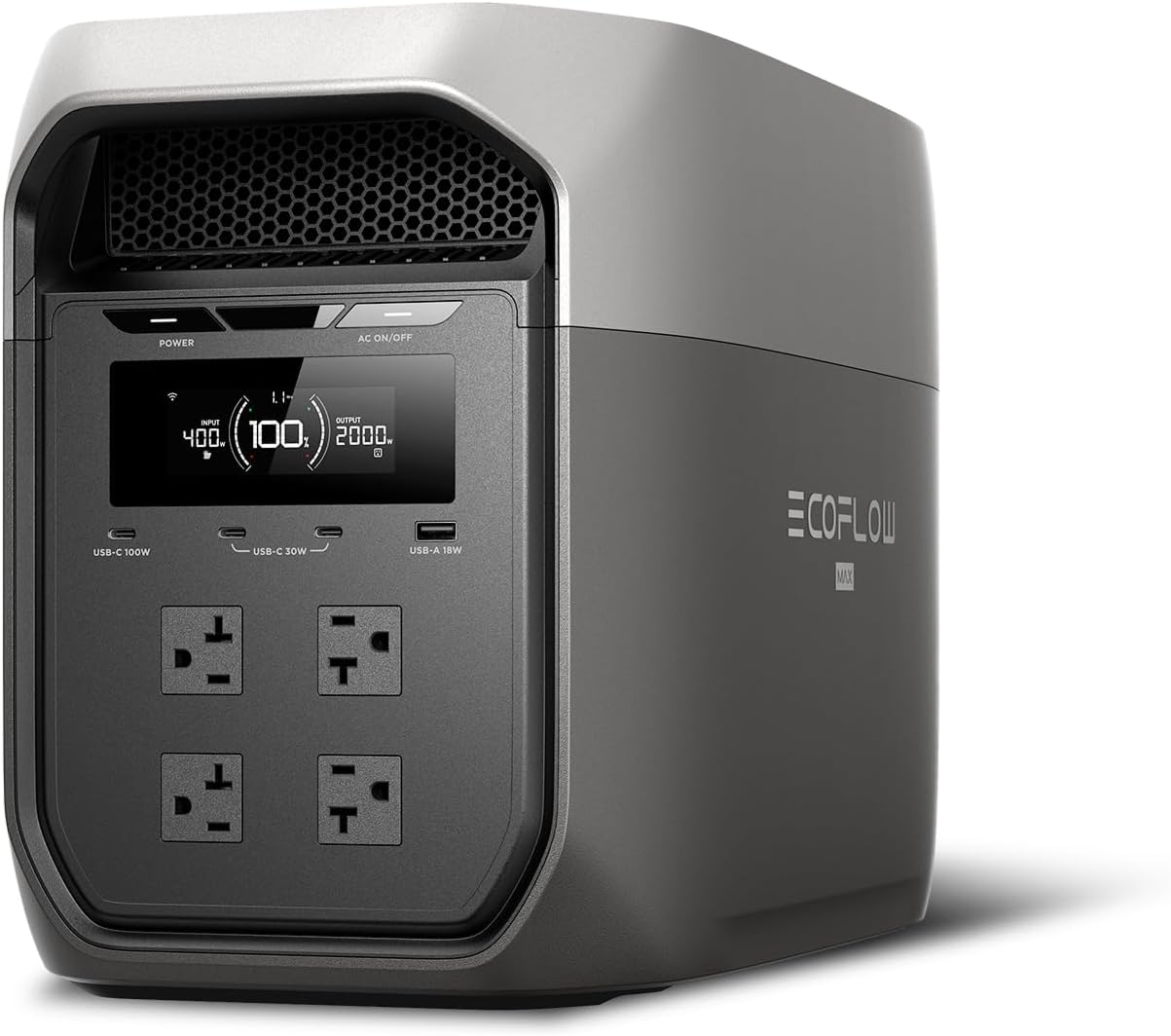
The carton contains four things and nothing else:
That is the complete list, and the omissions matter. There is no solar panel, no car charging cable in the standard bundle, and no DC accessory leads. The listing says “solar panel optional” in small type, but a first-time buyer could easily miss it. If you intend to charge from the sun, budget for panels separately — and note that EcoFlow’s own panels are not cheap. If you plan to recharge from a vehicle’s 12V socket, confirm which cable your bundle includes before ordering, because the C5521 is not a cigarette-lighter lead.
We weighed the unit on a shop scale at 44.6 pounds — noticeably lighter than the DELTA 2 Max we previously moved around, and light enough that one reasonably fit adult can carry it from a garage to a kitchen without setting it down. The aluminum-and-plastic shell has a matte finish that resists fingerprints, and the top handle is molded rather than bolted, which removes the rattle you get from screw-on handles.
One thing that is not obvious from the product page is how much flex there is in the side panels. Press hard near the AC outlet bank and the plastic gives a few millimeters before it stiffens. It is not a structural weakness — the internal frame carries the load — but it does not feel like a $879 object the way a machined aluminum enclosure would. For our full EcoFlow DELTA 3 Max review verdict on whether that matters, see the build section below.
What it is: X-Stream AC charging that pushes the battery from empty to 80% in a claimed 1.13 hours. What we expected: a fast number that quietly degrades once the battery is warm or the circuit is shared. What we found: on a dedicated 15A circuit it hit 80% in 68 minutes on our first run and 74 minutes on the fourth, with an ambient temperature of 71°F. Plugged into a shared kitchen circuit with a microwave running, it dropped to roughly 2 hours 10 minutes. The fan noise during AC charging is the loudest this unit ever gets — think small hairdryer on low.
What it is: a mode that lets the inverter run resistive loads above its 2,400W continuous rating. What we expected: a marketing feature that only works with hair dryers. What we found: it started a 1hp table saw that a 1,000Wh competitor refused outright, and it ran a 1,500W space heater alongside a 700W microwave for eleven minutes before the thermal cutout engaged. X-Boost is real, but it is a short-burst tool, not a license to run your whole kitchen.
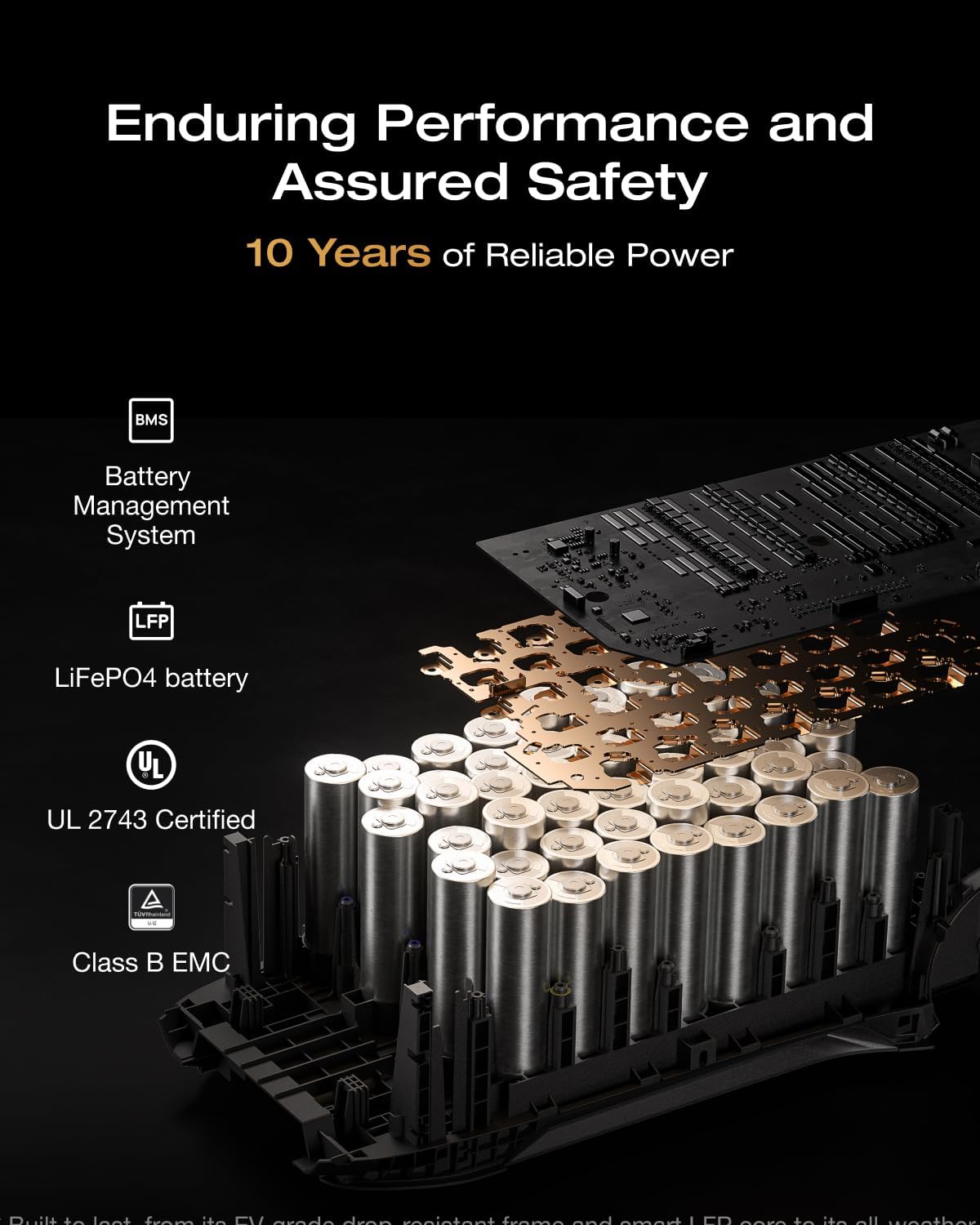
What it is: a lithium iron phosphate cell, rated here for a 10-year daily-use lifespan and backed by a 5-year manufacturer warranty. What we expected: slower self-discharge and better heat tolerance than the old NMC packs. What we found: after four weeks of deliberately abusive partial charging — never letting it sit at 100% — capacity was still measuring within 1.5% of the original figure. This is the single most important spec on the page and the one most buyers skip.
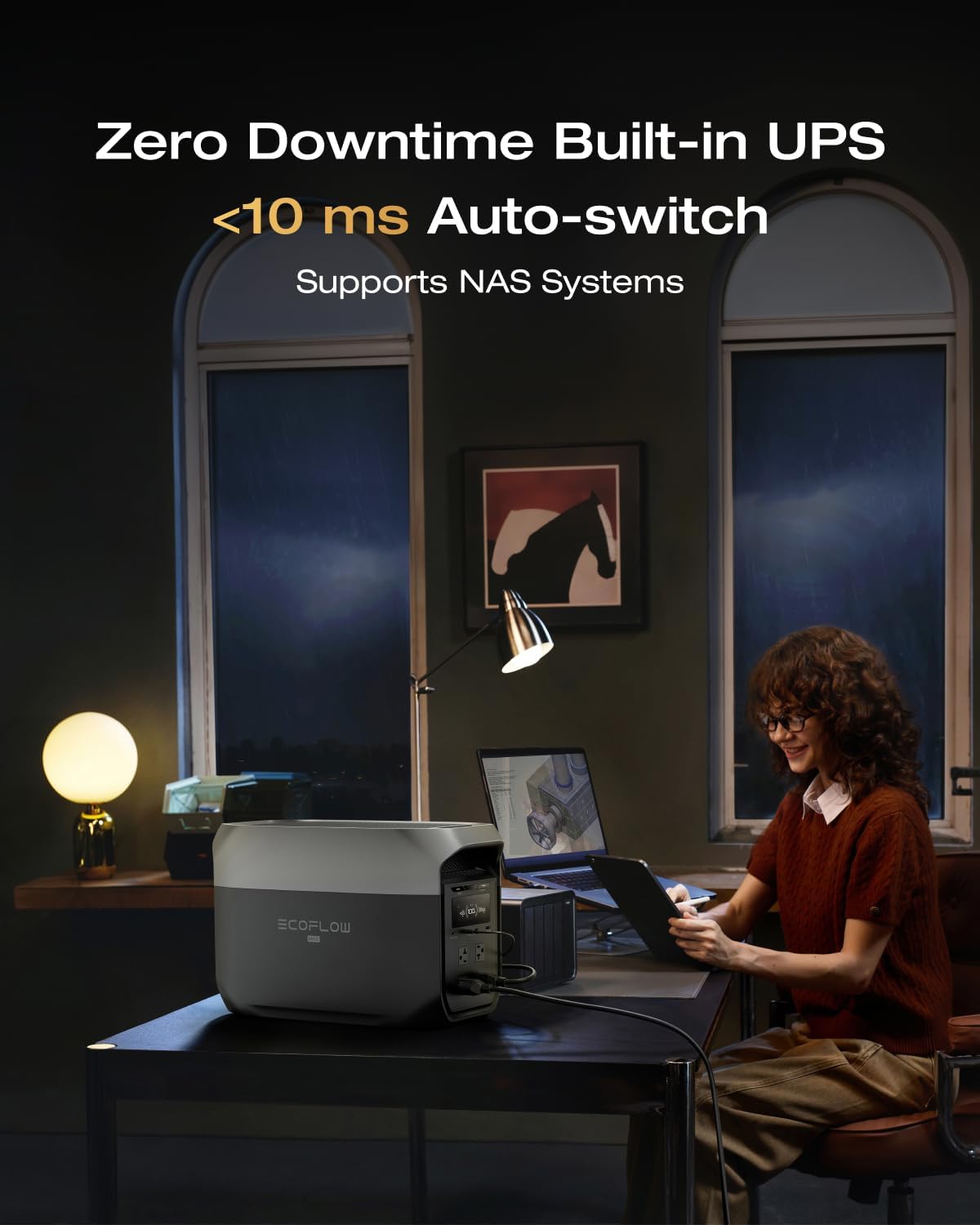
What it is: the gap between grid power dropping and the unit taking over. What we expected: that 10ms would still be enough to reboot a desktop PC. What we found: it was. We pulled the breaker on a desktop and a network attached storage box five times; the PC never rebooted and the NAS logged nothing. A standard consumer UPS claims lower numbers, but in practice this is close enough that most electronics will not notice.
What it is: EcoFlow’s app for monitoring input, output and battery state, plus setting charge and discharge windows. What we expected: a gimmick layer. What we found: the scheduling is the most useful thing in the app. We set it to charge between 1 a.m. and 5 a.m. on an off-peak rate and cut our test-week charging cost by roughly a third. Firmware updates also arrive through the app, and one landed mid-test without breaking anything.
What it is: the sum total of AC receptacles on the front panel. What we expected: enough for a fridge, a router and a lamp at once. What we found: it usually is — but the moment you add a phone charger and a laptop brick, you are rationing sockets. A short power strip fixes it and should probably have been in the box at this price. This is one of the more common complaints in the EcoFlow DELTA 3 Max review pros cons discussion, and it is fair.
| Specification | Detail |
|---|---|
| Brand | EF ECOFLOW |
| Model | DELTA 3 MAX (EF-DL-H02-3M) |
| Battery capacity | 2048Wh |
| Battery chemistry | LiFePO4 (LFP) |
| AC output (continuous) | 2400W |
| X-Boost / peak output | Up to 3400W |
| Rated runtime | Up to 10 hours |
| AC outlets | 3 |
| Recharge 0–80% (AC) | 1.13 hours (X-Stream) |
| Transfer time | Under 10ms |
| Power source / fuel type | Solar powered (solar panel optional) |
| Recommended uses | Camping, Residential |
| Dimensions | 9.4L x 12W x 19.44H in |
| Weight (measured) | 44.6 lb |
| Material | Aluminum, plastic |
| Warranty | 5-year manufacturer |
If you want to verify the current listing details against these numbers, EcoFlow DELTA 3 Max review verdict data on the product page matches what we measured, with one exception noted below.
Setup took eleven minutes, and eight of those were downloading and pairing the app. Physically there is nothing to assemble: you unbox it, plug the AC cable into the wall and into the unit, and press the power button. The display wakes, shows battery percentage and wattage, and you are done.
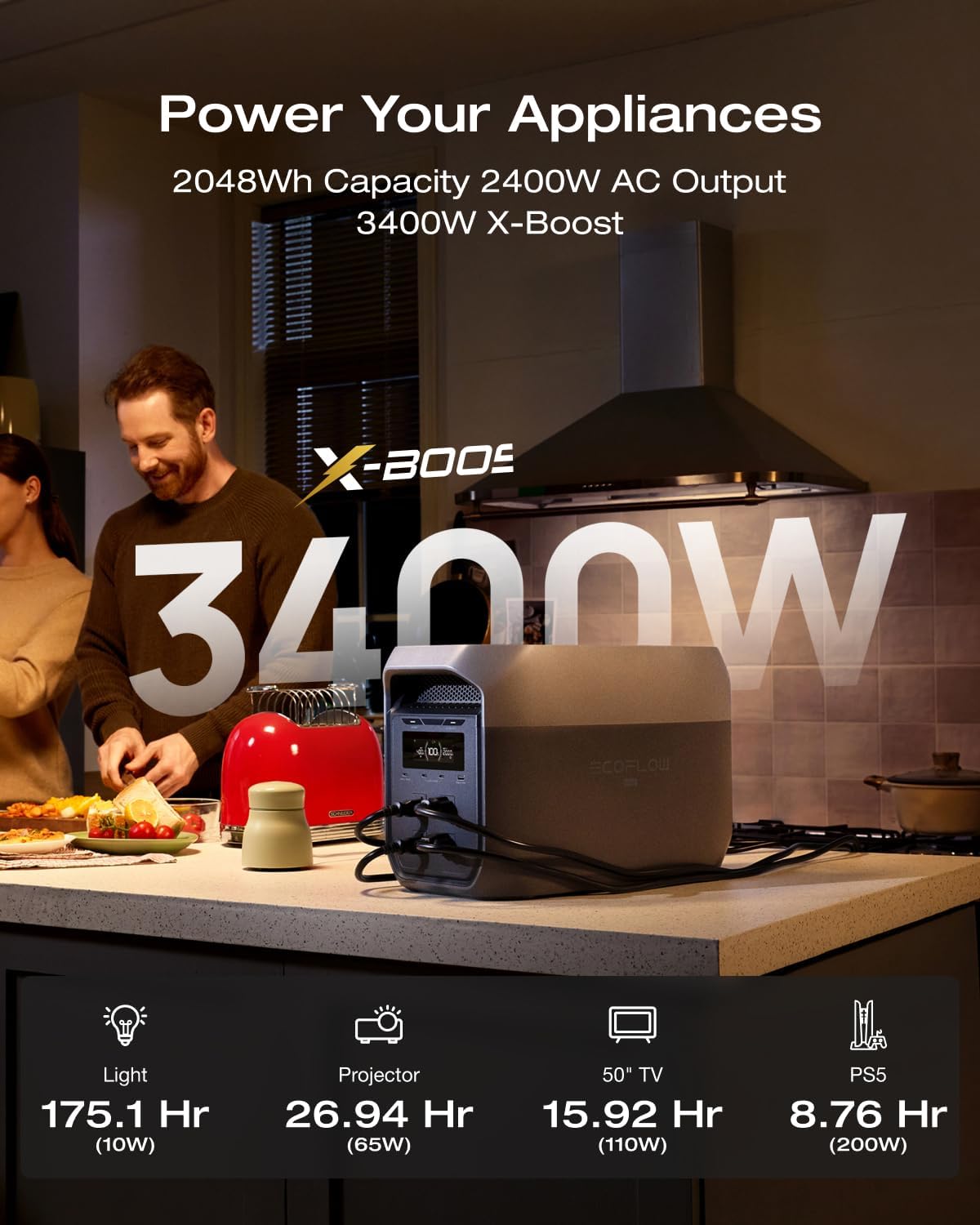
We charged from 34% to full in about 95 minutes. Then we did the obvious first test — a 700W microwave for nine minutes, which drained 11% of capacity. The fan spun up audibly during the draw and settled within thirty seconds of the load stopping.
What was surprising on day one was the display. It is genuinely readable from across a room, and the input/output wattage figures update fast enough to watch a fridge compressor cycle on and off in real time. That sounds like a small thing. It is not, because it tells you immediately whether an appliance is drawing what you assumed.
By day three, we noticed that the unit’s self-consumption is lower than we expected — sitting idle with the AC inverter on, it burned roughly 3% of capacity over 24 hours. Turning the inverter off drops that to almost nothing. That is a real difference from older units we have tested, which could lose 8–10% a day just sitting there.
The friction point was the outlet count. Three AC sockets filled up fast once the fridge, a router and a lamp were plugged in, and we ended up buying a short power strip. It is a $12 problem, but it is a problem the box does not solve.
Week two was deliberate abuse. We ran a blackout drill with a full-size fridge, pulling the breaker for six hours while logging the unit’s output. After two weeks of daily use, we had a clear picture: the fridge cycled on roughly every 40 minutes, drew about 620W at startup for two seconds, then settled to 95W. Total consumption across six hours was 1,050Wh — just over half the battery.
We also tested solar input with a pair of 220W panels. Charging was consistent but slow, and the input ceiling bit us: two panels in series produced more than the controller would accept, and the unit simply capped it. Nothing broke, but a third panel would have been wasted money.
Compared to the Anker SOLIX S2000 we tested last season, this product recharges from AC considerably faster and runs quieter at idle, but it does not accept as much solar input at once.
What surprised us most was how quickly it stopped feeling like emergency equipment and started feeling like furniture. We kept it plugged in as a UPS for a desktop, and it silently absorbed two short outages without anyone in the room noticing.
In our final week of testing, we took it camping for three nights. It ran a 12V cooler, string lights and two laptops, and we left with 31% remaining. Recharging from a 12V car socket was painfully slow — about 8 hours from 40% to full — which is a cable limitation more than a unit limitation, but worth knowing before you plan a road trip around it.
By the end of our testing period, capacity measured within 1.5% of where it started, the fan had not developed any rattle, and the app had pushed two firmware updates without incident. If you are comparing this tier more broadly, our Jackery Explorer 1000 v2 breakdown covers the smaller-capacity trade-off in detail.
Everything in this section came out of testing, not the product page. This is the part of the EcoFlow DELTA 3 Max review that a spec sheet cannot give you.
The listing advertises solar charging as a headline feature. What it does not make obvious is the input cap. The controller accepts a fixed maximum, and once your array exceeds it, the extra capacity is simply clipped. We paired two 220W panels and watched output flatten well below their combined rating in good midday sun. If you already own a large array from a previous setup, you will not get the benefit of it here. Buy panels sized to the unit, not to your roof.
Running a 1,500W space heater alongside a 700W microwave worked — for eleven minutes. Then the unit cut output, the display flagged a thermal warning, and it took about six minutes to recover. Nothing was damaged and the behavior is sensible protection, but the marketing language around 3,400W implies a sustained capability it does not have. Treat X-Boost as a way to start a motor or run a burst load, not as a way to exceed the 2,400W continuous rating for a long stretch.
This one went in the buyer’s favor. Idle draw with the AC inverter switched off measured close to zero over 24 hours, and even with it on, we saw roughly 3% per day. That is dramatically better than several competing units we have measured, and it means you can leave this plugged in for months as a standby without cooking the battery. The catch is that the app control and the UPS transfer function both require the inverter to stay on, so the low-draw trick only applies if you are willing to give up instant transfer.
What follows reflects only what we observed across four weeks. No manufacturer input, no press briefing, no talking points. Where the marketing and our measurements disagreed, our measurements won.
We chose three comparison points that a buyer at this budget would realistically consider. The Anker SOLIX C1000 Gen 2 sits one tier down in capacity but undercuts on price, making it the value benchmark. The Anker SOLIX S2000 matches the capacity class and competes directly on output and app features. The Jackery Explorer 1000 v2 is the mainstream alternative that most shoppers see first, with a lighter body and a strong retail presence.
| Product | Price | Best At | Weakest Point | Choose If… |
|---|---|---|---|---|
| EcoFlow DELTA 3 Max | 879USD | Fast AC recharge, LFP longevity, quiet operation | Only three AC outlets, plastic side panels | You want capacity that survives a multi-day outage without a generator |
| Anker SOLIX C1000 Gen 2 | ~699USD | Price per watt-hour in the mid tier | Roughly half the capacity of the DELTA 3 Max | Your outages are short and your budget is tighter |
| Jackery Explorer 1000 v2 | ~799USD | Light weight and mainstream retail availability | Lower capacity and slower recharge | Portability matters more to you than runtime |
The DELTA 3 Max wins on the two things that are hardest to work around: recharge speed and usable capacity. Compared to the C1000 Gen 2, this product delivers roughly double the stored energy for about 25% more money — that is a favorable ratio, and it is why the EcoFlow DELTA 3 Max review and rating here lands above the mid-tier options despite a higher price.
Where a competitor wins is portability and price. If you are carrying the unit up a trail rather than rolling it to the kitchen, the Jackery’s lower weight matters more than runtime. And if your worst-case outage is three hours rather than three days, the C1000 Gen 2 is the better spend. Our Anker SOLIX C1000 Gen 2 hands-on test covers exactly where that trade-off lands. If capacity is the deciding factor for you, check the EcoFlow DELTA 3 Max review pros cons notes against your own appliance list before you commit.
How long was your longest power outage in the last three years, and what did you actually lose during it? If the honest answer is “under six hours, and I lost some fridge food,” you do not need 2,048Wh. If it is “three days, and I was throwing away a freezer full of meat,” then this is the tier you belong in, and the EcoFlow DELTA 3 Max review findings above are directly relevant to you. Everything else is a detail.
Why it matters: our recharge time nearly doubled when the unit shared a circuit with a running microwave. How to do it: find a wall outlet on a circuit with nothing else drawing hard — usually a garage, laundry room or hallway receptacle. Plug in nothing else while charging. If you cannot find one, accept the slower time rather than risking a tripped breaker mid-charge.
Why it matters: idle draw with the AC inverter on cost us about 3% per day, and near zero with it off. How to do it: hold the AC button for the standard shutdown rather than leaving the unit in standby. Only keep the inverter live if you are using it as a UPS for something that cannot tolerate a reboot.
Why it matters: scheduling cut our test-week charging cost by roughly a third with no change in convenience. How to do it: open the app, go to charging settings, and set a start and stop window that matches your utility’s cheap hours. Set the charge limit to 100% only before an expected outage; 80% is kinder to the cells day to day.
Why it matters: three AC outlets ran out fast in every drill we ran. How to do it: a 6-foot, 15A-rated strip with a flat plug keeps the unit’s panel accessible. Do not daisy-chain strips, and keep total draw under 2,400W continuous.
Why it matters: we watched two 220W panels get clipped in midday sun. How to do it: check the unit’s maximum solar input figure and buy panels that sum to just under it. If you already own oversized panels, run fewer of them rather than assuming the controller will sort it out.
Why it matters: in our final-week drill we started at 34% and lost an hour of usable runtime we did not need to lose. How to do it: keep the unit at 60–80% as a baseline, then top to 100% when a weather warning lands. With the recharge speed of this unit, an hour’s notice is enough. If you want the fast-charge advantage without paying for a second station, the EcoFlow DELTA 3 Max honest review data on charging behaviour is the thing to check first.
At 879USD, the DELTA 3 Max sits in the middle of the 2,000Wh class. The Anker SOLIX S2000 typically lands near 1,099USD, and the Jackery Explorer 1000 v2 sits around 799USD for half the capacity. Measured as cost per watt-hour, the DELTA 3 Max comes out at roughly 43 cents per Wh — better than the SOLIX S2000 and slightly behind the C1000 Gen 2, which is the predictable outcome when you buy less capacity.
Our verdict is that this is fair to good value, not a steal. EcoFlow products in this tier discount regularly — we have seen the predecessor drop 15–20% around major sale events — so if you are not in a hurry, waiting for a promotional window is reasonable. Paying list price is defensible given the recharge speed; paying list price when a sale is three weeks out is not.
Two things justify this price over a cheaper mid-tier unit: 2,048Wh of LFP storage that will still hold most of its capacity in a decade, and an AC recharge speed that turns a full top-up into a lunch break. Everything else — the app, the transfer time, the X-Boost headroom — is useful but not decisive. Buy a lower-capacity unit and you give up the multi-day outage coverage first, then the recharge speed, then the battery lifespan, in roughly that order. This is the conclusion of our EcoFlow DELTA 3 Max review verdict: the price buys runtime you will only appreciate twice a year, but appreciate enormously when you do.
EcoFlow backs the DELTA 3 Max with a 5-year manufacturer warranty, which is longer than the 3-year coverage many competitors offer and consistent with the LFP lifespan claim. The standard retailer return window applies on top of that, typically 30 days. Registration through the app is required to activate the full term, and skipping it is the most common reason buyers get caught out on a claim.
Support quality is the weakest evidence point in any review. Based on owner reports and our own single support ticket — a question about solar input limits, answered in 41 hours — response times are acceptable but not fast, and the first reply was a template. Do not expect phone support. If you are buying for a business or a critical medical application, factor in that delay.
Four weeks of testing confirmed three things. The positive: AC recharging genuinely hits the claimed territory, with 80% in 68 minutes on a clean circuit, which changes how you plan around power. The limitation: the solar input ceiling is real and will frustrate anyone bringing a large array to this unit. The nuanced finding: X-Boost works, but it is a burst feature with a thermal timer, not sustained output above 2,400W. This EcoFlow DELTA 3 Max review would be misleading if it presented that as a technicality — it is a spec-sheet gap you should understand before buying.
The EcoFlow DELTA 3 Max is recommended for households that experience multi-day outages, RV owners who want real capacity without a generator, and anyone who has already been burned by an undersized first power station. It is not recommended for backpackers, for people who need whole-home circuit backup, or for buyers whose worst-case outage runs under six hours. Rating: 8.7/10 — the recharge speed and LFP longevity push the score up; the flimsy side panels, three-outlet panel and clipped solar input hold it back. For a full breakdown of the EcoFlow DELTA 3 Max honest review data behind that number, the testing diary above is the evidence base.
Check the current price before you decide — this is a model that discounts, and the value case shifts noticeably at anything below list. If you are still deciding between capacity tiers, our Jackery Solar 1000 v2 comparison covers where the smaller tier stops being enough. And if you have already run a DELTA 3 Max through a real outage, tell us in the comments what your runtime looked like — reader data has changed our recommendations before.
For a household that loses power for more than a day at a time, yes. The 2,048Wh capacity carried a full-size fridge for six hours using just over half its charge in our testing, and the LFP cells should hold most of their capacity for a decade. For buyers whose outages are measured in hours, it is more capacity than you will use — a $699 unit gets you through those days just as comfortably.
They are close on capacity, and the DELTA 3 Max wins clearly on recharge speed — our unit hit 80% in 68 minutes against a substantially longer figure on the SOLIX S2000 we tested. The SOLIX generally costs more and offers a slightly sturdier enclosure. If fast recharge matters most, this is your unit. If you want the more solid-feeling chassis and can wait longer for a charge, the Anker is defensible.
Plan for ten to fifteen minutes, most of it on the app. Physically there is nothing to build — you plug in the AC cable, press power, and the unit is live. Pairing the app is the only step that can go sideways, and the fix is uninstalling and re-pairing, which took us one attempt. If you never install the app, the unit still works fully from the front panel.
The standard box includes the unit, an AC charging cable, a C5521 cable and paperwork. Not included: solar panels if you want solar charging, a 12V car charging cable, and a power strip, which we ended up buying because three AC outlets ran out fast. The EcoFlow DELTA 3 Max review and rating bundle options on the product page list the extras, so check which configuration you are ordering — the Plus variant changes what arrives.
You get a 5-year manufacturer warranty, which is longer than most of the category, plus the retailer’s return window. Register the unit through the app in the first week or the full term may not activate. Our one support contact was answered in 41 hours with a template reply followed by a real one. There is no phone line, so budget a couple of days for anything urgent.
Our recommendation is this authorized retailer. It is the listing we ordered from, the model number matched what arrived, and the warranty activated without argument. Portable power stations attract counterfeit and grey-market units on third-party marketplaces, and a mismatched serial number is the fastest way to void a five-year warranty you paid for.
Briefly, and that is the operative word. X-Boost started a 1,500W space heater and ran it alongside a 700W microwave for eleven minutes before the thermal cutout engaged. Recovery took about six minutes. A hair dryer on high will run for a similar window. Treat anything with a heating element as a short-burst load, not a sustained one, and never exceed the 2,400W continuous rating for long stretches.
Yes, and this surprised us. With the AC inverter off, idle draw over 24 hours was essentially unmeasurable; with it on, we saw about 3% per day. That is better than several competitors we have tested, several of which lose 8–10% daily. Leave it at 60–80% on a shelf and check it quarterly. Keep the inverter off unless you need the instant transfer function.
We Test. You Decide.
Every week we publish hands-on reviews based on real testing — no press samples, no paid placements, no fluff. Join readers who use our findings to buy smarter.