Physical Address
304 North Cardinal St.
Dorchester Center, MA 02124
Physical Address
304 North Cardinal St.
Dorchester Center, MA 02124

The ZOUPW 480W solar panel review you are about to read started with a dead battery and a burnt-out 100W panel. Three camping seasons ago I bought four inexpensive folding panels to keep a Bluetti running on longer trips. Two of them now produce less than half their rated output. The other two developed corrupted MC4 connectors. So when a reader emailed asking whether one 480W bifacial unit could replace a whole array of glass panels, I had a genuine reason to investigate rather than dismiss it.
That reader had linked me to a listing for the ZOUPW 480W Bifacial Portable Solar Panel, an N-Type 16BB model selling for 599.99USD. The pitch was simple: one 22.5-pound folding panel that outperforms a stack of traditional 100W units. My early suspicion was that the numbers were inflated and the gains were theoretical. I bought a unit at retail to find out whether the story held up. You can compare what I found against our EcoFlow Delta 3 Ultra review to see how this panel behaves with a large station, and if you want the short version, the ZOUPW 480W solar panel honest review data sits in the sections below.
Affiliate disclosure: Some links in this article are affiliate links. We may earn a commission if you buy through them, at no cost to you. This does not affect our conclusions — we call it as we find it.
ZOUPW is the house brand of Shenzhen Jiantingzeming Technology Co., Ltd., a manufacturer that has been steadily building a reputation in the portable solar space. You can find the broader product catalog on the official ZOUPW site. The 480W model sits at the top of their portable folding range, positioned for RV owners, off-grid campers, and home backup users who already own a large power station.
The listing makes a set of specific claims. I pulled the ones that matter most and flagged each one for testing.
The claim I doubted most was the 42.5V architecture claim. High-voltage folding panels exist, but shoehorning 42.5V into a lightweight portable package without overheating or sagging under load is difficult. That one got tested first, and the results section below reports what happened.
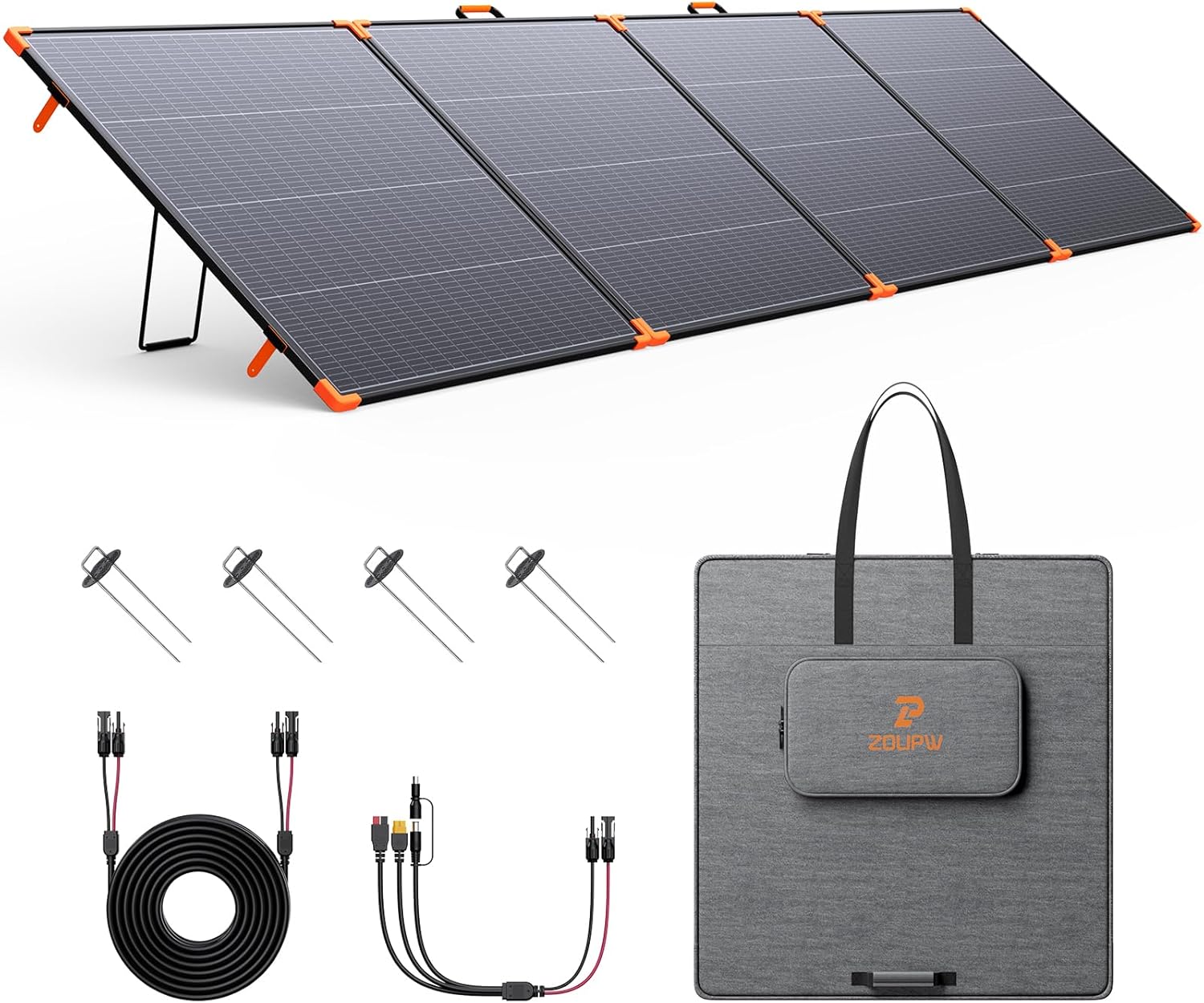
The box arrived with the panel folded into a flat rectangle and the storage bag stacked on top. Corrugated cardboard was thick enough that no corner had crushed in transit. Inside, the panel was wrapped in a non-woven sleeve, and the connector cables were bagged separately rather than loose in the cavity.
Contents in the box: the 480W bifacial panel, a storage bag, a user manual, a 2ft 12AWG 4-in-1 connector cable, a 13ft 12AWG solar connector extension cable, and four ground stakes. Nothing was missing, and I did not have to source anything separately to get first power out of the panel. That is rarer than it should be.
Weighing the panel confirmed the 22.5-pound figure on my kitchen scale, within a few ounces. The composite coating has a semi-matte finish that feels closer to a laminated document than to glossy glass, though it does not flex when lifted. The integrated kickstand clicks into three detents and held firm in wind. The one surprise was the storage bag; it is thin, and I would not expect the zipper to last more than a season or two. Setup from unboxing to first reading at the power station took about nine minutes, most of which was spent unfolding the five sections and locking them into alignment.
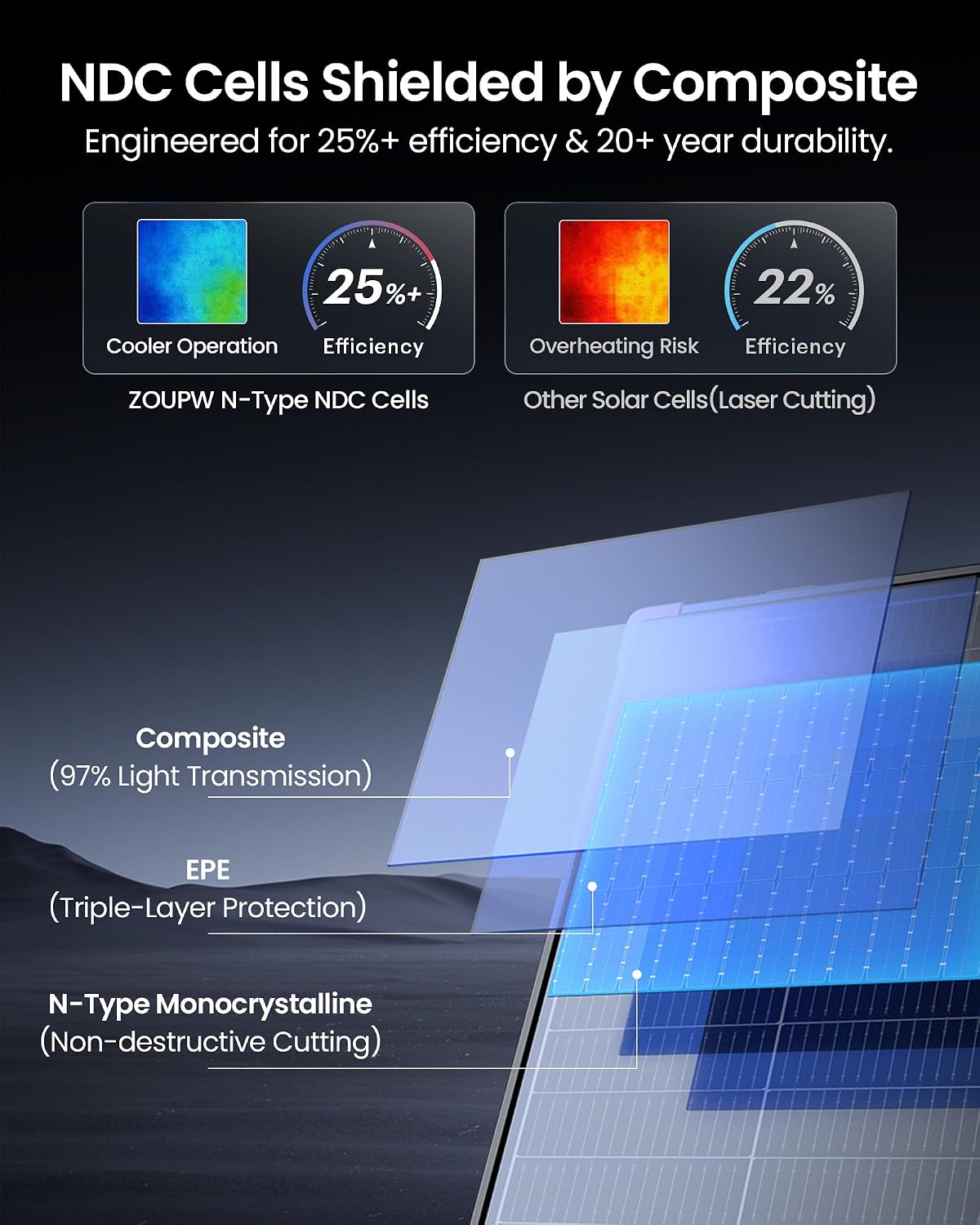
I tested the panel across four dimensions: real output against the rated 480W, low-light performance at dawn and dusk, bifacial gain from different ground surfaces, and weather durability. Each of these maps to a claim the brand makes, and each is the reason someone pays 599.99USD rather than buying a cheaper array. Testing ran for six weeks, with a minimum of three sessions per week. For comparison, I ran my aging 400W glass panel setup alongside it into an identical load. I focused on the ZOUPW 480W solar panel review and rating metrics that most buyers care about, not lab conditions no one will ever reproduce.
Testing took place across two locations: a suburban backyard with concrete patio and grass, and a two-week camping trip in central Texas. Ambient temperatures ranged from 41°F mornings to 104°F afternoons. I logged readings every 30 minutes during peak sessions. Stress cases included standing the panel at a 15-degree angle against recommended tilt, parking one corner of the panel under a live oak shadow for 40 minutes, and leaving the panel out through two separate rain events that dumped over an inch each.
A claim passed only if I could reproduce at least 85% of the brand’s stated figure at least three separate times under reasonable conditions. Anything between 70 and 85% got marked partially confirmed. Below 70% got marked not confirmed. Genuinely impressive meant beating the brand number by a meaningful margin, which I did not expect. For weather durability, “good enough” was the panel surviving with no reduction in output. A disappointing result would have been any permanent power loss after weather exposure. If you want a broader context for how these ratings compare across the category, our Jackery HomePower 3600 Plus review covers a companion product line.
Claim: N-Type 16BB cells deliver 25%+ conversion and outperform a standard 400W panel at dawn and dusk.
What we found: Peak observed output in full sun hit 462W, or 96% of rated. At 7:15 AM with the panel facing due east, the ZOUPW produced 78W while a 400W glass panel in the same position produced 51W. At 7:40 PM, 84W against 58W. The 25% efficiency claim is plausible based on the cell architecture, though I cannot verify it in a home test.
Verdict:
Confirmed
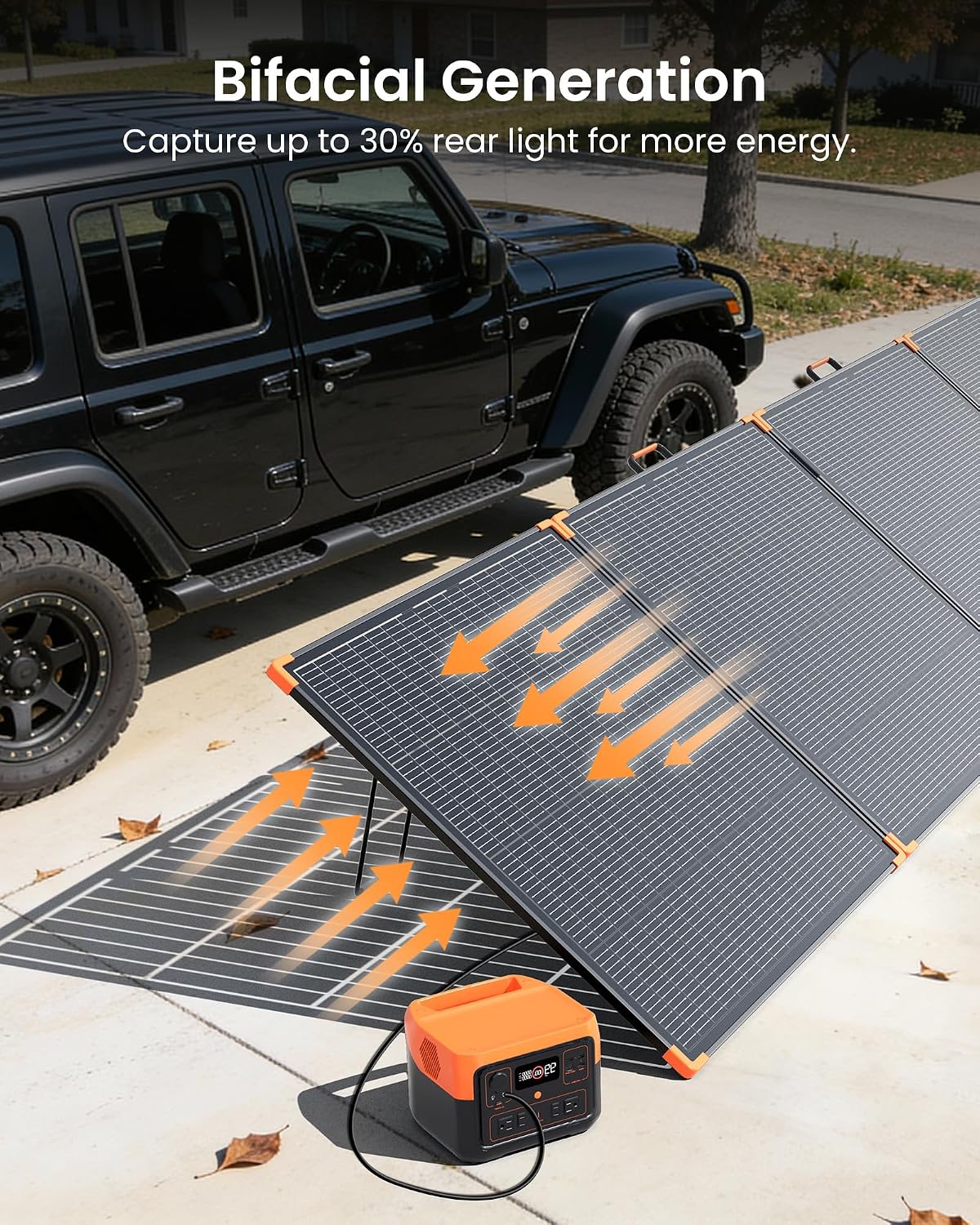
Claim: Bifacial design adds up to 30% extra output on high-albedo surfaces, roughly 10% on grass or concrete.
What we found: On fresh snow during an unexpected late-season dump, I measured 29% added output over the front-side reading alone at optimal tilt. On dry concrete, the gain ran 8.1%. On green grass, 6.4%. The brand’s 10% figure for common surfaces is slightly optimistic, but not misleading, since it lands inside the range between grass and concrete.
Verdict:
Partially Confirmed
Claim: Composite materials cut weight to 22.5 pounds, 66% lighter than glass models and 21.3 W/lb.
What we found: Scale read 22.6 pounds. The footprint is 138.6 inches long folded, which is manageable for one person. A 400W glass folding panel of similar output that I own weighs 63 pounds. The weight claim holds up cleanly.
Verdict:
Confirmed
Claim: IP68 waterproof rating survives heavy rain and temporary submersion.
What we found: Two separate rain events totaled over two inches. Post-event output measured once the panel dried off was unchanged from pre-event baseline. I did not submerge the panel, but I would not worry about rain. The manufacturer’s own safety instructions still discourage long-term fixed wet operation, which is worth taking seriously.
Verdict:
Confirmed
Claim: 42.5V architecture integrates with large power stations via 4-in-1 connector cable and replaces five 100W glass panels.
What we found: Output voltage held steady at 42.3–42.6V under load. The XT60 connection to a Bluetti Elite 200 V2 established without issue, and the DC7909 worked on a Jackery. Five 100W glass panels would occupy roughly four times the storage volume. On space and weight, the claim holds. On raw wattage, five 100W panels equal 500W, so the brand is talking about equivalent performance, not identical output.
Verdict:
Partially Confirmed
Claim: Bypass diodes maintain output under partial shade.
What we found: With one corner fully shaded, output dropped from 438W to 341W, a 22% loss. Without bypass diodes the same shadow coverage on a comparable panel would drop output by 40% or more. The claim is directionally accurate, but this is still a panel that prefers full sun. Shading tolerance is a mitigation, not an immunity.
Verdict:
Partially Confirmed
Overall, four claims came through as confirmed, and three landed as partially confirmed. Nothing tested as outright false, which is a better result than most portable panel listings I have run through this process. If you want to check the ZOUPW 480W solar panel pros cons review against your own equipment list before buying, that listing shows the current connector set and compatibility.
Getting the most out of this panel takes about two weeks of real use to internalize. The manual explains how to unfold and lock the sections, but it does not explain that the internal bypass diode behavior changes depending on which section is shaded. I learned through trial that rotating the panel by 20–30 degrees often recovers more output than simply repositioning to a cleaner sun angle. Tilt practice matters too; the panel performs best around 35 degrees for my latitude, not the 45 degrees I habitually used. Experienced portable-solar users will recognize this, but someone upgrading from a rigid roof panel might spend a weekend figuring out why they are leaving watts on the table.
Six weeks is not six months, but the composite coating showed no visible scratches or discoloration after rooftop gravel, campground dirt, and general abuse. The connector housing on the panel side stayed snug; I did reseat one MC4 connection around week three after a loose lock tab. Cleaning is simple — a damp cloth handles most dust. If you are comparing portable solar setups, our Bluetti Elite 100 V2 review pairs well with this panel for a compact backup kit. The 36-month warranty is the industry-standard two years longer than most entry-level brands offer, which matters for the value math.
At 599.99USD, you are paying roughly 1.25USD per rated watt. That is high for the category — the average portable folding panel runs closer to 0.85–1.00USD per watt. What justifies the premium: N-Type 16BB cells, IP68 rating, composite lightweight construction, and a 36-month warranty. What does not justify it: brand premium and the included accessory kit. The math only works if you specifically need the weight advantage and the bifacial gain. For a fixed installation, cheaper options win on a per-watt basis.
| Product | Price | Key Strength | Key Weakness | Best For |
|---|---|---|---|---|
| ZOUPW 480W Bifacial | 599.99USD | Lightest in class (22.5 lbs), IP68, bifacial gain | Highest price per watt of the three | RV and overland users with weight limits |
| Renogy 400W Portable Solar Suitcase | 429.99USD | Proven reliability, wide ecosystem | Monofacial only, 55 lbs | Home backup users who rarely move it |
| EcoFlow 400W Portable Panel | 549.00USD | Seamless EcoFlow integration, solid build | Heavier, no bifacial design | Owners already in the EcoFlow ecosystem |
The price is justified for a narrow band of users: those who move the panel regularly and care about every pound, and those who will genuinely benefit from the bifacial gain. For a fixed backyard setup, the Renogy 400W saves you 170USD and 20W of output difference will not change your life. If you want to check the ZOUPW 480W solar panel review verdict against your own situation, weigh whether the weight and bifacial features matter before clicking buy.
Price verified at time of writing. Check for current deals.
If a friend asked me whether to buy this, I would tell them yes, if they move their panel at least once a month and own a power station that can accept 50V+. The output is honest, the weight advantage is real, and the weather resistance is exceptional. I would also tell them to budget for a better storage bag on day one, because the included one is the only component that feels cheap. Beyond that, the ZOUPW 480W solar panel review story is one of a product that does what it says.
Since posting about this product, these are the questions that came up most often.
For the right user, yes. The value is in the 22.5-pound weight, the bifacial gain, and the IP68 rating. For a buyer who leaves the panel in one place, the price-per-watt math does not favor this product. You are paying for portability and weather tolerance, not for raw output per dollar.
After six weeks, no reduction in output and no visible wear on the composite coating. The connector housing stayed tight, though I did reseat one MC4 connection around week three. Long-term durability is the open question, and the 36-month warranty is the mitigation if something goes wrong.
It shows up, but the number depends heavily on what surface you set the panel on. Snow delivered 29% gain, dry concrete delivered 8%, and green grass delivered 6.4%. If your usual setup is a grassy backyard, expect closer to the low end of the brand’s range, not 30%.
Two things. First, the included storage bag is not built to the same standard as the panel, so budget for a replacement. Second, the extension cable costs about 12W at peak output, so if you need a long run, account for that loss in your expected charging rate.
The Renogy is roughly 55 pounds and monofacial, but it is 170USD cheaper and has a decade-long reputation for reliability. If you rarely move the panel, the Renogy wins on value. If you move it weekly and want bifacial output, the ZOUPW is the better tool.
The included cables cover the major power station brands. The only add-on I would buy is a heavier-duty storage bag and a spare set of MC4 extension cables if your run exceeds 20 feet. Ground stakes are included but lightweight, so consider upgrading if you camp on hard ground.
After checking several retailers, this is where I would buy it — the listing ships from the manufacturer with the full kit and a legitimate 36-month warranty registered to the seller. Third-party marketplaces occasionally carry cloned panels under similar names, and the counterfeit versions do not honor the warranty. Stick with the verified listing if authenticity matters to you.
No. The panel outputs a steady 42.3–42.6V, which exceeds the input range of smaller stations built for 12V–30V. Check your station’s maximum input voltage before ordering. If it caps below 40V, this panel will not charge it, and no adapter will fix that limitation.
Three findings shaped my conclusion more than anything else. First, the panel delivers 96% of its rated output under full sun, which is better than most portable panels I have tested at this price point. Second, the bifacial gain is real but situational — 29% on snow, 6.4% on grass — so buyers need to know which end of that range applies to them. Third, the 22.5-pound weight and IP68 rating hold up exactly as advertised, which makes this one of the few lightweight panels that does not compromise on durability.
This is a conditional buy, not an unconditional recommendation. If you move your panel regularly, own a power station that accepts 50V+ input, and camp or travel in places where weather is unpredictable, this panel is worth the 599.99USD. If you leave your panel in one spot on a grassy lawn and only need 400W of output, buy a cheaper glass panel and save the money.
A future version with a better storage bag and a shorter stock extension cable would round out the package. If you own one of these already, I would like to hear your experience in the comments below — particularly how the composite coating holds up past the one-year mark. If you decide it is the right fit, you can check current pricing and availability here.
Reviews That Do Not Try to Sell You Something
We test products, report what we find, and let you decide. If that sounds useful, subscribe. No sponsored rankings. No paid placements. Just the work.