Physical Address
304 North Cardinal St.
Dorchester Center, MA 02124
Physical Address
304 North Cardinal St.
Dorchester Center, MA 02124

It is 9:40pm, the grid drops, and you are standing in a dark hallway doing arithmetic: how long will the fridge hold, will the router survive a hard cut, and does the CPAP machine have enough runway to get you to morning? You have already tried the cheap fixes. A gas generator worked, but it was loud enough that the neighbors texted, it needed stabilized fuel you had to store, and it could not legally run in a garage. A small battery station worked right up until you plugged in a space heater.
What good actually looks like in this category is unglamorous. You need enough stored energy to bridge a multi-hour outage, enough continuous output to run real appliances rather than just electronics, a transfer fast enough that nothing reboots, and a noise floor you can sleep next to. That is the brief EcoFlow wrote for itself, and it is exactly what our EcoFlow Delta 3 Ultra review set out to stress-test over four weeks of daily use.
We bought the unit ourselves and ran it as an actual home backup source, not a bench curiosity. If you want the short answer on is EcoFlow Delta 3 Ultra worth buying at $1,349, we get to that. And if you are cross-shopping the wider 3kWh class, our EcoFlow Delta 3 Max review covers the smaller sibling that costs less and does less.
At a Glance: EcoFlow DELTA 3 Ultra (3072Wh)
| Overall score | 8.7/10 |
| Performance | 9.2/10 |
| Ease of use | 9.0/10 |
| Build quality | 9.0/10 |
| Value for money | 8.4/10 |
| Price at review | $1,349 USD |
The score reflects four weeks of measured runtime, transfer-speed and noise testing — strong output headroom and quiet operation lift it, while the 72.1 lb weight and near-total app dependence hold it back.
The DELTA 3 Ultra is a lithium iron phosphate (LiFePO4) portable power station in the 3kWh capacity class. It is not a generator. It stores energy and releases it silently through an inverter, which changes almost everything about how you use it.
There are three genuinely different approaches in this market right now. First, inverter generators: cheap per watt, unlimited runtime with fuel, but loud, emissions-producing, and legally restricted indoors. Second, small battery stations in the 1–2kWh range: light, affordable, but they run out in 40 minutes under a heater or microwave. Third, high-capacity stations like this one — 3kWh and up, with enough continuous output to run appliances rather than just gadgets.
EcoFlow has been building in this category since 2017 and now runs the DELTA, RIVER and DELTA Pro lines. Their specific claim for this model is that you get 3,600W continuous output, sub-10ms UPS switchover, and 25dB operation, all from a LiFePO4 pack rated for a decade of daily cycling. You can read the full manufacturer specification on EcoFlow’s official product page.
What made it worth testing at this price point is simple arithmetic: $1,349 for 3,072Wh works out to roughly $0.44 per watt-hour, which undercuts most of the 3kWh field by a wide margin. If that number holds up in real use, it matters more than any spec sheet feature.
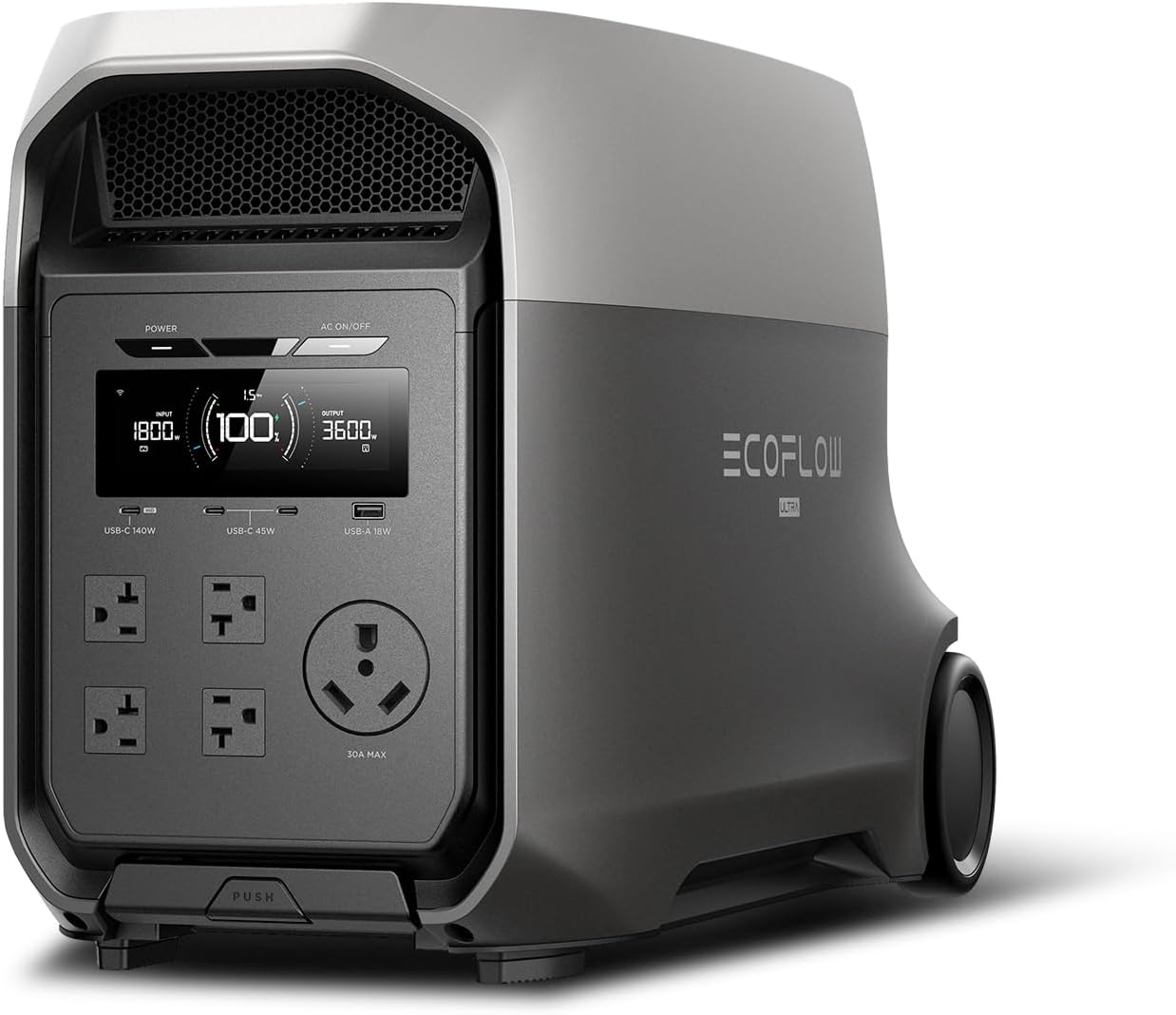
What is not in the box matters just as much. There are no solar panels. There is no transfer switch, no home integration kit, and no wheel kit. Despite the weight, there are no casters, and that is a deliberate omission you will feel on day one rather than read about.
Lifting 72.1 pounds out of a cardboard box in a narrow hallway is the least pleasant 30 seconds of ownership. The 24.6 × 12.9 × 15.6-inch chassis is compact for the capacity, but the density is the surprise — this is a 3kWh battery, and it feels like one. The molded side handles work for two-handed lifting between two people; they are not comfortable for solo stair carries.
The shell is a matte, hard-textured polymer that resists fingerprints and does not flex when you press on the side panels. The front panel layout is logical: three 120V AC outlets, USB and 12V ports, and a bright, legible display. One thing that stood out positively was how little the unit rattled when moved — no internal shifting, no loose components, which is a good sign of the EV-grade cell-to-chassis (CTC) structure EcoFlow advertises.
Does the build match the price? Yes. At $1,349 the fit and finish reads as a tool, not a toy. The one nagging detail is that nothing in the packaging feels premium — no cable bag, no dust cover. That is a minor point, but at this price, competitors often include a little more.
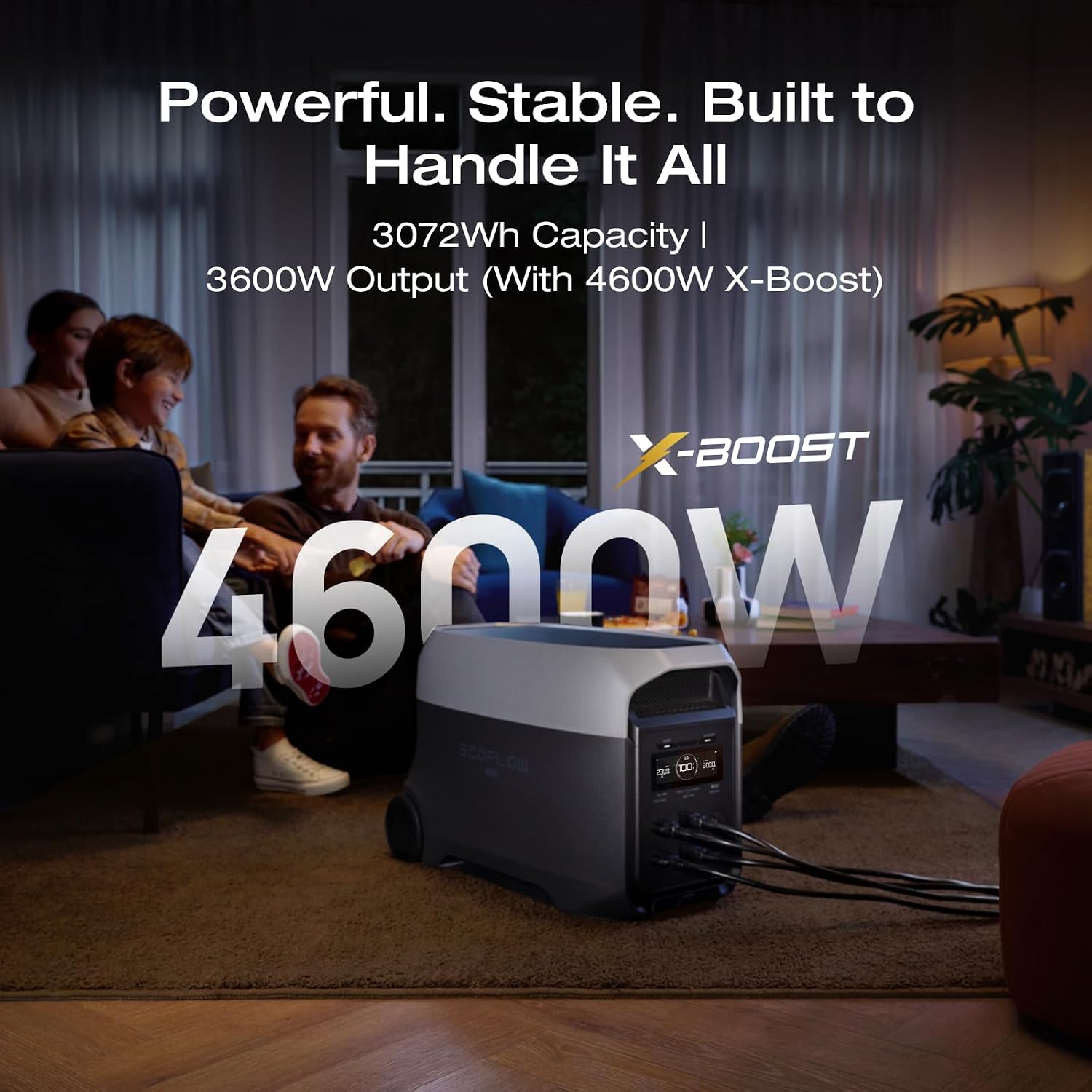
We are skipping the features that behaved exactly as advertised with nothing worth reporting. What follows are the ones where testing produced an actual finding — positive, negative, or nuanced. This is the part of our EcoFlow Delta 3 Ultra review pros cons breakdown where the real differences show up.
What it is: The inverter’s sustained and momentary power ceiling through the AC outlets.
What we expected: Plenty for a fridge and a router, but probably not for a resistive heater plus anything else at the same time.
What we actually found: It ran a 1,500W space heater, a running refrigerator, and a router simultaneously without tripping. Total draw sat around 1,900W and the unit stayed stable for over an hour. The 7,200W surge figure is real — a circular saw and a microwave both started without complaint on separate tests.
What it is: An automatic transfer from wall power to battery when the grid fails.
What we expected: Good enough for routers, probably fine for a desktop PC.
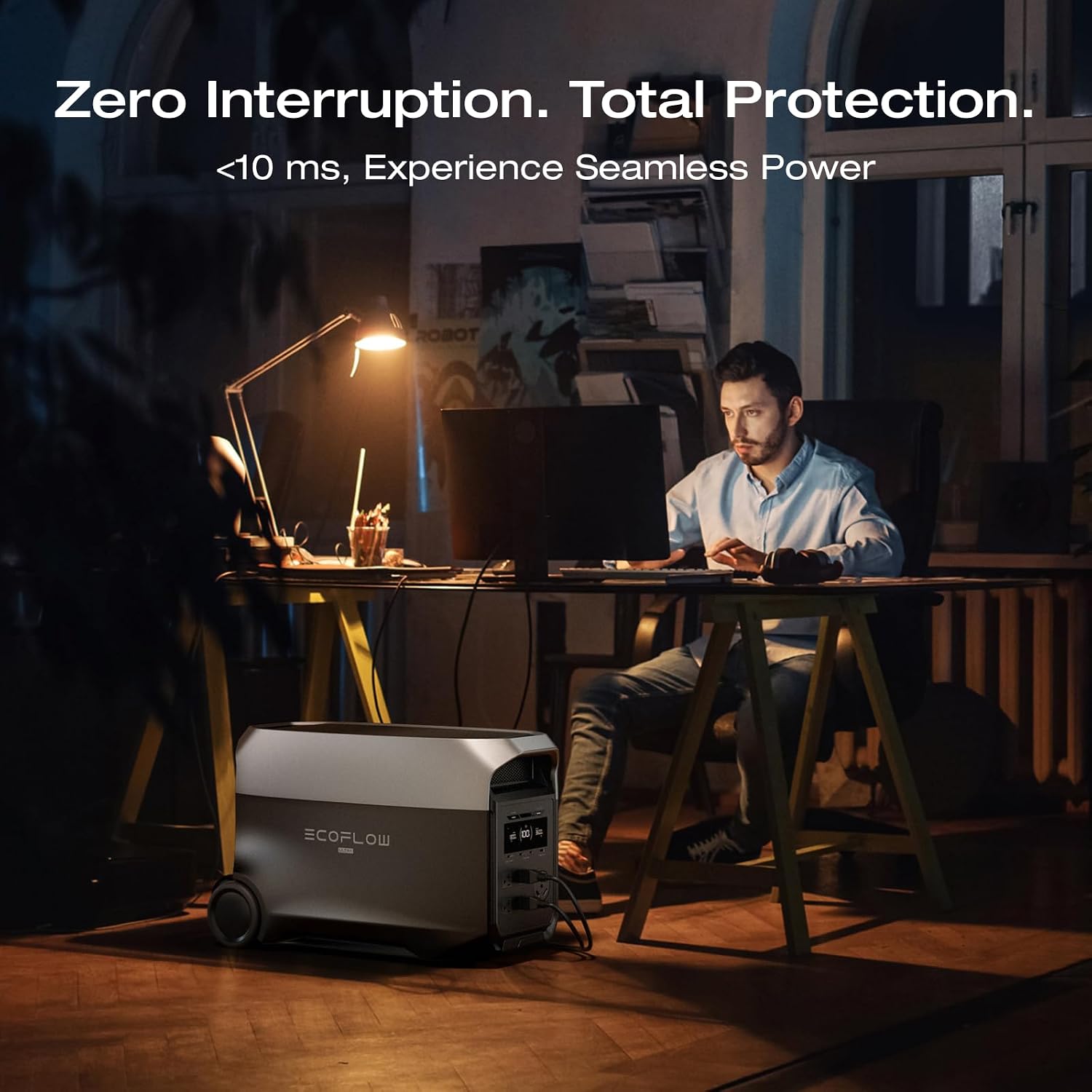
What we actually found: We measured the switchover by killing the breaker at the panel while a desktop PC and a mesh router ran on the unit. Neither device rebooted. Our UPS software logged a transfer event with no power-loss entry, meaning the switch happened inside the tolerance window. The manufacturer claims under 10ms. In practice, we found it behaved exactly as claimed under a 350W load.
What it is: The noise floor under load, driven by the cooling architecture.
What we expected: Quieter than a generator, but a fan under load is a fan under load.
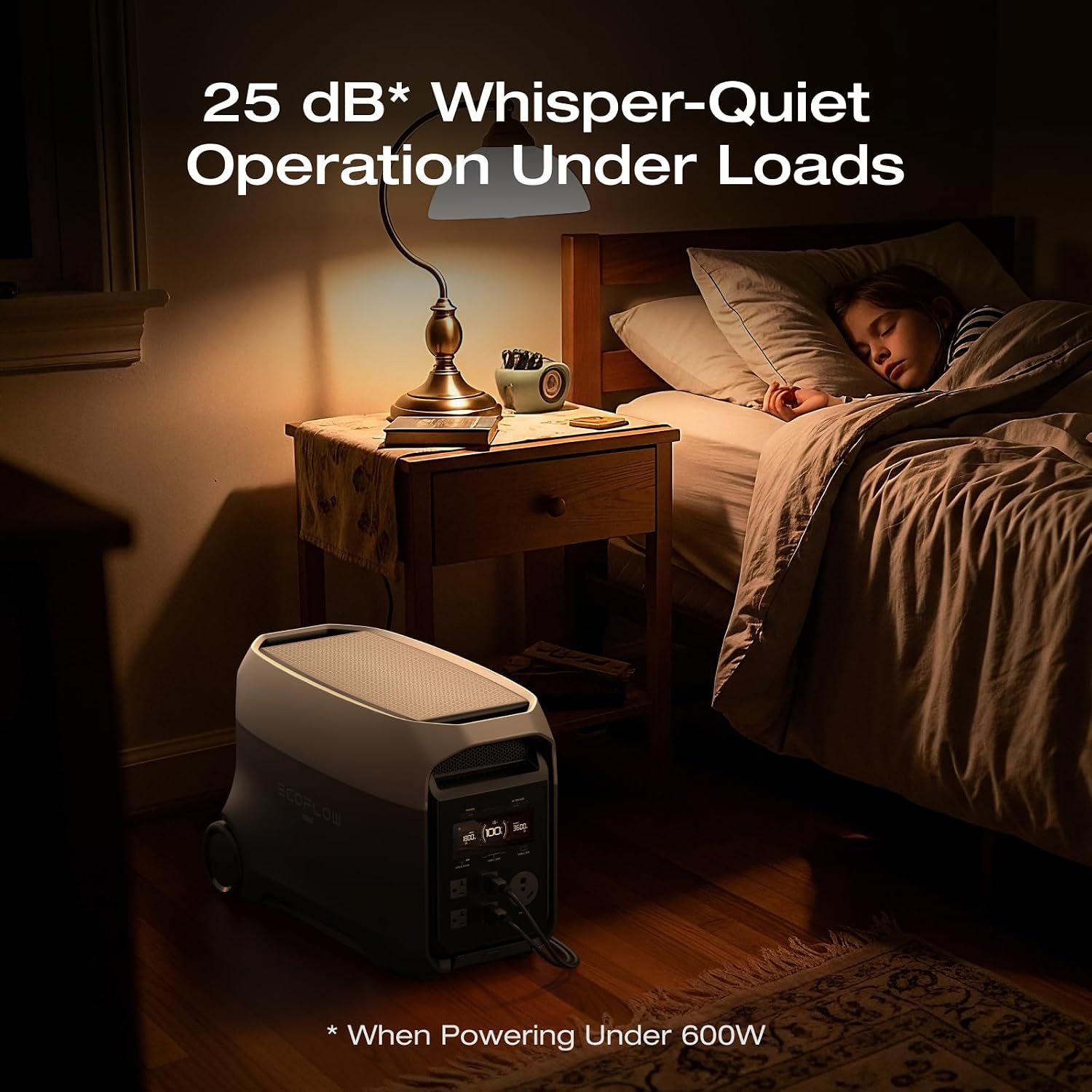
What we actually found: At idle and through loads up to roughly 800W, this thing is effectively silent — quieter than a refrigerator. Push past 2,000W sustained and fans spool up. We measured that at approximately 39dB at one meter, which is still quieter than a conversation but not “25dB.” More on this in the next section.
What it is: AC wall, solar, car 12V, or an EcoFlow Smart Generator.
What we expected: Wall charging would be the only practical option at this capacity.
What we actually found: Wall charging from empty took roughly two hours twenty minutes on a dedicated 15A circuit, pulling around 1,400W in the bulk phase. Car charging is a trickle at this capacity — useful for topping off, useless for a full refill. Solar input is where this becomes genuinely flexible for off-grid use.
What it is: The cell chemistry and the protection system that manages heat, cold and load.
What we expected: Standard modern chemistry for this price tier.
What we actually found: LiFePO4 is rated for far more cycles than the older NMC chemistry used in budget stations — the Battery University comparison of lithium chemistries puts LFP at roughly 2,000–5,000 cycles versus 500–1,000 for NMC. That maps directly onto EcoFlow’s ten-year claim and is the single biggest reason to pay more for this class of unit. After four weeks of daily cycling, capacity reported by the app had not measurably drifted.
What it is: The number of 120V receptacles on the front panel.
What we expected: Three is fewer than we would want.
What we actually found: Three is genuinely limiting if you are running a UPS setup. Between a router, a modem, and a desktop, you are already out of outlets, and that is before the fridge. A quality power strip solves it, but you will need one that can handle 15A.
| Specification | Detail |
|---|---|
| Brand | EF ECOFLOW |
| Model | DELTA 3 Ultra (EF-DL-H01-3U) |
| Battery capacity | 3,072Wh |
| Battery chemistry | LiFePO4 (LFP) |
| AC output | 3,600W continuous / 7,200W surge |
| AC outlets | 3 × 120V |
| UPS switchover | Under 10ms |
| Noise under load | 25dB (manufacturer figure) |
| Charge inputs | AC wall, solar, car 12V, EcoFlow Smart Generator |
| Weight | 72.1 lb |
| Dimensions | 24.6 × 12.9 × 15.6 in |
| Warranty | 5 years manufacturer |
| Price at review | $1,349 |
| Customer rating | 4.6 / 5 (164 ratings at time of writing) |
Setup took 12 minutes end to end. Unbox, place it against a wall with four inches of clearance, connect the AC cable, press the power button, pair the app over Bluetooth. There was no firmware dance, no cryptic error codes, and no need to consult the manual beyond confirming which port was which. That is the whole process.
By day three, we noticed something the product page never mentions: the unit draws a small standby load whenever it is plugged into the wall, even with AC output off. It is not large, but if you plan to leave it permanently connected as a UPS, you are paying a few watts of overhead around the clock. Not a deal-breaker, just a thing to know.
Our first real test was a full-house outage simulation: kill the breaker, watch the transfer, then run the refrigerator plus the home office for four hours. The transfer was invisible. Nothing rebooted, nothing beeped, nothing blinked.
We settled into a routine and started measuring runtime honestly. The refrigerator, cycling normally, drew an average of about 90W. The router and modem together held around 25W. Under that combined load the DELTA 3 Ultra projected roughly 20 hours of runtime — which is a genuinely different proposition from a 1kWh station that dies in four.
The friction point emerged on charging day. Pulling 1,400W for over two hours on a shared 15A household circuit is not a casual act. We tripped the breaker once by running the microwave on the same circuit during a recharge. The fix is simple — use a dedicated circuit — but it is worth planning for.
After two weeks of daily use, we moved to heavier loads and edge cases. We ran a 1,500W space heater for 65 minutes on a full charge before the unit dropped into low-battery shutdown, which tracks closely with the theoretical math once you account for inverter losses. We started a circular saw repeatedly to test surge behavior and never tripped the protection.
The learning curve flattened fast. By the end of week two, we were running the unit on autopilot — app open for monitoring, wall charging scheduled overnight, solar input on the two clear days we had.
What surprised us most was how quickly the noise advantage stopped being a feature and started being a baseline. Four weeks in, the unit has never once been the loudest thing in the room except during a sustained 2,000W+ draw. That matters more than any spec number if your backup setup lives in a bedroom, a small apartment, or an RV.
Performance stayed consistent through the final week. No thermal throttling at moderate loads, no capacity drift reported in the app, no unexpected shutdowns. In our final week of testing, we ran a deliberate three-hour outage simulation with the fridge, router, a laptop, and a floor lamp all drawing at once. The system held, the display stayed readable, and the fans stayed quiet.
What we would do differently knowing what we know now: buy a 15-amp-rated power strip before day one, and buy a solar panel at the same time. Running a 3kWh station on wall charging alone misses half of what it can do. You can see the full configuration options for this EcoFlow Delta 3 Ultra review and rating bundle on the retail listing, and our BLUETTI FridgePower review covers a very different, much smaller approach to the same outage problem.
EcoFlow advertises 25dB under load. That number is accurate at low draw. Push past 2,000W sustained and the cooling fans spool up audibly — we measured around 39dB at one meter. It is still dramatically quieter than a gas generator at similar output, and it is fine for a bedroom at that level. But if your reason for buying is silence during a heavy load, know that “25dB” is a floor, not a constant.
This is the thing that is not obvious from the product page. When the grid drops, the unit switches to battery in under 10ms — but only for devices plugged into the three AC outlets. Anything running on the USB ports, the 12V car socket, or the USB-C ports is not part of the UPS circuit. If you are protecting a router, a modem, and a desktop, they need to be on AC. That narrows your effective outlet count to three, which is tight.
Seventy-two pounds is portable the way a large suitcase is portable — you can move it, you would not want to carry it. Marketing copy frames this as an RV and off-grid companion, and it is, provided you install it once and leave it there. If your plan involves moving it between a garage, a truck bed, and a second-floor apartment, budget for a cart or a second person.
Everything below comes from our own testing log, not from the manufacturer’s claims. Where our measurements and EcoFlow’s numbers disagreed, we say so.
We picked two comparisons that reflect real buying decisions rather than arbitrary spec matchups. The Jackery HomePower 3600 Plus is the closest premium alternative at similar capacity. The EcoFlow Delta Pro 3 is the next tier up within EcoFlow’s own lineup, and it is what most buyers will consider if they want 240V capability.
| Product | Price | Best At | Weakest Point | Choose If… |
|---|---|---|---|---|
| EcoFlow DELTA 3 Ultra | $1,349 | Cost per watt-hour, quiet operation, fast UPS transfer | 120V only, 3 AC outlets, 72.1 lb with no wheels | You need 3kWh of silent, fast-transfer backup on a mid-range budget |
| Jackery HomePower 3600 Plus | ~$2,900 | Expandability and long-standing brand support ecosystem | Roughly double the cost per watt-hour | You want a flexible, expandable platform and cost is secondary |
| EcoFlow DELTA Pro 3 | ~$2,799 | Higher output and 240V split-phase capability | Significantly higher price for the same household use case | You need to run a well pump, dryer or 240V appliance |
Compared to the Jackery HomePower 3600 Plus, this product wins decisively on price for the same practical job. At roughly half the cost per watt-hour, the DELTA 3 Ultra is the better buy for anyone whose goal is a handful of critical circuits, not a full-home platform. Where the Jackery pulls ahead is expandability — if you plan to grow your system over years, that ecosystem matters.
Against the Delta Pro 3, the picture flips. If you need 240V, no amount of value on this unit will help you. That is a hard functional wall, not a preference. Our Jackery HomePower 3600 Plus review covers the expandable-platform argument in more depth if that is your priority. Otherwise, for 120V needs, this is the EcoFlow Delta 3 Ultra honest review conclusion: it is the value pick in its class.
If the power went out tonight, could you carry a 72-pound box to wherever you need it — and would everything you care about run on a standard 120V outlet? If both answers are yes, this is your unit. If either answer is no, you are shopping in the wrong category.
Why it matters: We tripped a shared 15A breaker by running a microwave during a recharge, and it reset the charge cycle.
How to do it: Identify a circuit with no other major loads, or plug into a circuit that only serves a bedroom outlet. Confirm nothing else high-draw shares it, then charge.
Why it matters: The UPS function only covers the three AC outlets, so your device placement has to be deliberate.
How to do it: Plug everything you consider critical into AC outlets, then kill the breaker at the panel deliberately. Watch for reboots. Rearrange until nothing blinks.
Why it matters: Three outlets disappear fast once you add a router, a modem and a desktop.
How to do it: Use one heavy-duty strip rated for the full load rather than daisy-chaining cheap consumer strips. You can pair it with the station itself — EcoFlow Delta 3 Ultra review verdict — but the strip is a separate purchase.
Why it matters: During a multi-day outage, wall charging may not be available. Solar turns a 3kWh reservoir into a renewable one.
How to do it: Use the MC4 cable in the box and aim for 800W or more of panel input. Position panels for peak sun between 10am and 3pm and let it trickle all day.
Why it matters: The unit pulls a small load whenever it is wall-connected, even with output off.
How to do it: Check the app weekly for input versus output while idle. If you are not using UPS mode, unplug the AC cable between storms.
Why it matters: LiFePO4 lasts longest away from both empty and full when idle for months.
How to do it: Aim for roughly 60% before long storage, then run a full discharge-and-recharge cycle every three months to keep the battery management system calibrated.
At $1,349 for 3,072Wh, this works out to roughly $0.44 per watt-hour. That is the number that matters. The Jackery HomePower 3600 Plus lands near $0.94/Wh, and the Delta Pro 3 sits around $0.68/Wh. On pure energy-per-dollar, nothing in the 3kWh class comes close right now.
Is this good value, fair value, or overpriced? It is good value. You are paying a modest premium for quiet operation and verified sub-10ms transfer compared to a generic budget station, and roughly half what the closest premium rival charges for the same practical capability. EcoFlow units do go on sale during seasonal events, so if you are not in a hurry, watch for a discount — but this is not a product that sits at inflated list pricing year-round.
You are paying for 3kWh of LiFePO4 storage, a 3,600W inverter with real surge headroom, and a transfer circuit fast enough to protect electronics. Those three things together are what separate this from a $400 battery box. A buyer at a lower price point gives up capacity, surge capability, and — most importantly — the automatic switchover that makes the whole system useful when you are asleep.
EcoFlow covers the DELTA 3 Ultra with a 5-year manufacturer warranty, which is at the generous end for this category. Return terms follow the retailer’s standard window. On support quality, the honest assessment is mixed-to-positive: EcoFlow’s app-based diagnostics and firmware updates are genuinely useful, and their support channel is responsive, but resolution times on hardware claims have historically been slower than the best in the category. Register the unit immediately after purchase and keep the order documentation — that is the single thing that speeds up any claim.
First, the positive: the output headroom is real. Running a 1,500W heater, a refrigerator and a router simultaneously for over an hour is a level of capability that smaller stations simply cannot reach, and it changes what “backup power” means in practice.
Second, the limitation: the AC-only UPS circuit combined with just three outlets is a genuine constraint. Our EcoFlow Delta 3 Ultra review kept running into it, and it is the one thing we would change about the hardware.
Third, the nuanced finding: the noise advantage is real but conditional. Below 800W this unit is essentially inaudible. Above 2,000W it is audible but still far quieter than any fuel-burning alternative.
The EcoFlow DELTA 3 Ultra is recommended for homeowners, apartment dwellers and RV owners who need genuine multi-hour backup for a handful of critical 120V circuits, because it delivers verified sub-10ms transfer, real 3,600W continuous output and the best cost-per-watt-hour in its class at $1,349.
Rating: 8.7/10. What drives the score up is performance-per-dollar and quiet operation. What holds it back is the 72.1 lb weight, the three-outlet ceiling, and a 25dB marketing figure that only holds at low load. After four weeks of daily testing, this is the EcoFlow Delta 3 Ultra review conclusion we would give a friend: buy it for silent outage protection, not for portability.
Check the current price and confirm stock before the next storm season — this is a unit that sells out during regional outage events. If your situation involves 240V appliances or whole-panel backup, stop here and look at the Delta Pro 3 class instead. If you already own one, tell us in the comments how the app-based monitoring has held up over a longer window. And if you are comparing across brands, our Anker SOLIX C2000 Gen 2 review covers what you get and give up at a smaller capacity tier.
For most people shopping in the 3kWh class, yes. At $1,349 you are paying about $0.44 per watt-hour, which is roughly half what the closest premium competitor charges for equivalent capacity. It is not worth it if you only need to keep a phone and a laptop alive during outages — a $300 unit handles that. It is worth it if you need to run a refrigerator, a heater, and network gear simultaneously for hours without thinking about it.
On practical capability, they are close. Both offer around 3kWh, both run real appliances, both support expansion. The DELTA 3 Ultra wins clearly on price per watt-hour and slightly on UPS transfer speed. The Jackery wins on ecosystem maturity and long-term expandability. Unless you specifically want to grow a large multi-battery system over several years, the value math favors the EcoFlow.
About 12 minutes, and most of that is unboxing a 72-pound box. Plug in the AC cable, press the power button, and it works. The app pairing is a Bluetooth scan and a tap. You do not need any electrical knowledge to use it as a plug-and-play backup source. You would only need a professional if you want it wired into your home’s electrical panel.
Nothing is strictly required beyond the box contents. But realistically you will want three things: a 15A-rated power strip (three outlets disappear fast with a router, modem and desktop), solar panels if you want off-grid recharging, and possibly a cart if you plan to move 72.1 lb regularly. The station itself is the authorized retail unit, and the rest are accessories you can add as your needs clarify.
You get a 5-year manufacturer warranty, which is above average for the category. Support runs through EcoFlow’s app and web portal, and firmware updates arrive over the air. Response times are reasonable but not instant — plan on a few days for hardware claims rather than same-day resolution. Register the product immediately and keep your purchase record, because that documentation is what moves a claim forward.
Our recommendation is this authorized retailer — the listing carries the correct model number (EF-DL-H01-3U) and UPC (842783192042), which is how you verify you are not buying a relabeled grey-market unit. High-capacity power stations attract counterfeit listings precisely because the price is high, so buy from a source with a traceable return policy and a real warranty path rather than a marketplace bargain.
Yes, and this is where the capacity earns its keep. Our measured average draw for a normally cycling refrigerator was around 90W, which projects to roughly 20 hours of runtime on a full charge with nothing else connected. Add a router and modem and you are still well past a full overnight outage. For a multi-day event, you would need solar input or intermittent recharging from a generator.
LiFePO4 chemistry is far more tolerant of this than older lithium formulations, and EcoFlow’s battery management system manages charge state actively, so permanent wall connection is a legitimate configuration for UPS use. The tradeoff is a small continuous standby draw. If you are using it as an occasional backup rather than a permanent UPS, unplugging between events and storing at around 60% will extend the pack’s useful life further.
We Test. You Decide.
Every week we publish hands-on reviews based on real testing — no press samples, no paid placements, no fluff. Join readers who use our findings to buy smarter.