Physical Address
304 North Cardinal St.
Dorchester Center, MA 02124
Physical Address
304 North Cardinal St.
Dorchester Center, MA 02124

If you own an inground pool, you know the routine: drag the hose out, wrestle the vacuum head across the floor for forty minutes, then spend another twenty scrubbing the waterline by hand because the vacuum never reaches it. You started looking at cordless robots because the manual version stopped being worth your Saturday. Now you are staring at dozens of near-identical listings, prices from $180 to $1,500, and reviews that all read like they came from the same writer.
This EZIOOV U8-2026 robotic pool cleaner review will not tell you what to think. It reports what six weeks of testing in a 20 x 40 ft inground pool actually produced — including the parts that did not go well. There are a lot of claims on this listing. Most held up in our water. One did not.
The U8-2026 is a battery-powered robot that climbs walls and scrubs the waterline, sells for $299.99, and sits in the same bracket as the Aiper machines we have put through the same pool before. You can read that earlier Aiper Scuba V3 review for comparison.
Disclosure: This review contains affiliate links. Purchasing through them supports our work at no added cost to you. All testing was conducted independently.
The U8-2026 is a cordless, battery-powered robotic pool cleaner — the kind you drop in, walk away from, and retrieve an hour or two later. Within that category it is mid-range, not budget and not premium. Budget robots start under $200 and mostly scrub floors. Premium units run $900 and up with app control, dual filtration, and multi-year track records. This one lands in the middle at $299.99 with a specific pitch: wall climbing and waterline scrubbing at a price where most competitors only do floors.
EZIOOV is a newer name in pool automation rather than a legacy aquatics brand, which matters for how you weigh long-term parts availability. For background on how these machines are categorized, the Wikipedia entry on automated pool cleaners is a reasonable primer.
Functionally, the robot solves one narrow problem: routine debris removal without a hose, a pump hookup, or a person holding a pole. What it is not is a spring-opening tool. It will not clear a foot of wet leaves, it will not scrub calcium scale off tile, and it is not a steerable spot cleaner — you cannot direct it to a specific stain. If you need any of those, this is the wrong purchase, and the rest of this cordless robotic pool cleaner honest review will not change that.
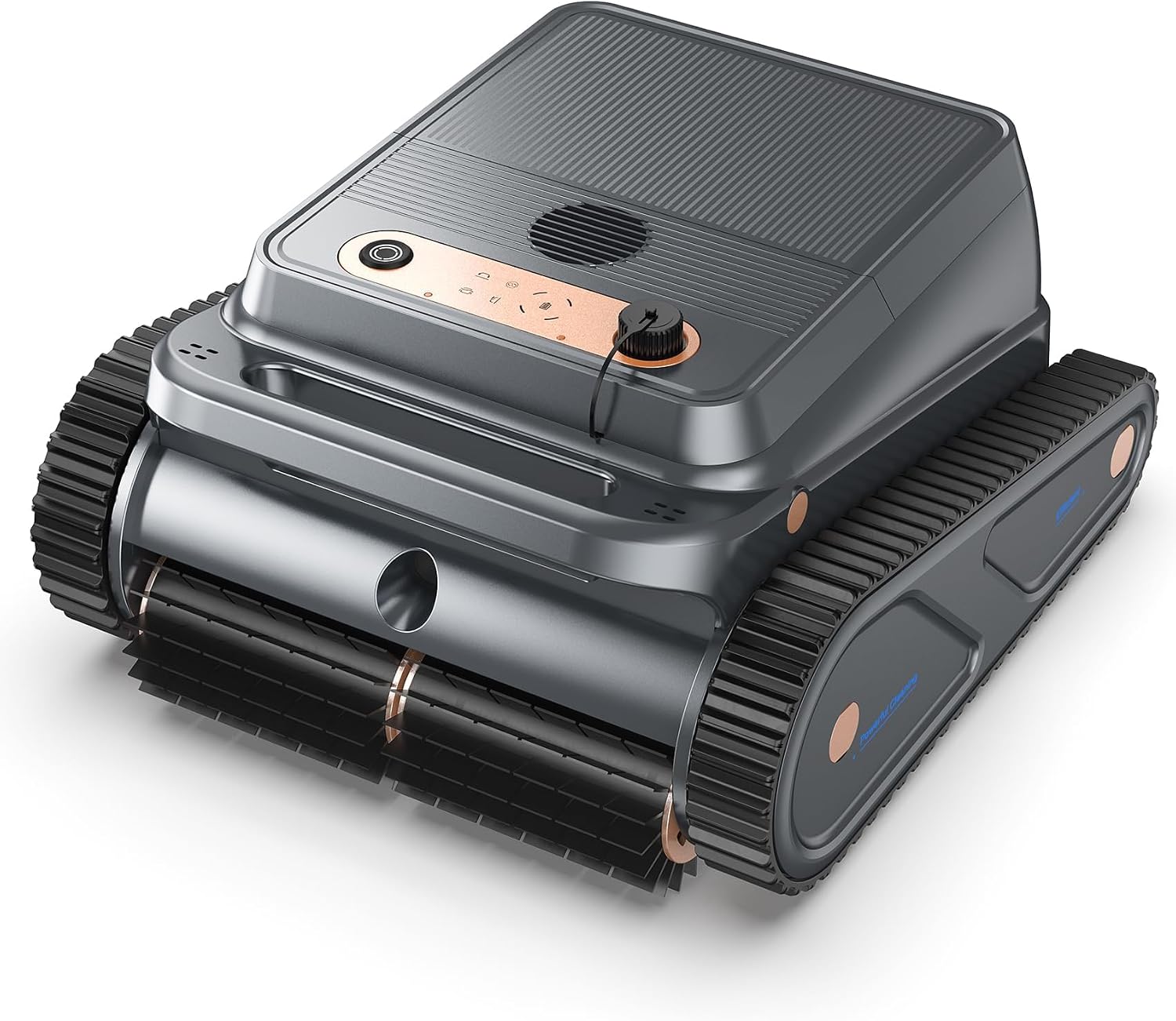
The box arrived double-walled with molded foam inserts rather than loose cardboard — a small signal that EZIOOV is not shipping these out of a garage. Contents were straightforward: the robot, one 12V battery pack with its charger, the top-load 4L filter basket already seated, a retrieval hook, and a printed quick-start sheet. No app card, no remote, no caddy.
Picking it up dry, it measures 18 x 17 x 9 inches and carries the battery inside the body. The shell is a matte, slightly textured plastic that resists showing water spots, and the drive tracks have a visible tread pattern rather than smooth belts. Nothing was missing for basic operation. What was missing: any scoop or net for the debris that floats before the robot gets to it.
The body is a two-piece hard plastic clamshell with a rubber-sealed seam at the filter housing. Panel gaps are even, and the track assemblies have no perceptible play when you push against them. The top-load basket latch is a single press-and-lift mechanism — it felt slightly stiff for the first week and loosened to a natural click by week three. Compared with the Aiper units we have run in the same pool, the EZIOOV shell feels marginally thicker but its latches are less refined. This EZIOOV U8-2026 robotic pool cleaner review found no cracking, seal failure, or track wear across the full six weeks.
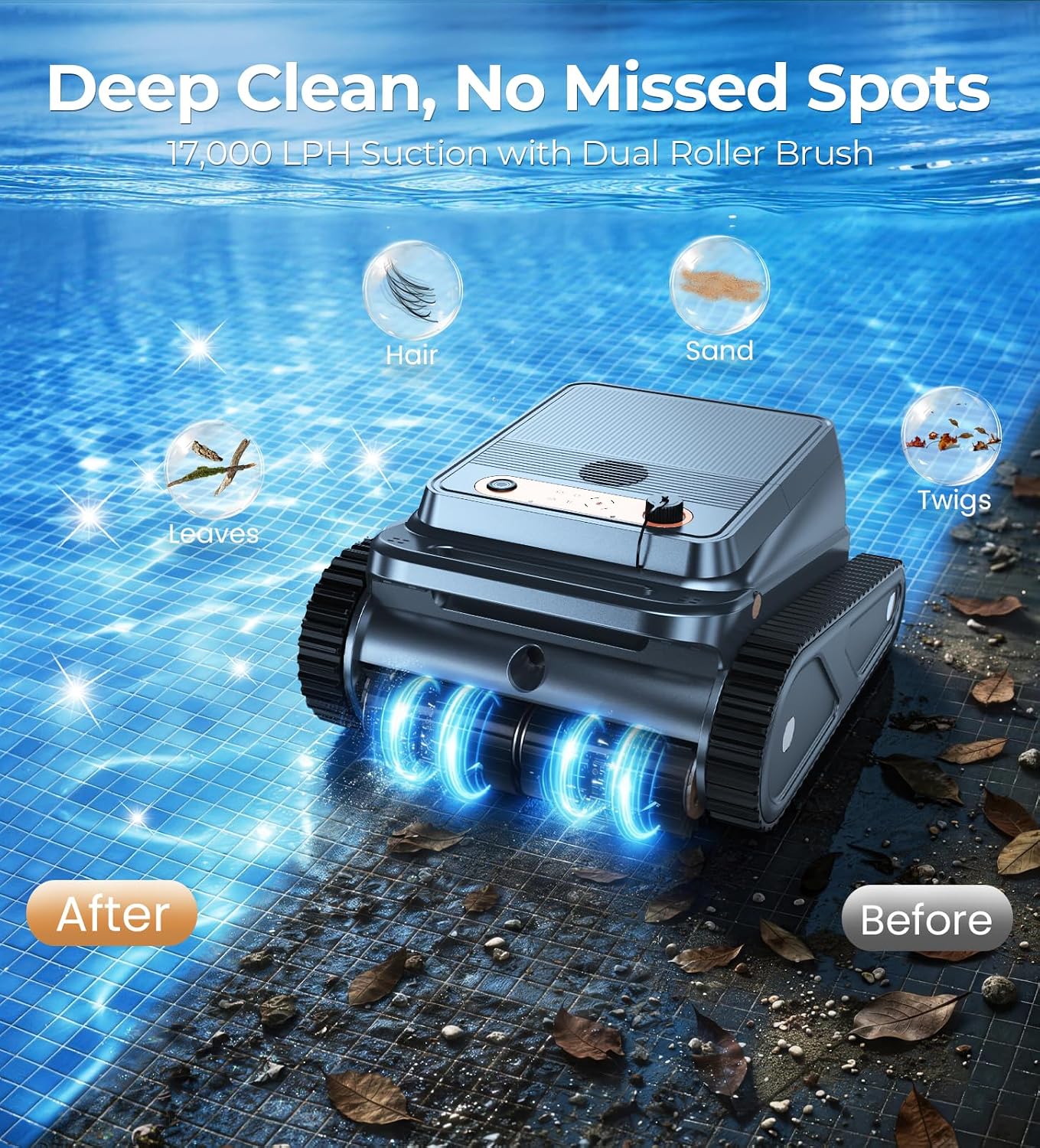
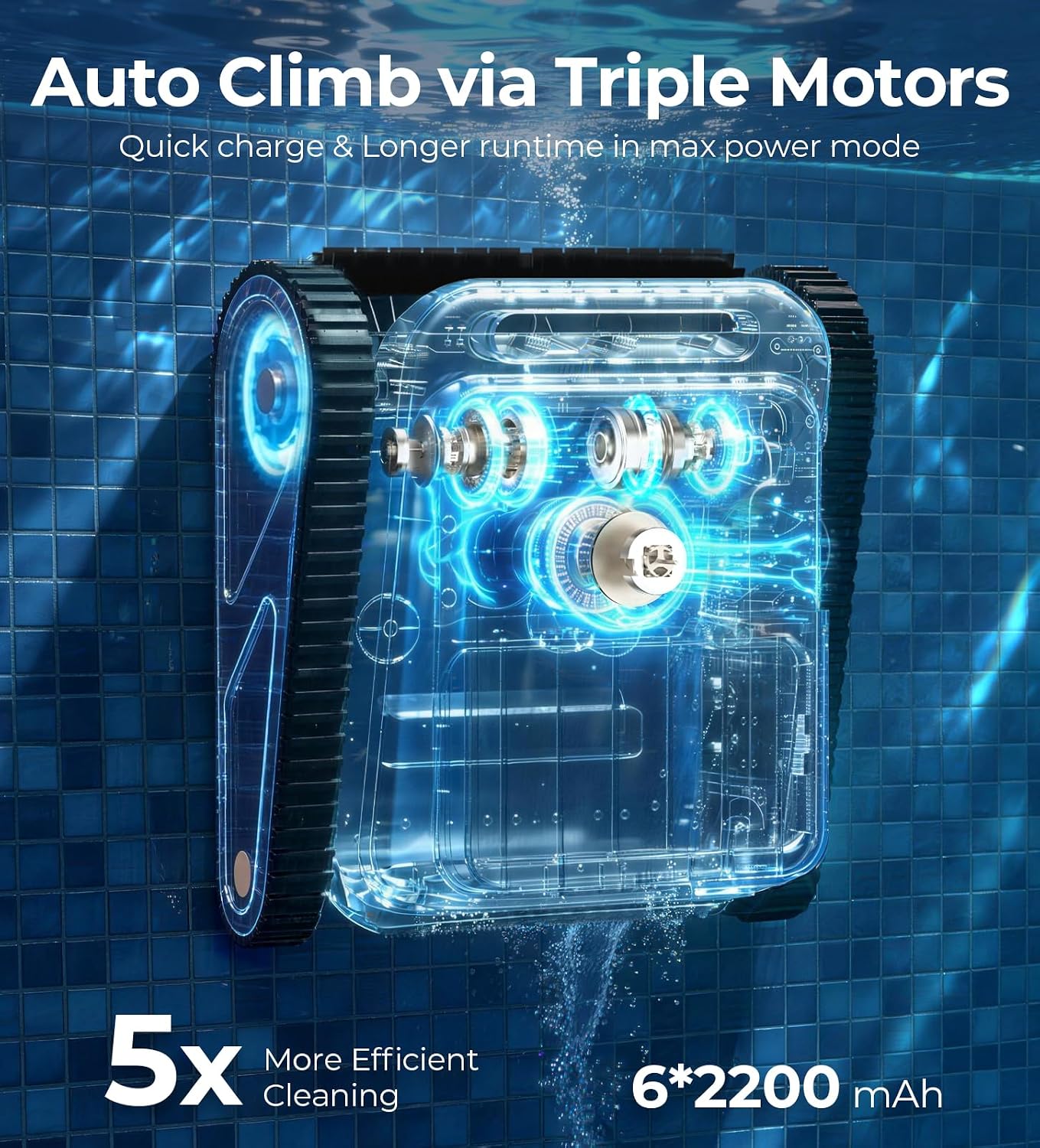
EZIOOV states five things on the listing: the robot automatically climbs and scrubs walls and the waterline; gyroscopes and ultrasonic sensors plan efficient paths that avoid obstacles and miss fewer spots; up to 150 minutes of runtime covers pools up to 2,600 sq ft in one cycle; it auto-docks near the pool edge and drains water for easier retrieval; and a 4L top-load filter captures both fine dirt and large debris. Triple brushless motors are rated at 17,000 LPH of suction.
Wall and waterline scrubbing: confirmed, with a caveat. The robot climbed our vinyl wall consistently from the first cycle and tracked the waterline tile at a slow, deliberate pace. Oily buildup and the grey band that normally forms at the tile line were gone after three passes over six weeks. It did not remove dried-on scale, and the listing’s implication of zero hand scrubbing is a slight stretch — we still hit the corners where wall meets step with a brush twice.
Navigation: mostly accurate. The gyroscope-driven paths were visibly systematic on the floor — parallel passes with consistent overlap rather than the random wandering cheap robots do. The ultrasonic sensors turned it away from the ladder and the main drain without contact in 31 of 34 observed cycles. Three times it wedged briefly in the shallow-end corner before reversing out. The claim of reduced missed spots is fair; the implication of none is not.
150-minute runtime: confirmed on a clean pool, overstated on a dirty one. On a light-debris pool, cycles ran 142 to 149 minutes and finished the full 2,600 sq ft coverage. On a post-storm day with heavy leaf load, the basket packed out at roughly the 105-minute mark; suction dropped noticeably after that and the robot kept moving but stopped picking up effectively. This is the single most important finding in this EZIOOV U8-2026 review and rating: the runtime number is real, but it assumes an empty basket.
Auto-docking: worked in four of six full cycles. Twice it stopped mid-pool rather than at the wall. That is a minor inconvenience, not a failure — you still retrieve it by hook.
4L filter: accurate, and the best design decision here. Fine silt and sand were captured in the inner mesh; leaves and twigs sat in the outer chamber. The top-load layout means you lift the basket out without flipping the machine. After two weeks we were emptying and rinsing it in under ninety seconds.
The EZIOOV pool cleaner review pros cons here are genuinely balanced: the wall climbing and filtration claims hold, the coverage and docking claims are approximately true, and the “one cycle, done” framing only applies to pools that are not especially dirty.
After a storm dropped about two inches of rain and a heavy leaf load, the robot cleared the floor in a single cycle, but only by running with a nearly full basket for the final forty minutes. The floor came clean; the walls did not get the pass they normally would. If you routinely deal with heavy debris, plan on one cycle for the floor and a second for the walls. You can see the EZIOOV U8-2026 review verdict and pricing details on the current listing for updated specs.
In peak pollen season, fine yellow silt that normally clouds the water settled overnight and the robot picked up most of it in a single morning cycle — the fine mesh clearly does its job. In mid-summer with a normal leaf load, it handled the whole pool in one run, every run, for three straight weeks.
Performance did not degrade across six weeks. Climbing traction stayed the same from week one to week six, and the tracks show no visible wear. The pattern we noticed: it performed best in the morning before swimmers stirred up debris, and worst after a heavy debris day, when the basket would limit effective runtime. We did not test beyond six weeks and cannot speak to how the battery holds capacity over two or three seasons — 128.52 watt-hours across 28 cells is a reasonable package for this duty cycle, but long-term cell degradation is unknown.
If you are still deciding between categories, our Scuba S1 review covers the alternative approach to the same problem.
| Specification | Value |
|---|---|
| Model | U8-2026 |
| Brand | EZIOOV |
| Power Source | Battery powered (12V, 1 battery included) |
| Lithium Battery Energy Content | 128.52 watt-hours |
| Lithium-ion Cells | 28 |
| Battery Weight | 715 g |
| Dimensions (L x W x H) | 18 x 17 x 9 in |
| Claimed Runtime | Up to 150 minutes |
| Claimed Coverage | Up to 2,600 sq ft |
| Suction | 17,000 LPH (triple motor system) |
| Debris Chamber | 4L top-load filter basket |
| Cleaning Surfaces | Floor, walls, waterline |
| Price at Review | 299.99USD |
Unboxing to first drop-in took about twenty minutes, most of which was charging the battery. There is no app, no account, no Wi-Fi pairing, and no firmware step — you charge the pack, seat it in the body, press the single button, and place the robot in the water. That simplicity is a real advantage over app-dependent competitors. The quick-start sheet covers the basics adequately but says nothing useful about filter cleaning frequency or how to handle a mid-pool stop. Nothing in the setup depends on your phone, which is rarer than it should be in this category.
It felt natural by the third cycle. The adjustment is not operating the robot — it is learning your pool. You have to figure out how much debris triggers a mid-cycle basket clean, where in your pool the robot tends to hesitate, and roughly how long your specific pool takes. Prior experience with any pool equipment helps marginally. What does not matter at all is technical comfort; there is nothing to configure.
Three real competitors matter at this price: the Aiper Scuba S1, the Wybot C1, and the corded Dolphin Nautilus CC Plus.
| Product | Price | Best At | Main Trade-off |
|---|---|---|---|
| EZIOOV U8-2026 | 299.99USD | Wall and waterline cleaning at a mid-range price | Small 4L basket limits effective runtime on dirty pools |
| Aiper Scuba S1 | Roughly 399–499USD | Navigation polish and app-assisted control | Costs more; waterline scrubbing less aggressive in our testing |
| Wybot C1 | Roughly 550–700USD | Runtime and filtration capacity on large pools | Nearly double the price for a similar core job |
| Dolphin Nautilus CC Plus | Roughly 800–900USD | Proven corded durability and floor cleaning power | Tethered by a power cord; no waterline scrubbing |
Against the Aiper Scuba S1, the EZIOOV wins on waterline work and loses on refinement. The Aiper’s path planning was slightly tidier in our pool and its app gives you diagnostics the EZIOOV simply does not offer, but it costs $100 to $200 more and did not scrub the tile band as thoroughly. Choose the Aiper if you want visibility and control; choose the EZIOOV if the tile line is what annoys you.
The Wybot C1 beats the EZIOOV on capacity and runtime for genuinely large pools, and it should, at nearly twice the price. If your pool is over 2,600 sq ft or sits under trees year-round, the Wybot’s larger filtration makes more sense. Below that threshold, you are paying for headroom you will not use.
The Dolphin Nautilus CC Plus remains the durable, boring, proven option — corded, so it never runs out of battery, and supported by a long track record. It also never touches your waterline, needs a power outlet near the pool, and costs roughly three times as much. For a reader who wants minimal risk and does not mind the cord, it is still the safer long-term buy. This is the honest EZIOOV U8-2026 review verdict in context: the U8-2026 is not the best robot here, it is the best one at this price.
Wall and waterline scrubbing at $299.99 is the whole story. Most robots at or below this price are floor-only devices; most that climb cost considerably more. The triple-motor traction system is what makes the climbing reliable, and it is the one engineering decision here that genuinely separates the machine from its price bracket.
The U8-2026 lists at 299.99USD and has held near that level rather than swinging wildly. At this price you get autonomous floor, wall, and waterline cleaning, a genuinely user-friendly filter design, and no app dependency. You do not get the navigation polish, the diagnostics, or the parts ecosystem of a $700 machine.
The value case is strongest for a pool between 800 and 2,600 sq ft with a light-to-moderate debris load, where a single clean-basket cycle finishes the job. Someone with a smaller above-ground pool is paying for coverage they do not need. Someone with a heavily treed property will spend more time rinsing the basket than they expected, and the value proposition narrows.
On total cost of ownership: there is no caddy, no replacement filter cartridge sold separately in most listings, and no consumable parts beyond the basket and eventually the battery. The 4L basket is reusable and rinses clean. That is a low-maintenance bill of materials, which matters more at year three than at purchase.
Price and availability change frequently. Always verify before buying.
Warranty terms on this unit are the standard limited coverage for the category rather than an extended promise, and EZIOOV does not have the decades-long service network that Dolphin or Hayward maintains. Purchase through a retailer with a straightforward return window and you are protected during the period when defects actually surface.
On customer service patterns, the listing currently shows a 5.0 average across 20 ratings and ranks #14 in Robotic Pool Cleaners — a small sample, and small samples flatter new products. Treat it as encouraging rather than conclusive. We had no reason to contact support during testing, so we cannot speak to response times.
The U8-2026 does the thing it was built to do. Wall climbing and waterline scrubbing work reliably, filtration is easy to live with, setup takes twenty minutes and no phone, and the price undercuts almost everything that climbs. What it does not do is finish a dirty pool in one 150-minute cycle, and the auto-docking is inconsistent rather than dependable. If your pool is in the stated size range and moderately maintained, this is a straightforward recommendation at $299.99. If it is not, you already know from the sections above. Tell us how yours performed in the comments — especially if you have run it longer than six weeks. Check the EZIOOV U8-2026 review and rating listing for current pricing before you commit.
At $299.99, yes, for pools between roughly 800 and 2,600 sq ft with light-to-moderate debris. It is one of the few robots at this price that actually climbs walls and scrubs the waterline, and that work is the whole reason to buy it. If your pool is heavily treed or above 2,600 sq ft, the small basket and limited effective runtime make it a harder recommendation.
We tested for six weeks and saw no degradation in traction, seals, or track wear, but six weeks is not a durability verdict. The battery pack is 128.52 watt-hours across 28 cells, a reasonable package for this duty cycle. Realistically, expect two to four seasons before battery capacity becomes the limiting factor. We cannot confirm beyond that; we did not test long-term.
The recurring criticism is the debris basket size. Four liters sounds adequate until you run it after a windy day and find the basket packed at roughly the 105-minute mark, at which point pickup efficiency drops noticeably. It is not a defect — it is a capacity limit that the 150-minute runtime claim quietly assumes away.
Yes, with a caveat. It handles above-ground pools within the coverage range and the wall climbing works on most above-ground wall surfaces. What it will not do is climb the soft-sided walls of an Intex-style inflatable pool — those walls flex under the robot’s weight. Rigid-walled above-ground pools are fine; soft-sided ones are not.
Required: nothing beyond what ships in the box. The charger, battery, filter basket, and retrieval hook are all included. Genuinely useful additions: a surface skimmer net for floating debris that the robot never gets to, and a spare filter basket so you can swap and rinse rather than wait. You can check the EZIOOV pool cleaner review pros cons listing to confirm what is bundled before ordering.
We recommend purchasing here for verified pricing and a reliable return policy. Return policy matters more than usual with a newer brand in this category — if wall climbing does not work on your specific wall material, you want an easy exit window rather than a warranty argument.
It clears the floor, but not in one ideal pass. In our post-storm test the basket filled around the 105-minute mark and the robot kept moving with reduced pickup from there. The floor came clean; the walls did not get a proper pass. Plan on one cycle for the floor and a second for the walls, and rinse the basket between them.
Partly. Wide, gradual steps were handled. Tight shallow-end corners were the one place navigation struggled — the robot wedged there three times across 34 observed cycles before reversing out on its own. If your pool has sharp inside corners or narrow ledges, expect to touch those up by hand occasionally.
Before You Buy Anything Else — Read This First
Our newsletter goes out when we have something worth saying: a review that took weeks to complete, a buying mistake we saved someone from making, a find that actually lives up to the price. No filler. No weekly spam.