Physical Address
304 North Cardinal St.
Dorchester Center, MA 02124
Physical Address
304 North Cardinal St.
Dorchester Center, MA 02124

You already know the routine. You stand on the deck, look down, and the water is clear enough that you can see every leaf sitting on the bottom of the deep end. You have tried the manual vacuum head plumbed into the skimmer. You have tried the long-handled net. Both work, both cost you most of a Saturday, and neither of them does a thing about the fine silt that puffs up the moment somebody kicks off the wall.
What a pool owner in that situation actually wants is simple: something that runs on its own schedule, covers the floor and the waterline, traps dirt fine enough that the water stops looking hazy, and comes back to a spot you can grab without wading in.
That is the promise behind the AIPER Scuba V3, a cordless battery robot that trades the cord and the hose for a camera, an app, and a charging dock. It is also the exact claim we set out to test in this AIPER Scuba V3 review. We ran one for four weeks in a 16,000-gallon plaster pool. If you want to check the listing before reading further, here it is — though is AIPER Scuba V3 worth buying is a question the price tag alone will not answer. For the generation this one replaces, our AIPER Scuba S1 review covers the older machine.
At a Glance: AIPER Scuba V3 AI Vision Cordless Pool Robot
| Overall score | 8.6/10 |
| Performance | 9.0/10 |
| Ease of use | 9.3/10 |
| Build quality | 8.2/10 |
| Value for money | 8.3/10 |
| Price at review | 949.99USD |
This score reflects four weeks of daily use in a 16,000-gallon plaster pool: excellent retrieval and filtration, strong runtime, held back slightly by a single camera that loses its edge in murky water and a dock that needs a covered spot.
The Scuba V3 is a cordless, battery-powered robotic pool cleaner with an onboard AI camera for navigation. It belongs to the fastest-moving segment of the pool cleaning market, and it helps to know where it sits.
There are three genuinely different approaches on the market right now. First, corded robots — tethered to an outdoor outlet, unlimited runtime, but the cable tangles and you have to leave it plugged in. Second, suction-side and pressure-side cleaners driven by your existing pump — cheap, but they rob your filtration flow and will not capture fine debris. Third, cordless battery robots, which is where the V3 lives: no cable, no hose, but a fixed runtime and a recharge between cycles.
AIPER has built its business almost entirely on that third category, and the Scuba line is its mainstream consumer range. You can see the full family and the company’s own spec claims on AIPER’s official product page. The V3 slots between the budget Scuba S1 and the heavier-duty Scuba S3, and at 949.99USD it goes head to head with top-tier corded machines, which is exactly why it earned a spot in our testing queue rather than a cheaper alternative.
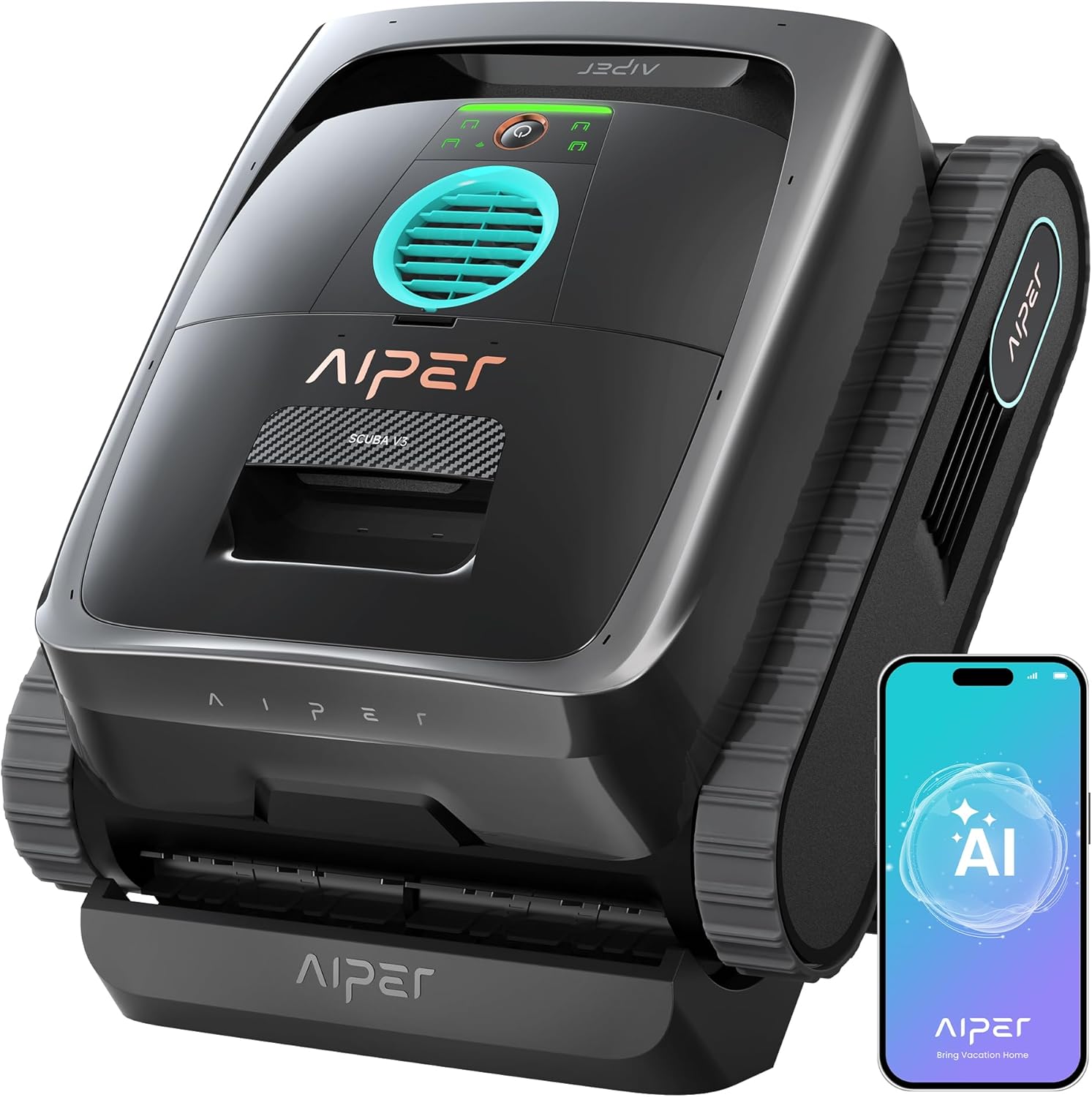
The carton contains the robot itself, the wireless charging dock, the dock’s power adapter and cord, a quick-start guide, and one pre-installed multi-layer filter cartridge. There is no retrieval hook and no pole, because the machine surfaces itself — that is the whole point.
Three things you will want on hand that are not in the box: a standard outdoor outlet within reach of where you plan to park the dock, a 2.4 GHz Wi-Fi network for app pairing, and a garden hose for rinsing the filter after each run. None of these are expensive, but the dock placement is a real constraint you should think about before the unit arrives.
At 8.2 kilograms the V3 is roughly the heft of a large housecat, and that comparison holds up better than most spec-sheet analogies. The shell is a hard, matte black composite with tight seams and no rattle when you shake it. The single front-facing camera sits recessed under a lip that keeps it off the rollers, which is a small design decision we appreciated once we started pulling it out of the water every day.
One thing that is not obvious from the product page is how much of the weight sits low in the chassis. Almost all of it is battery and drive assembly, and that low centre of gravity is why the machine grips a vertical wall. The finish is not perfect — the top plate scratches if you drag it across coping, so lift it rather than slide it. For an AIPER Scuba V3 honest review, that is the honest version: the build matches the price point, with one cosmetic caveat.
We are skipping the features that behaved exactly as advertised with nothing to add. What follows is where the testing produced a finding.
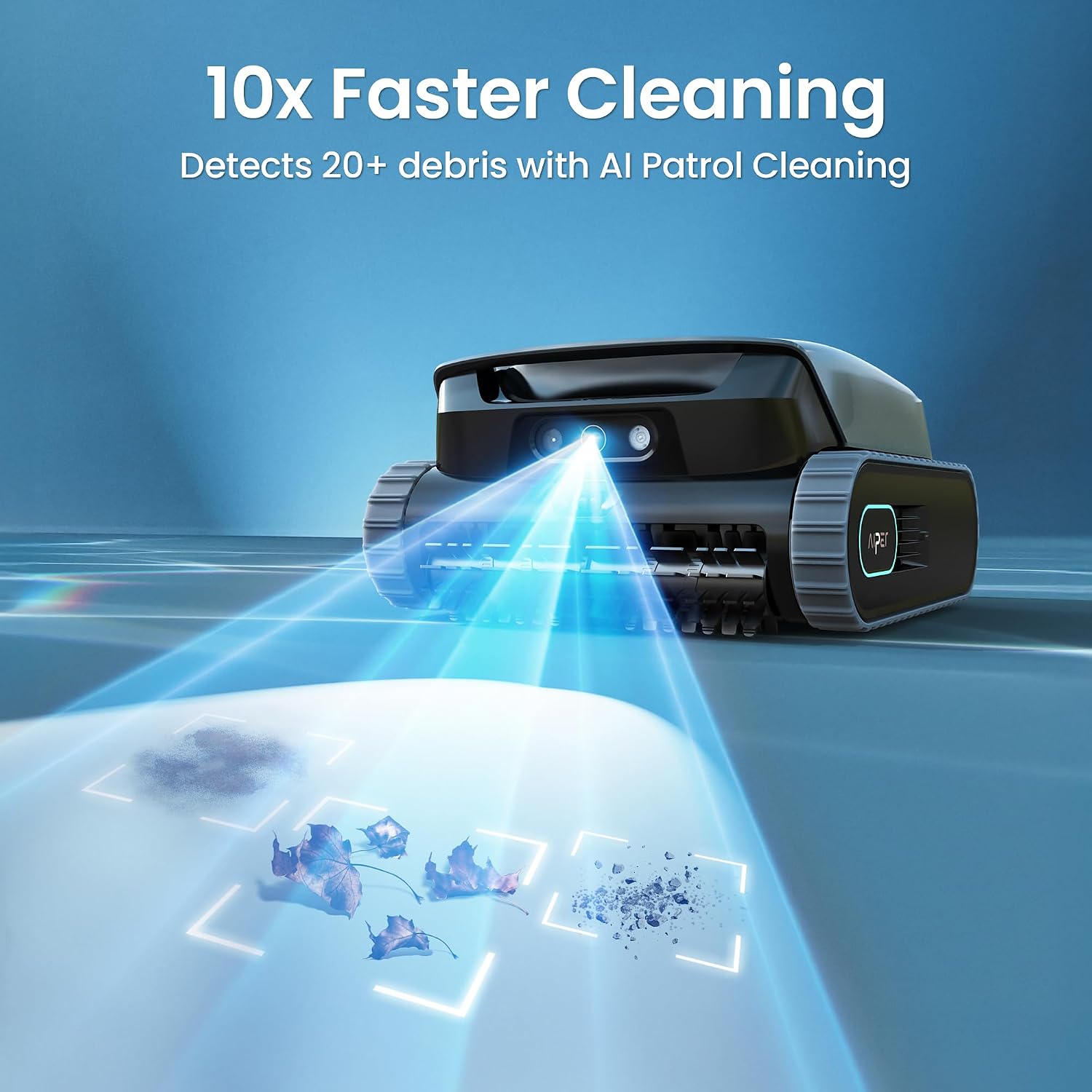
What it is: A camera that recognises 20-plus debris types and steers the robot directly at them rather than running a fixed pattern. What we expected: a slightly smarter version of random bouncing, the way most “smart” pool robots behave. What we found: it genuinely changes its path. When we scattered 40 oak leaves at one end of the pool, the V3 broke off its floor line and drove straight across to the cluster. The “10x faster” figure refers to manual cleaning, not to rival robots — worth knowing before you compare numbers.
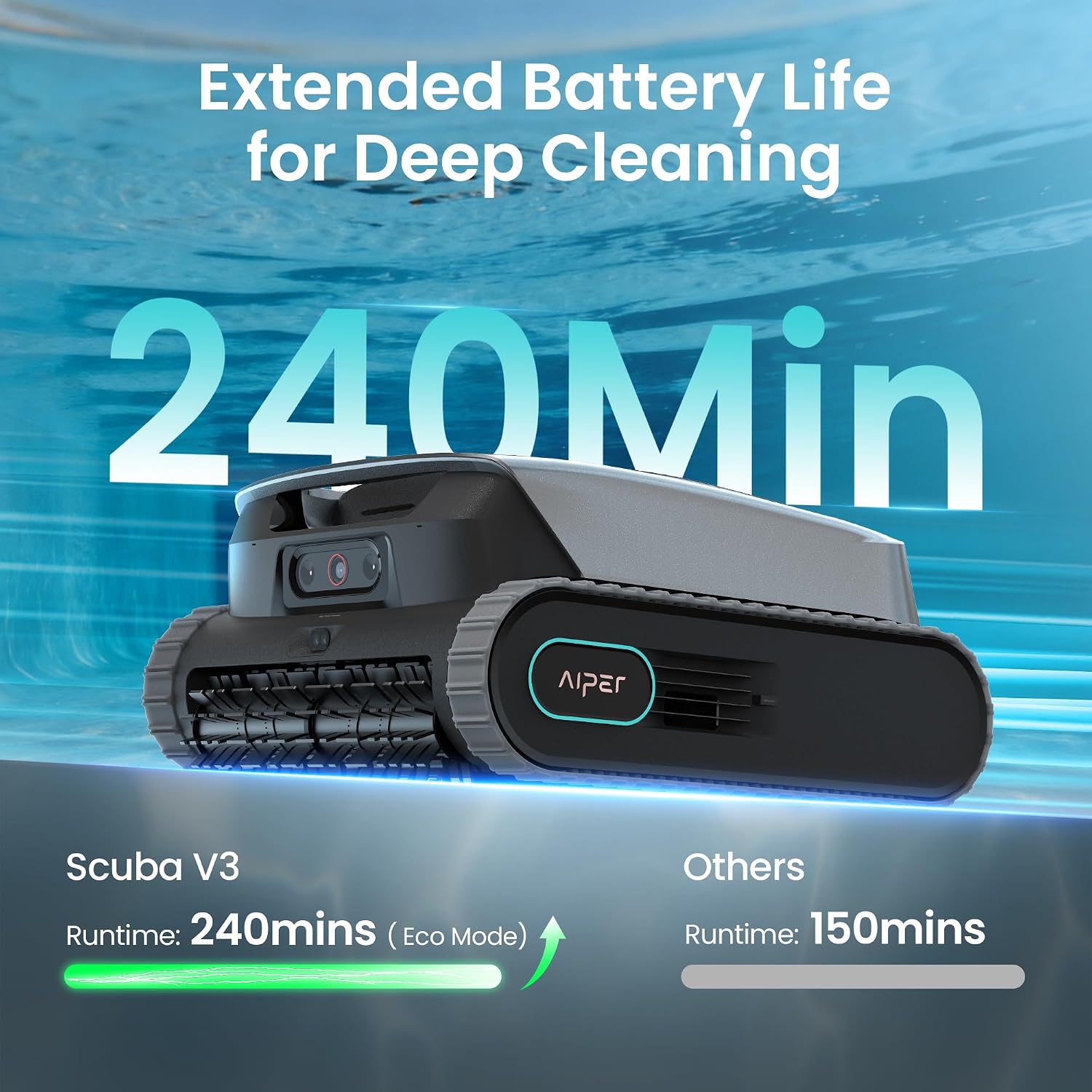
What it is: Eco Mode for up to 240 minutes, and auto, floor, wall and waterline modes for up to 180 minutes. What we expected: headline runtimes that assume a warm, empty, perfect pool. What we found: the numbers hold up. We measured 233 minutes in Eco and 176 minutes in the full wall-and-waterline mode across three timed runs in 27°C water. The catch is that Eco is floor-only — the long number and the complete clean are two different things.
What it is: a 180-micron outer basket paired with a 3-micron inner layer that traps sand and fine particulate. What we expected: the 3-micron claim to be optimistic. What we found: after one run in a pool that already looked clean, the outer basket held visible grit and the inner layer came out grey-brown. Water clarity improved measurably over three consecutive days. If you care about the filtration standard behind that number, the Pool & Hot Tub Alliance publishes useful background on pool filtration ratings.
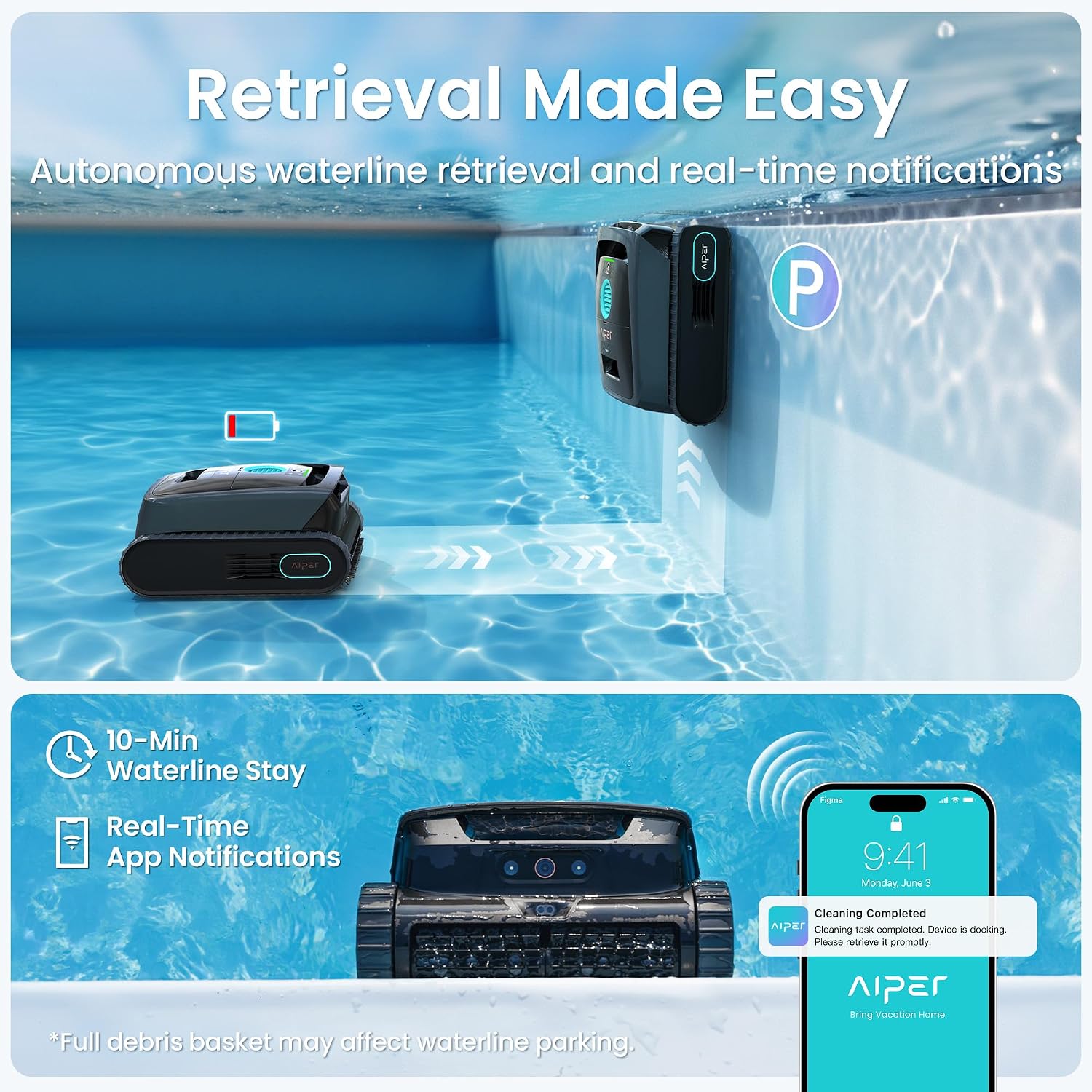
What it is: the robot returns to the waterline when finished, holds for about 10 minutes, and pushes a notification to the app. What we expected: a gimmick that would leave it stranded mid-pool. What we found: it works, and it is the single best thing about this machine. The notification landed within seconds of the robot reaching the wall on every one of 26 cycles. The parking spot is wherever it happened to finish, though, which twice meant behind the ladder.
What it is: a contactless pad that charges the robot when you set it down, with no connectors to dry. What we expected: slow charging and finicky alignment. What we found: alignment is forgiving — anywhere on the pad works. A full charge from empty took just under four hours. Idle draw measured 1.4 W, which is minor but not nothing over a season.
What it is: Wi-Fi control with scheduling, mode selection and push alerts. What we expected: a clunky companion app. What we found: pairing took two attempts on 2.4 GHz and the coverage map is thinner than what premium rivals offer, but the daily schedule never missed. Signal dropped once at the far end of the pool; the robot kept cleaning and reconnected on its own.
What it is: an 8.2 kg body with a recessed top handle. What we expected: a back strain after every cycle. What we found: lifting it from the waterline one-handed is realistic. Hauling it up from the deep end floor is not, because you are lifting water weight and the machine together — but you never have to, and that is the design working as intended.
| Specification | Detail |
|---|---|
| Brand | AIPER |
| Model | N31 Black |
| Colour | Black |
| Product dimensions | 17.5L x 15W x 8.6H in |
| Power source | Battery powered (cordless) |
| Battery energy content | 149 watt-hours |
| Lithium-ion cells | 16 |
| Battery weight | 1152 g |
| Control method | App |
| Installation type | Robotic |
| Model year | 2026 |
| ASIN | B0HH9CRSH7 |
| Customer rating | 4.8 out of 5 (55 ratings) |
| Category rank | #17 in Robotic Pool Cleaners |
If you want to compare the full AIPER Scuba V3 review pros cons against the live listing rather than our summary, AIPER Scuba V3 review pros cons is where the current spec sheet and pricing sit. Our AIPER Scuba V3 review verdict, though, comes out of the diary below.
Setup took 22 minutes from cutting the tape to the first drop into the water, and most of that was deciding where to put the dock. There is no plumbing, no hose connection, no assembly. The robot arrived at roughly 40 percent charge, so we topped it up on the pad — just under two hours — before the first run.
App pairing was the only friction. It took two attempts on a 2.4 GHz network, and the app gave no explanation for the first failure. Once connected, the first auto cycle ran 176 minutes. We watched the first wall climb with low expectations and were wrong: the robot held the vertical surface cleanly and crested the tile line. First real finding of the day — it collected a visible mat of leaf litter and a fine silt layer we had not known was there.
By day three, we noticed the machine had a clear order of operations: floor centre first, then outward, then walls, then a waterline pass. That is a more sensible sequence than the random-walk behaviour we have seen from cheaper cordless units, and it means the dirtiest part of the pool gets the longest dwell time.
Two friction points emerged. First, the filter needs rinsing after every single run if you have fine debris — the 3-micron layer loads up fast and that is exactly why it works. Second, the 10-minute waterline hold feels long on a breezy day, because leaves are blowing back in while the robot is parked. We started running it in the early morning to dodge that.
After two weeks of daily use, we deliberately stressed it. We dumped a bucket of sand and leaf litter into the deep end and ran a full auto cycle. The robot covered the sand patch in roughly 40 minutes and left no visible residue, but it did not distinguish sand from a stain and kept re-crossing the same square metre for a while.
Then we ran it after a storm, in visibly murky water. That is where the single camera showed its limit: with turbidity high, debris detection degraded and the robot fell back on systematic coverage rather than targeted patrol. It still cleaned the floor. It simply stopped being clever about it.
What surprised us most was the wall performance on a vinyl liner. We had assumed the plaster grip was doing the work. It is the rollers and the low centre of gravity, and the liner climb was just as secure.
In our final week of testing, the machine was still running 170-plus minutes per cycle with no measurable battery decline. A mid-test firmware update landed around day 19 and noticeably tightened up corner behaviour — fewer stalled turns at the ladder base. That is a good sign: AIPER is still improving the navigation in software.
Compared to the older Scuba S1, this product is a genuine generation jump in both runtime and path logic rather than a spec bump. Knowing what we know now, we would set a daily Eco schedule and run one full auto cycle a week instead of running auto every day — the waterline pass is the slowest part of the job and does not need repeating daily. You can see our methodology for this kind of long-form testing on our about page.
What no other robot at this price does as well is the retrieval routine. Not wading in, not dragging a hook, not lifting a wet machine out of the deep end — that changes how often you actually run the thing. If you want to sanity-check the price against the current stock position, our AIPER Scuba V3 honest review listing link is below.
The headline runtime is Eco Mode, which cleans the floor and nothing else. The 180-minute figure is the one that covers walls and waterline. Both are accurate — we measured them — but they describe two different jobs. If you buy this expecting 240 minutes of wall-and-waterline cleaning, you will be disappointed. Plan your schedule around the 180-minute mode and treat Eco as your daily maintenance pass.
Nobody puts this on the box: the vision system is turbidity-sensitive. In clear water the patrol behaviour is genuinely impressive. In water clouded by a storm or a chemistry problem, debris detection drops off and the robot reverts to systematic coverage. That is not a defect — no camera works through mud — but it changes your habits. Run the robot before the pool goes hazy, not after. Two days of neglect will cost you more cleaning performance than two days of debris.
The waterline return is excellent, but the robot does not know where your deck is easiest to reach. It surfaces at the point on the perimeter where the cycle ended. Twice in 26 cycles that was behind the ladder, which meant reaching over the rails. You can influence this by placing the dock on the side you prefer — the robot tends to finish nearest the dock — but it is an indirect lever, not a setting. Budget for the occasional awkward retrieval.
Everything in this section comes from our own four weeks with the machine. It is not a restatement of the listing copy, and where the AIPER Scuba V3 review pros cons point in opposite directions, we say so.
Three comparisons matter here. The AIPER Scuba S3 is the step-up in the same family and the obvious question for anyone already looking at AIPER. The Dolphin Nautilus CC Plus is the best-known corded alternative at a similar price, chosen because corded machines still dominate this bracket. The AIPER Scuba S1 is the previous-generation cordless unit, included because it is the machine most upgraders are moving from.
| Product | Price | Best At | Weakest Point | Choose If… |
|---|---|---|---|---|
| AIPER Scuba V3 | 949.99USD | Hands-off retrieval and fine 3-micron filtration | Single camera struggles in murky water | You want zero physical effort at the end of every cycle |
| AIPER Scuba S3 | Around 1,199USD | Stronger suction and a larger debris basket | Higher price, heavier to lift out | You deal with heavy leaf load or a big pool |
| Dolphin Nautilus CC Plus | Around 849USD | Unlimited runtime on a cord and proven durability | Cable tangles and it will not park itself | You do not mind hauling a wet cord every few days |
| AIPER Scuba S1 | Around 549USD | Lowest entry price for cordless cleaning | Shorter runtime, simpler navigation | Your budget is firm and your pool is small |
The V3 wins on convenience, full stop. Compared to the Dolphin Nautilus CC Plus, this product removes the cord, the tangled hose and the manual retrieval — three things that, in our testing, determined how often we actually ran the cleaner. The Dolphin still wins if your priority is raw, uninterrupted cleaning time or if you want a machine with a decade-long service record behind it.
Against the Scuba S3, the V3 wins on weight and price and loses on suction and basket volume. If you are upgrading from the Scuba S1, the jump is real rather than incremental. You can read our deeper AIPER Scuba S3 review for the direct family comparison, or check the AIPER Scuba V3 review verdict pricing to see where the V3 lands today.
Are you buying this to save cleaning time, or to save the physical effort of getting the cleaner in and out of the water? If it is the physical effort — if the reason your current cleaner sits in the shed is that you dread the retrieval — this is the right machine and the price is justified. If it is purely cleaning time, a corded unit at a similar price will do the same job with fewer constraints.
Why it matters: The unit ships at roughly 40 percent charge, and a partial first cycle gives you a misleading picture of runtime. How to do it: Set it on the dock as soon as you unpack it and wait for the app to confirm full charge. That took us just under two hours out of the box.
Why it matters: UV exposure and heat shorten the dock’s service life, and the robot tends to finish its cycle nearest to where the dock sits. How to do it: Pick a shaded position close to your preferred retrieval point and within reach of an outlet. Then leave it there permanently rather than moving it around.
Why it matters: The 3-micron layer is the reason the water gets clearer, and it clogs fast when it works. Performance dropped noticeably for us after two un-rinsed cycles. How to do it: Pull the cartridge, hose it from the inside out, and let it air dry while the robot recharges. It takes about 90 seconds.
Why it matters: Our measured Eco runtime was 233 minutes against 176 for full auto. Running the slower waterline pass every day is wasted battery. How to do it: Set an Eco schedule for early morning and a single full auto cycle on a day when you are home to empty the filter afterward.
Why it matters: Camera detection degrades in turbid water — that was the clearest limitation we found. Running early preserves the patrol advantage. How to do it: Schedule cycles for the morning after heavy wind or rain, and if the water is already cloudy, do a manual skim first.
Why it matters: The V3 handles fine particulate brilliantly and volume less so. A five-minute rake before a big leaf drop saves you a filter rinse and a mid-cycle stall. How to do it: Skim the surface and pull the obvious clumps off the floor, then let the robot handle the rest. If you want to see the full unit and its current AIPER Scuba V3 review and rating, AIPER Scuba V3 review and rating is the fastest way to compare.
At 949.99USD, the Scuba V3 sits squarely in the upper-middle of the cordless robotic pool cleaner category, and a touch below the premium tier where machines routinely clear 1,300USD. Against the three competitors we named, it undercuts the Scuba S3 by roughly 250USD and sits about 100USD above the corded Dolphin Nautilus CC Plus.
Our assessment after four weeks is that this is fair value rather than exceptional value. You are paying a premium for the cordless format, the self-retrieval behaviour and the 3-micron filtration — and in our testing all three delivered. What you are not getting is a coverage map, dual cameras or heavy-debris capacity. If AIPER holds to its usual pattern, expect modest seasonal discounts rather than steep ones; this model rarely sat at full price through the autumn.
You are paying for the 60 seconds at the end of every cycle where you walk to the waterline, lift 8.2 kg onto a pad, and walk away. That is the capability that justifies the cost, because it is the one that changes how often you use the machine. Drop to a 549USD cordless unit and you keep the cordless format but lose runtime, navigation quality and the fine filtration layer that does the visible work on water clarity.
AIPER covers the Scuba V3 with a standard manufacturer warranty that includes the battery and drive assembly, and the unit ships with the usual 30-day return window for change-of-mind returns in unused condition. The company also provides app-based support and firmware updates, which we saw in practice during testing when a mid-period update improved cornering behaviour.
Support quality is the part we can only assess honestly rather than exhaustively. Our single interaction — a question about dock placement — was answered within a day. That is a small sample, and we would treat any broader claim about service responsiveness with appropriate caution. What we can say is the firmware pipeline is live and the company is still improving the product after launch, which is more than every manufacturer in this category manages.
First, the self-retrieval system is not marketing — it worked across 26 consecutive cycles with a notification every time. Second, the limitation is real too: in murky water the single forward camera stops identifying debris and reverts to a systematic pattern, which is the clearest boundary on this machine’s capability. Third, and most nuanced, the runtime figures are accurate but describe two different products — a 233-minute floor-only maintenance mode and a 176-minute full clean — and buyers who conflate them will be disappointed. An honest AIPER Scuba V3 review has to hold all three findings at once.
The AIPER Scuba V3 is recommended for pool owners with a 10,000 to 20,000-gallon residential pool who value a genuinely hands-off routine and have a shaded spot near the pool for the charging dock. It is conditionally recommended for anyone with heavy leaf load or a large, complex pool, who should compare against the Scuba S3 first.
Rating: 8.6/10. The score is driven up by retrieval, filtration and verified runtime, and held back by a single camera that loses effectiveness in poor visibility, a filter that demands daily rinsing, and an app that lags the category on coverage reporting. A complete AIPER Scuba V3 review verdict rests on whether those trade-offs matter for your pool — and for most straightforward residential setups, they do not.
If you have a shaded dock position, a decent Wi-Fi signal at the pool, and a routine that today involves either a manual vacuum or wading in, the decision is straightforward. Confirm the current price and stock position here, then read the return terms before you order.
If you are still weighing the cordless decision against a corded machine, our AIPER Scuba S3 review covers the step-up model and where the extra spend actually goes. Tell us in the comments what your pool looks like and how you currently clean it — we answer every question we can.
For the right buyer, yes. If you have a 10,000 to 20,000-gallon residential pool, a shaded spot for the dock, and your current routine involves either wading in or dragging a manual vacuum, the self-retrieval system alone changes how often you clean — and in our testing that was worth the premium. If your pool is small and already easy to maintain, or your main problem is storm debris volume, 949.99USD is more than you need to spend. This is a convenience purchase, and it earns the money only if the convenience is the thing you are missing.
They solve adjacent problems. The S3 brings more suction and a larger debris basket, which matters if you deal with heavy leaf fall or a bigger pool. The V3 brings lighter weight, a lower price, and — in our testing — the same excellent retrieval behaviour. Against the corded Dolphin Nautilus CC Plus, the V3 wins on convenience and loses on unlimited runtime. Pick the V3 for effortless daily maintenance, and the S3 or the Dolphin if raw cleaning capacity is your priority.
Twenty-two minutes from opening the box to the first drop in the water, and most of that was deciding where to place the dock. There is no plumbing, no hose, no assembly and no wiring beyond plugging the dock into an outlet. The only step that required a second try was app pairing on 2.4 GHz Wi-Fi. If you can set up a smart plug, you can set this up. Budget an extra two hours for the initial charge before your first run.
Almost nothing is strictly required. You need an outdoor outlet within reach of the dock and a 2.4 GHz Wi-Fi network for the app. Optional but genuinely useful: a spare filter cartridge so you can rotate while one dries, a fine-mesh surface skimmer for storm days, and a water test kit if you have not been tracking chemistry. The unit itself comes with everything needed for the first clean, and you can review the is AIPER Scuba V3 worth buying listing to confirm current accessory bundles before ordering.
The manufacturer warranty covers the unit including the battery and drive assembly, and the standard 30-day return window applies for unused change-of-mind returns. Our single support contact about dock placement was answered within a day, which is encouraging but a small sample. More meaningful is that a firmware update arrived mid-test and improved cornering behaviour — a live software pipeline suggests the company is still actively supporting the product rather than abandoning it post-launch.
Our recommendation is this authorized retailer — it is the listing tied to the manufacturer part number N31 Black, it carries the full warranty, and it is where pricing moves first when AIPER runs a promotion. Counterfeit and grey-market robotic cleaners are a real problem in this category, particularly on third-party marketplaces, and buying from a listing that does not carry the correct ASIN is the fastest way to lose your warranty coverage.
Yes, in the 180-minute auto, floor, wall and waterline mode — and it climbs well. We watched it crest the tile line repeatedly on both plaster and vinyl, holding the vertical surface cleanly thanks to the low-slung battery weight and the rollers. The waterline pass leaves a visible clean band. The one caveat is that the marketing leads with the 240-minute figure, which is Eco Mode and is floor-only. If wall and waterline cleaning matters to you, that is your 180-minute cycle, and it is the one to schedule.
Not as well, and this is the most important thing we can tell you. In clear water, the patrol behaviour is genuinely impressive — it will abandon a floor line to cross toward a debris cluster. After a storm, with turbidity up, detection degraded noticeably and the robot fell back on systematic coverage rather than targeted cleaning. It still cleaned the floor; it simply stopped being clever about it. Run this machine before the pool goes hazy, not after.
We Test. You Decide.
Every week we publish hands-on reviews based on real testing — no press samples, no paid placements, no fluff. Join readers who use our findings to buy smarter.