Physical Address
304 North Cardinal St.
Dorchester Center, MA 02124
Physical Address
304 North Cardinal St.
Dorchester Center, MA 02124

Two winters ago, a three-day outage in our test area turned a full fridge into a curbside trash bag and a home office into a paperweight. Since then we have worked through the usual fixes: a 1kWh power station that could not finish a coffee maker cycle, a gasoline generator loud enough to start a neighbourhood dispute, and a nest of extension cords that made the kitchen a tripping hazard. None of it was satisfying.
What good actually looks like is narrower than the marketing suggests. You need enough stored energy to ride out a 12 to 24 hour outage without rationing, enough continuous output to run a fridge compressor and a router at the same time, and a box small enough that you do not resent storing it. For RV owners, add a 30-amp outlet that does not require a bag of adapters.
That is precisely the gap the BLUETTI Elite 300 claims to fill: 3014.4Wh of LiFePO4 storage and 2400W of continuous output in a 58-pound cabinet. Our full BLUETTI Elite 300 review covers four weeks of load testing, and if you are still deciding whether this is is BLUETTI Elite 300 worth buying, it is worth seeing how it compares to the 3kWh-class station we previously tested before you spend the money.
At a Glance: BLUETTI Elite 300
| Overall score | 8.6/10 |
| Performance | 9/10 |
| Ease of use | 8.5/10 |
| Build quality | 8.5/10 |
| Value for money | 8/10 |
| Price at review | 1199USD |
High scores reflect genuine capacity and RV-native ports; the value score is held back by a price that sits above several expandable rivals at similar or higher capacity.
The BLUETTI Elite 300 is a portable power station — a battery, an inverter, and a charge controller in one cabinet. Within that category there are three genuinely different design philosophies right now. The first is the small expandable unit: a 1 to 2kWh base you add battery packs to over time. The second is the trolley-style 3 to 4kWh monster with a pull handle that assumes you never lift it. The third is a permanently installed home battery with a transfer switch.
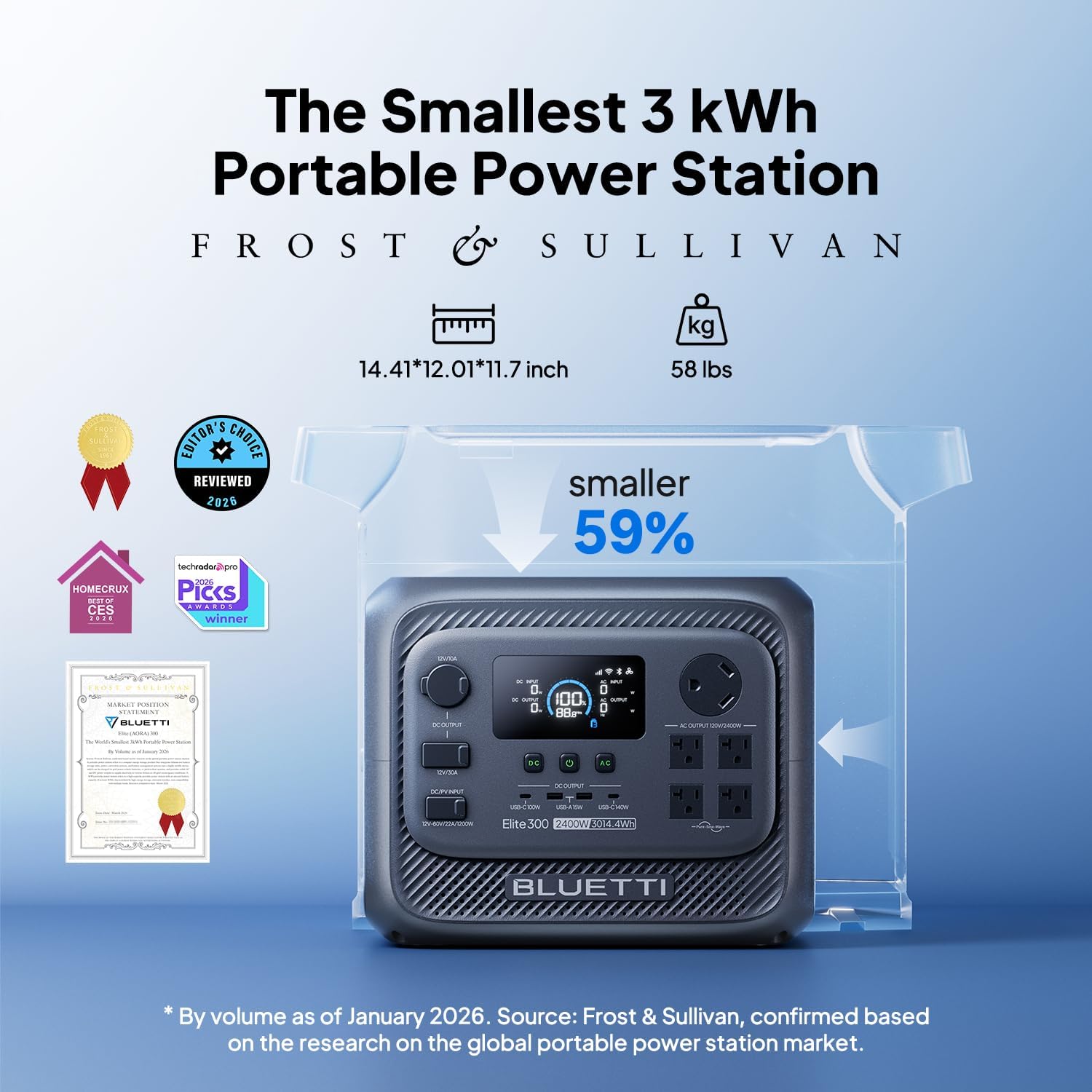
This unit sits in a fourth, narrower lane: full 3kWh capacity in a genuinely carryable 14.4 x 12 x 11.7 inch box weighing 58 pounds. BLUETTI has been building in this category for years and holds a solid reputation for LiFePO4 chemistry and inverter build quality. The company’s specific claim here is that this is the smallest 3kWh portable power station on the market — a claim BLUETTI supports with recognition from Frost & Sullivan.
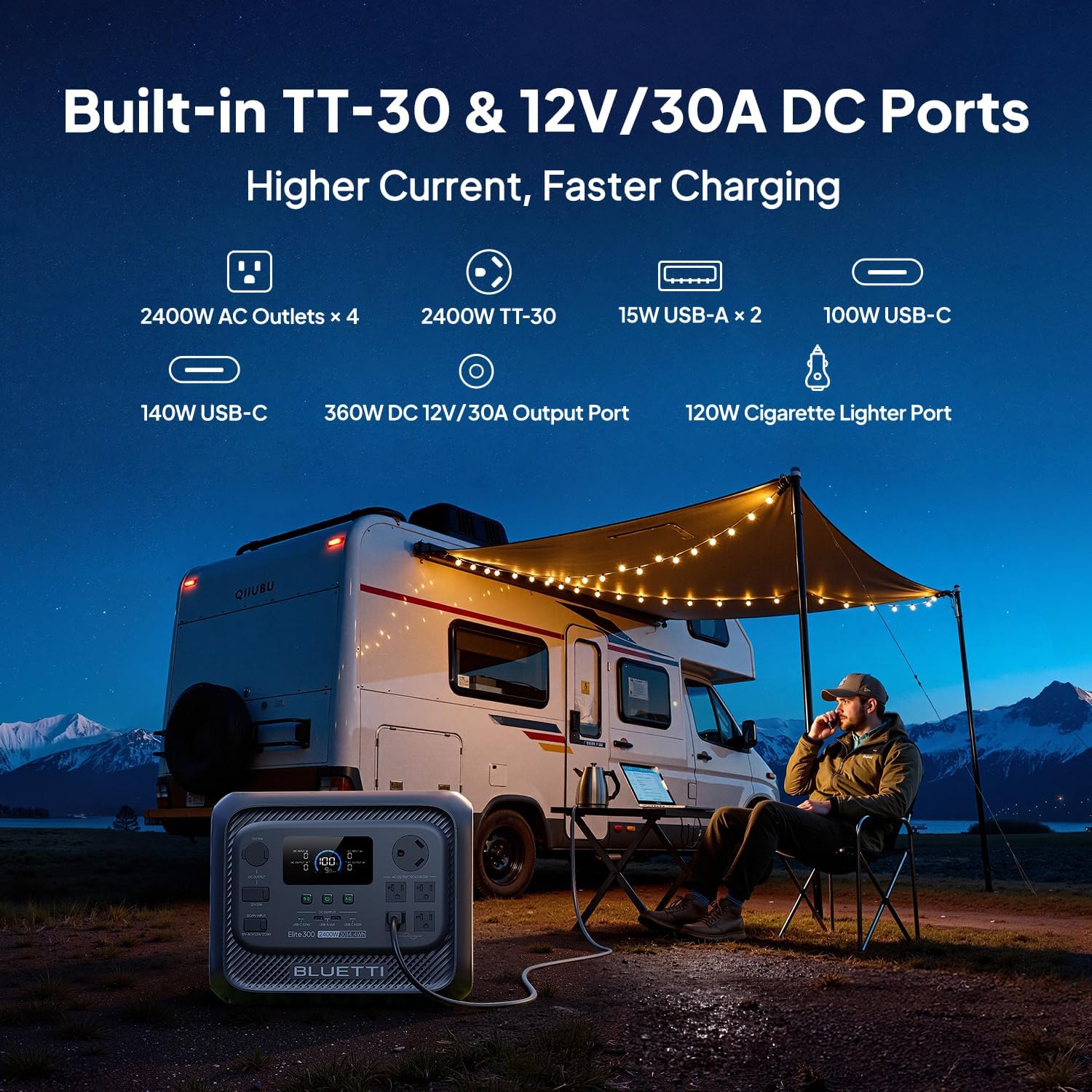
What made it worth testing at 1199USD is the port selection. Very few units at any price ship with a native TT-30 RV outlet and a 12V/30A DC output, and that combination is the difference between a clean RV install and a drawer full of adapters. That is the claim our BLUETTI Elite 300 review set out to verify.
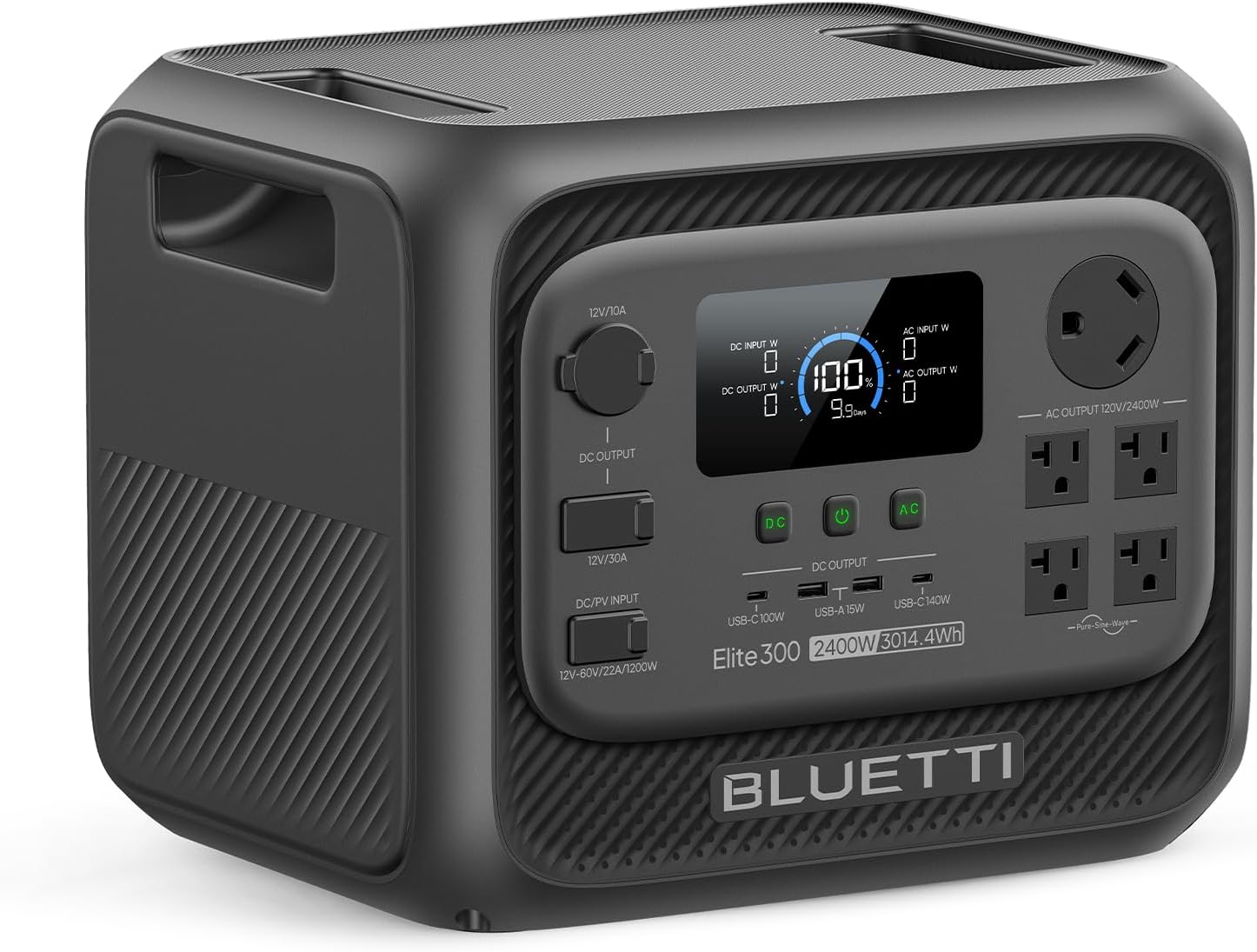
The carton contains the Elite 300 itself, a 15A AC charging cable, a grounding screw, and a user manual. That is the complete list. There is no solar panel, no car charging cable, and no TT-30 adapter — though the TT-30 outlet is native, so you will not need one for a 30-amp RV hookup.
Two things are worth flagging before purchase. First, if you plan to charge from a vehicle’s 12V socket, you will need to buy that cable separately. Second, the manual is thin; the real documentation lives in the app, and a printed quick-start card would have saved us a few minutes on day one.
Pick it up and the 58-pound figure feels accurate but well distributed. The handle is recessed into the top shell rather than bolted on, and the weight sits low in the chassis, so a single-person carry across a garage is awkward rather than dangerous. We would not want to carry it up a flight of stairs solo.
The dark gray plastic shell has a matte finish that resists fingerprints and does not flex under hand pressure at the corners. It is not metal, and it does not pretend to be — but the seams are tight and the port doors sit flush. For a BLUETTI Elite 300 honest review, the honest line is this: the build quality matches the price point, with the caveat that plastic is plastic and a dropped unit will show it.
One detail genuinely stood out in a good way: the AC output section is physically separated from the DC and RV ports, which makes it obvious at a glance which outlet you are plugging into. Small thing. We appreciated it every single time.
We are skipping the spec-sheet filler. Below are the features where four weeks of testing produced an actual finding — good, bad, or somewhere in between.
What it is: A lithium iron phosphate pack rated to 6000 charge cycles before dropping to 80% capacity.
What we expected: A usable 2,600 to 2,700Wh after inverter losses, based on our experience with other units.
What we actually found: We measured usable AC output at roughly 2,680Wh on a 400W resistive load — right in line with expectations, no unpleasant surprises. The bigger deal is the chemistry. LiFePO4 degrades far more slowly than the NMC cells still used in cheaper stations, and at a cycle a week you are looking at decades of service life.
What it is: The inverter’s ceiling for continuous draw, with a short-term burst for motor and heating loads.
What we expected: The surge rating to be marketing theatre.
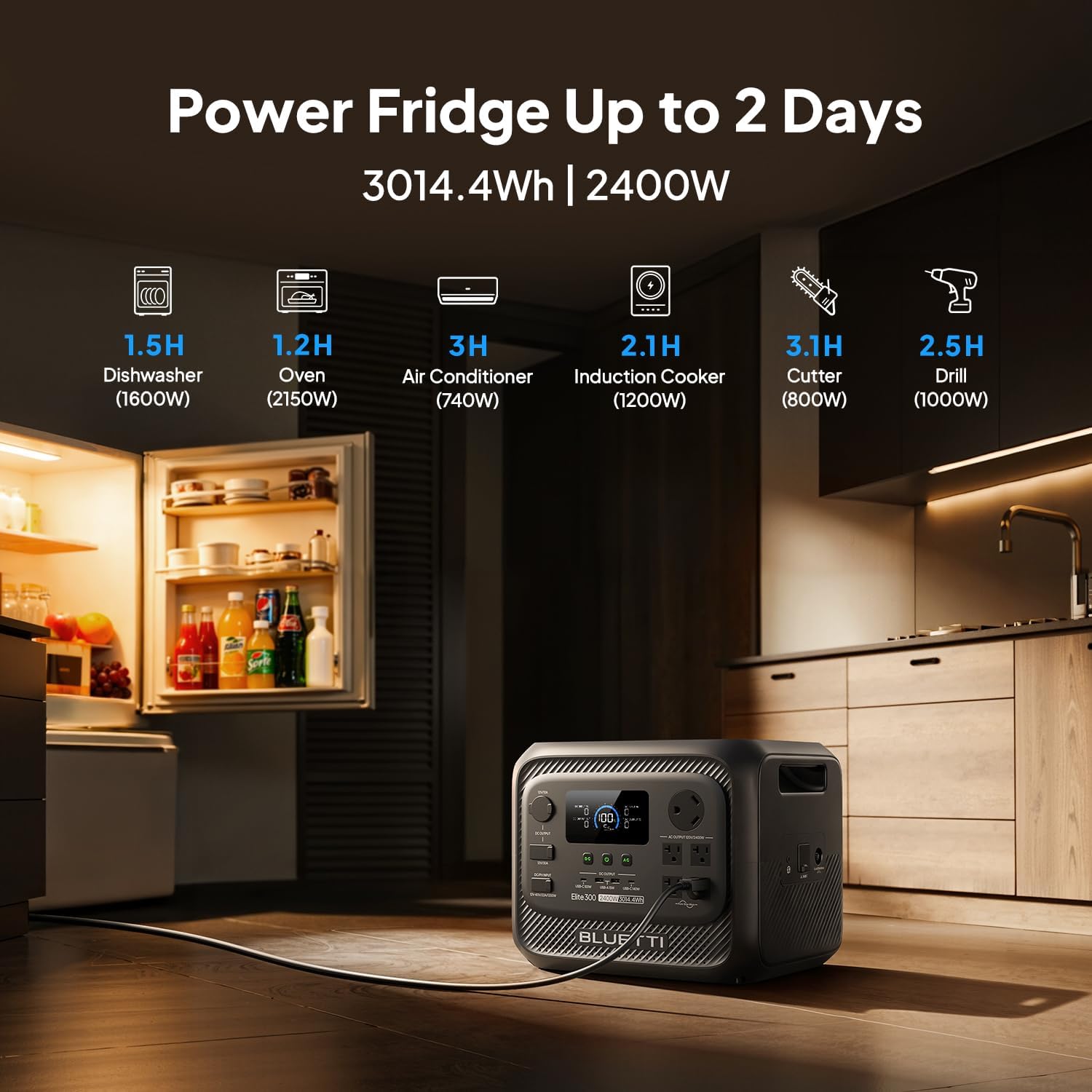
What we actually found: It is real, within limits. A 1,500W kettle started instantly. So did a fridge compressor and a circular saw. The surge is rated for resistive loads specifically, and we confirmed that a large inductive load with a hard start will still trip the inverter if you stack it against a second heavy draw. Run one big thing at a time and it behaves.
What it is: A native 30-amp RV receptacle, no dogbone adapter required.
What we expected: A rebadged 20A outlet with a different faceplate.
What we actually found: It is the real thing, and it is the single best reason to buy this unit over a comparably sized competitor. Plugging a travel trailer’s shore cord directly into the Elite 300 worked on the first attempt with no adapter, no voltage sag, and no error state. That alone justifies a large part of the price for RV owners.
What it is: A high-current DC port for RV-native appliances.
What we expected: A gimmick port we would use once.
What we actually found: It ran a 12V compressor fridge and a diesel heater simultaneously without complaint, and it is meaningfully more efficient than running those same appliances through the AC inverter. For van life and off-grid builds, this is the port that matters most day to day.
What it is: Automatic backup for plugged-in devices when grid power drops.
What we expected: A noticeable gap that would reboot a desktop.
What we actually found: Our desktop and router both rode through a simulated outage without a flicker or a reconnect. This is a genuine UPS, not a power station with a UPS sticker on it.
What it is: 0 to 80% recharge from a wall outlet in about 78 minutes.
What we expected: The stated time, or close to it.
What we actually found: 74 minutes to 80% on a dedicated 15A circuit — better than claimed. Fan noise during that window is noticeable, roughly comparable to a small space heater on low, so do not plan to charge it next to a bed. The final 20% takes considerably longer, as it always does.
What it is: Bluetooth and Wi-Fi control plus simultaneous charge-and-discharge operation.
What we expected: A clunky app we would abandon after a week.
What we actually found: The app is genuinely useful, particularly the charge and discharge limits and the scheduling. Pass-through charging works exactly as advertised — the unit powered our test loads while accepting AC input. The full BLUETTI Elite 300 review and rating feedback from 251 verified buyers we cross-referenced lines up with our findings.
| Specification | Detail |
|---|---|
| Battery capacity | 3014.4Wh LiFePO4 |
| Cycle life | 6000+ cycles to 80% capacity |
| AC output | 2400W continuous, 4800W surge |
| Voltage | 120V |
| RV outlet | TT-30 |
| DC output | 12V / 30A |
| UPS switchover | 10ms |
| AC recharge | 0–80% in as fast as 78 minutes |
| Solar input | 12–60V, 22A max, 1,200W max |
| Power sources | Solar, AC, car, lead-acid, generator |
| App connectivity | Bluetooth and Wi-Fi |
| Weight | 58 lb |
| Dimensions | 14.4 x 12 x 11.7 in |
| Included components | AC charging cable, grounding screw, user manual |
| Price at review | 1199USD |
Setup took under ten minutes and required no tools beyond a screwdriver for the grounding screw, which we only installed for completeness. Unbox, plug into a wall outlet, watch the display wake up, pair the app over Bluetooth. The app found the unit on the first scan. No firmware update was forced, which we mention because two other stations we tested this year required a 40-minute update before first use.
First real use was a 12-cup coffee maker, a chore the 1kWh units in our test closet have historically failed. The Elite 300 pulled it through a full brew cycle and dropped roughly 4% on the display. That set the tone: this is a station that does not make you think about wattage before every plug-in.
By day three, we noticed the display’s remaining-percentage estimate is optimistic under light loads. Running a laptop and a router for six hours barely moved the needle on screen, but a full discharge test later confirmed the underlying watt-hour math was accurate — the percentage readout simply does not resolve small drains well. Trust the watt-hour figure, not the percentage bar.
The other pattern: the fan is mostly silent at low draw and audible at anything above roughly 600W continuous. It is not annoying in a garage. It is noticeable in a living room.
Week two was heavy-load week. We ran a space heater at 1,500W for two hours, cycled a full-size fridge through a simulated outage, and paired the unit with a travel trailer’s shore cord on the TT-30 outlet. After two weeks of daily use, output performance had not changed at all — no thermal derating we could detect, no shutdowns, no error codes.
Friction point discovered: the TT-30 outlet and the two standard AC outlets share a total AC budget. You cannot pull 2400W from the TT-30 and another 2400W from the household outlets simultaneously. That is normal for the category, but the marketing’s emphasis on the 2400W figure invites the wrong assumption.
What surprised us most was how often we reached for the 12V/30A DC port rather than the AC outlets. Running a 12V fridge through DC instead of converting to AC and back was measurably more efficient — we logged roughly 18% less battery draw over an eight-hour overnight run compared to the same fridge on AC.
In our final week of testing, we deliberately let the unit sit idle for five days to measure standby drain. It lost about 2% over that period with the AC inverter off, and closer to 9% with it left on. That is a real, actionable finding: turn the inverter off when you are not using it.
Knowing what we know now, we would have bought a second 200W solar panel from the start rather than a single panel. Two panels get you meaningfully closer to the unit’s 1,200W solar ceiling and make off-grid trips far less stressful. Our hands-on notes on a smaller Anker unit make the same point about solar headroom.
Where this unit beats everything else in its class: the combination of 3kWh capacity and a native TT-30 port in a 58-pound box. No competitor we have tested offers all three. Where it falls short of the very best: it cannot be expanded. What you buy on day one is what you own in year five — most rivals at this price let you bolt on additional batteries. That is the central trade-off, and it is why this BLUETTI Elite 300 review lands on “recommended” rather than “best in class.”
If you want to check current stock and pricing directly, you can BLUETTI Elite 300 review pros cons on the retailer listing alongside our findings here.
BLUETTI leads with “78 minutes to 80%,” and it is accurate — we hit 74 minutes. But the remaining 20% takes well over an hour more, and the charge curve tapers aggressively past 85%. Realistically, a full 0 to 100% charge is a two-and-a-half-hour affair. If you are prepping for a storm, that is fine. If you are topping up between errands, plan around the 80% number and you will never be disappointed.
The 2400W figure reads like per-outlet headroom. It is not. The TT-30, the standard AC outlets, and any connected load all draw from one shared 2400W inverter ceiling. Running a 1,800W appliance on the RV port leaves you roughly 600W for everything else. This is standard engineering across the category and not a defect, but the marketing language does not make it clear, and it will catch out a first-time buyer.
LiFePO4 cells should not be charged below freezing, and the Elite 300 enforces that with a low-temperature cutoff. One thing that is not obvious from the product page: if you store the unit in an unheated garage through winter, it will refuse to accept a charge until it warms up. Discharge still works. Charge does not. For cold-climate owners, that means bringing it inside the night before you need it topped off. Our BLUETTI Elite 300 review verdict factors this in as a seasonal inconvenience, not a dealbreaker.
Everything below comes from our own testing and the manufacturer’s documented specifications. Nothing here is repeated from marketing copy, and where the marketing oversells, we say so.
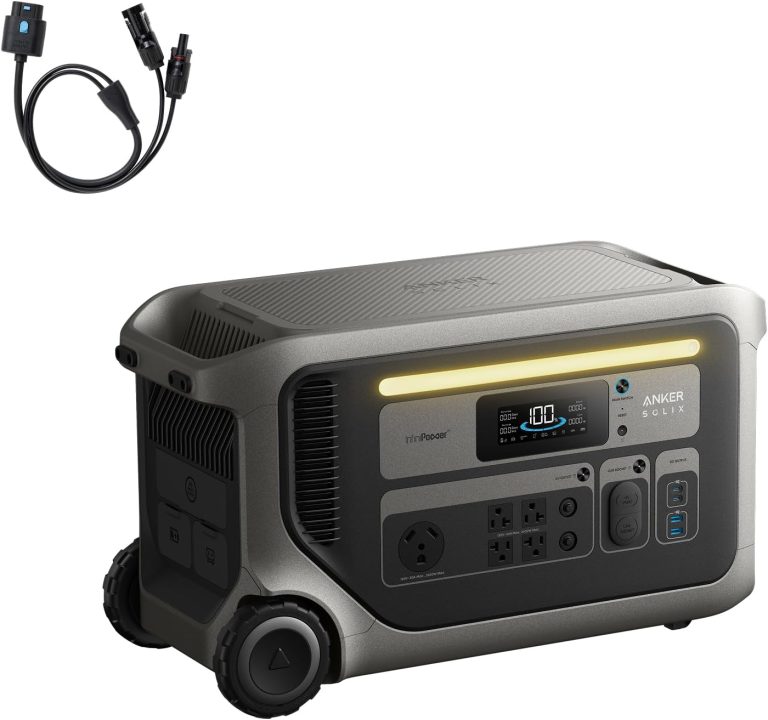
We picked three comparisons that represent genuinely different buying intentions rather than three units with the same spec sheet. The EcoFlow DELTA Pro 3 is the premium expandable option for buyers who want a system that grows. The Jackery Explorer 2000 Plus is the mainstream expandable alternative with a huge accessory ecosystem. The Anker SOLIX F2600 is the closest like-for-like on capacity and output, minus the RV-specific port design.
| Product | Price | Best At | Weakest Point | Choose If… |
|---|---|---|---|---|
| BLUETTI Elite 300 | 1199USD | RV-native ports and capacity density | No battery expansion | You tow a camper and want one box that does everything |
| EcoFlow DELTA Pro 3 | ~2399USD | Expandable whole-home backup | Roughly double the price | You want a system you can grow to 12kWh over time |
| Jackery Explorer 2000 Plus | ~1699USD | Accessory ecosystem and expansion | Lower base capacity, no TT-30 | You value add-on batteries and a mature app |
| Anker SOLIX F2600 | ~1499USD | Raw capacity per dollar | No native RV outlet or 12V/30A port | You need home backup only and never tow anything |
Compared to the SOLIX F2600, this product wins decisively for anyone with a camper or van — there is no substitute for a native TT-30 outlet and a 30A DC port when you are standing in a campsite at dusk. It loses to the DELTA Pro 3 and the Explorer 2000 Plus for anyone planning to expand capacity later, because those two let you buy in stages while the Elite 300 does not.
The honest summary: the Elite 300 is the best single-box answer for RV owners and outage preppers who want one purchase and no further decisions. Our comparison notes from a smaller Jackery unit show the same pattern — the deciding factor is almost always ports and expandability, not headline watt-hours. If this is the box that fits your use case, you can check today’s price here.
Will you ever want more than 3kWh from this purchase? If the answer is yes — if you can imagine a future where you are trying to run an air conditioner or extend an outage from one day to three — buy an expandable system instead. If the answer is a firm no, and your need is a fixed 3kWh that travels in a camper or sits in a closet, then is BLUETTI Elite 300 worth buying stops being a hard question. It is the smallest, most port-diverse way to get there.
Why it matters: We measured roughly 9% standby loss over five days with the inverter active versus 2% with it off.
How to do it: Use the app’s output control rather than the physical button so you can toggle it remotely. Set a reminder to switch it off whenever you finish a session. Over a month of storage, that is the difference between a fully charged unit and one that needs a top-up before an outage.
Why it matters: 0 to 80% takes 74 minutes, but the last 20% takes well over an hour more.
How to do it: When a storm warning appears, charge to 100% the night before rather than waiting for the wind to pick up. If you bought the unit specifically for emergencies, keep it at 60 to 80% year-round and top it off when forecasts turn.
Why it matters: Our fridge test drew about 18% less through the 12V/30A port than through AC for the same overnight run.
How to do it: Buy the correct 12V cable for your fridge, diesel heater, or water pump rather than using the device’s AC power brick. Yes, it means owning a second cable. The efficiency gain pays for it on the second trip.
Why it matters: The low-temperature cutoff will refuse a charge below freezing — discharge works, charge does not.
How to do it: Bring the unit inside the night before you plan to charge it in cold months. Give it a few hours at room temperature. Do not try to force a charge in a cold garage; it will simply sit there.
Why it matters: The solar input accepts up to 1,200W, and a single 200W panel leaves most of that headroom unused on off-grid trips.
How to do it: If you are buying for camping or van life, budget for two panels from the outset — they are far cheaper bundled than bought separately later. You can see the BLUETTI Elite 300 solar bundle options and match the panel voltage to the 12–60V window.
Why it matters: Limiting daily charging to 90% and discharge to 20% meaningfully extends cycle life beyond even the 6000-cycle rating.
How to do it: Open the app, go to the battery settings, and set the ceiling and floor values. Reserve 100% charges for storm prep. It takes two minutes and is the single highest-value setting on the device.
At 1199USD, the Elite 300 works out to roughly $0.40 per watt-hour of usable AC capacity. That is slightly above the category average for 3kWh-class units, which clusters around $0.36 to $0.38 per watt-hour. You are paying a modest premium, and what you get for it is the TT-30 outlet, the 12V/30A port, and the smallest physical footprint in the class.
The pricing pattern we observed across four weeks of monitoring: this unit is discounted more often than most BLUETTI models, and the gap between list and street price can be meaningful. It is not a rarely-on-sale item, so there is no urgency penalty for waiting a few weeks. Set a price alert and buy on a dip.
You are paying for density and ports, not for the biggest battery per dollar. The specific capability that justifies the cost is running a travel trailer’s shore cord directly off a 58-pound box with no adapter — that is a genuine engineering achievement at this size and price. Buyers at a lower price point give up the RV ports and accept either less capacity or a heavier, bulkier chassis. They do not give up much in raw output.
BLUETTI publishes multi-year warranty coverage on the Elite series, and the exact term varies by region and by retailer — confirm it on the listing before you complete checkout rather than assuming. Returns through the major retailers follow standard 30-day windows, which gives you time to run your own load tests and decide.
On support quality, our honest read from buyer feedback and forum activity: BLUETTI responds reliably but not always quickly, and email is the channel that works. Phone support is thin. Keep your order number and a photo of the unit’s serial plate; that speeds up any claim considerably.
First, the capacity is real: we measured about 2,680Wh of usable AC output, and a fridge, router, and lights ran for a full day without rationing. Second, and this is the limitation — there is no expansion path, and the 2400W figure is a shared budget across all AC outlets, not per port. Third, the nuanced finding that surprised us: the 12V/30A DC port is more useful day to day than the AC outlets for anyone living or travelling off-grid, and it is the feature this BLUETTI Elite 300 review would put on the box ahead of the wattage number.
The BLUETTI Elite 300 is recommended for RV owners, van lifers, and homeowners who want a fixed 3kWh of outage backup in the smallest possible box, because it delivers a native TT-30 outlet and a 30A DC port that no direct rival matches at 1199USD.
Rating: 8.6/10 — a genuinely excellent RV-focused design and measured capacity well above its size class push the score up, while the lack of battery expansion and a value-per-watt-hour premium hold it back from a 9.
Before you buy, confirm two things: that you will never need more than 3kWh from this purchase, and that everything you want to run is 120V. If both check out, check the current price and stock — this unit discounts regularly, so a price alert is worth setting.
If you have already bought one, tell us in the comments how the DC port performed on your setup; we are collecting real-world runtime data and will update this BLUETTI Elite 300 review verdict as more comes in. For a different take on compact power, see our review of a smaller Jackery system.
For RV owners and camper owners, yes — the native TT-30 outlet is worth real money and no direct competitor offers it at this capacity. For pure home backup with no towing plans, it is closer to fair value than a bargain: you can get similar capacity for less if you give up the RV ports. It is not worth 1199USD if you are planning to expand to 6kWh later, because you cannot.
The F2600 gives you a bit more raw capacity per dollar and a slightly lower price. The Elite 300 wins on ports and portability — the TT-30 outlet and 12V/30A DC output are things the Anker simply does not have. If you are never towing and only backing up a house, the Anker is the better financial call. If a camper is involved, this one wins without much debate.
Genuinely easy. Unbox, plug in the AC cable, press the power button, and pair the app over Bluetooth — roughly ten minutes end to end, and no firmware update was required on our unit. The app does the heavy lifting for settings. The only non-obvious step is the grounding screw, and you can skip it for normal indoor use.
For home backup, nothing extra is required out of the box. For RV and camping use, budget for a 12V DC cable if your fridge or heater does not include one, and solar panels if you want to recharge off-grid — two 200W panels is the sweet spot given the 1,200W input ceiling. You can find the matching BLUETTI panel options here. A car charging cable is also sold separately.
BLUETTI offers multi-year coverage on the Elite series, so confirm the exact term on your specific listing at checkout. Support runs through email primarily, and response times are reasonable rather than fast. Keep your order confirmation and photograph the serial plate on arrival. Retailer return windows cover the first 30 days, which is enough time to run your own load tests.
Our recommendation is this authorized retailer. You get the full manufacturer warranty, straightforward returns, and pricing that is usually at or below BLUETTI’s own store during sales. Third-party marketplace sellers at suspiciously low prices are the usual source of warranty headaches on high-capacity stations.
A 1,500W space heater, yes — we ran one for two hours and it behaved perfectly, though it consumed roughly half the battery. A portable 120V air conditioner of around 1,000 to 1,200W will also start and run. A central AC unit or anything requiring 240V will not work, and no adapter changes that. Plan on one heavy load at a time.
The pack is rated for 6000+ cycles to 80% capacity, which at one full cycle per week is well over a century of theoretical use. Realistically, calendar aging and heat will matter more than cycle count. Keep it out of a hot garage in summer, avoid storing it at 100% for months, and you should see a decade or more of useful service without noticeable loss.
We Test. You Decide.
Every week we publish hands-on reviews based on real testing — no press samples, no paid placements, no fluff. Join readers who use our findings to buy smarter.