Physical Address
304 North Cardinal St.
Dorchester Center, MA 02124
Physical Address
304 North Cardinal St.
Dorchester Center, MA 02124

At 2:14 a.m., a transformer two blocks from my house blew and the entire street went dark. I was mid-export on a video project, the fridge was running a defrost cycle, and the WiFi router was the only thing keeping my security cameras online. None of them noticed. The HomePower 3000 had been plugged into a single garage outlet for two days, and when the grid dropped, it picked up the load fast enough that my desktop never flickered and the router never rebooted. This Jackery HomePower 3000 review is based on six weeks of hands-on testing: three weeks running the unit as a permanent backup in my garage office, two weeks in a 24-foot travel trailer, and a handful of deliberate overload and recharge tests using a Kill A Watt meter and a clamp meter. I also ran it side by side with an EcoFlow Delta 3 Ultra to compare UPS switchover behavior and recharge times under identical loads. What follows is my Jackery HomePower 3000 review honest opinion — the parts that genuinely surprised me, the parts that irritated me, and a direct answer to is Jackery HomePower 3000 worth buying at $1,799. If you would rather have the conclusion first, the verdict box sits immediately below.
Disclosure: This article contains affiliate links. If you purchase through our links, we may earn a small commission at no extra cost to you. Our testing and opinions are independent.
Jackery HomePower 3000 and 2x200W Solar Panels — Quick Verdict
Best for: Homeowners who want silent, automatic backup for a fridge, router, and home office without a permanent electrician install or a gas generator outside.
Not ideal for: Anyone who needs to move 60 pounds regularly, run 240V appliances, or power a whole-house transfer switch.
Price at time of review: $1,799
Tested for: Six weeks — three at home in a garage office, two in a travel trailer, plus overload and recharge stress tests.
Bottom line: A genuinely well-executed 3kWh station with the fastest hybrid recharge I have measured in this class, held back by a 400W solar ceiling and a weight that makes it a semi-permanent fixture rather than a camping toy.
The Jackery HomePower 3000 is a portable power station — a large lithium battery with an inverter, transfer switch, and charge controller in one enclosure. Jackery positions it as home backup first and outdoor power second, which is a meaningful shift for a company that built its reputation on camping batteries. In the current market, this sits in the premium tier: not the cheapest route to 3kWh, but among the most space-efficient.
Jackery has been manufacturing portable power since 2012 and is one of the few brands in this category with a decade-plus track record. You can view the full factory specification sheet on Jackery’s official site.
The problem it solves is practical. A gasoline generator needs fuel, oil changes, and an outdoor location away from windows — none of which is convenient during a blizzard at 3 a.m. The HomePower 3000 sits indoors, runs silent, and switches over automatically. Two engineering choices stand out, and any Jackery HomePower 3000 review should lead with them. First, the LiFePO4 cells are rated to 4,000 cycles while retaining 70% capacity, which is roughly four times the lifespan of the NMC cells used in older stations. Second, Jackery uses a cell-to-body structural design that eliminates the separate battery module and mounting cage, making the unit 47% smaller and 43% lighter than comparable 3kWh stations.
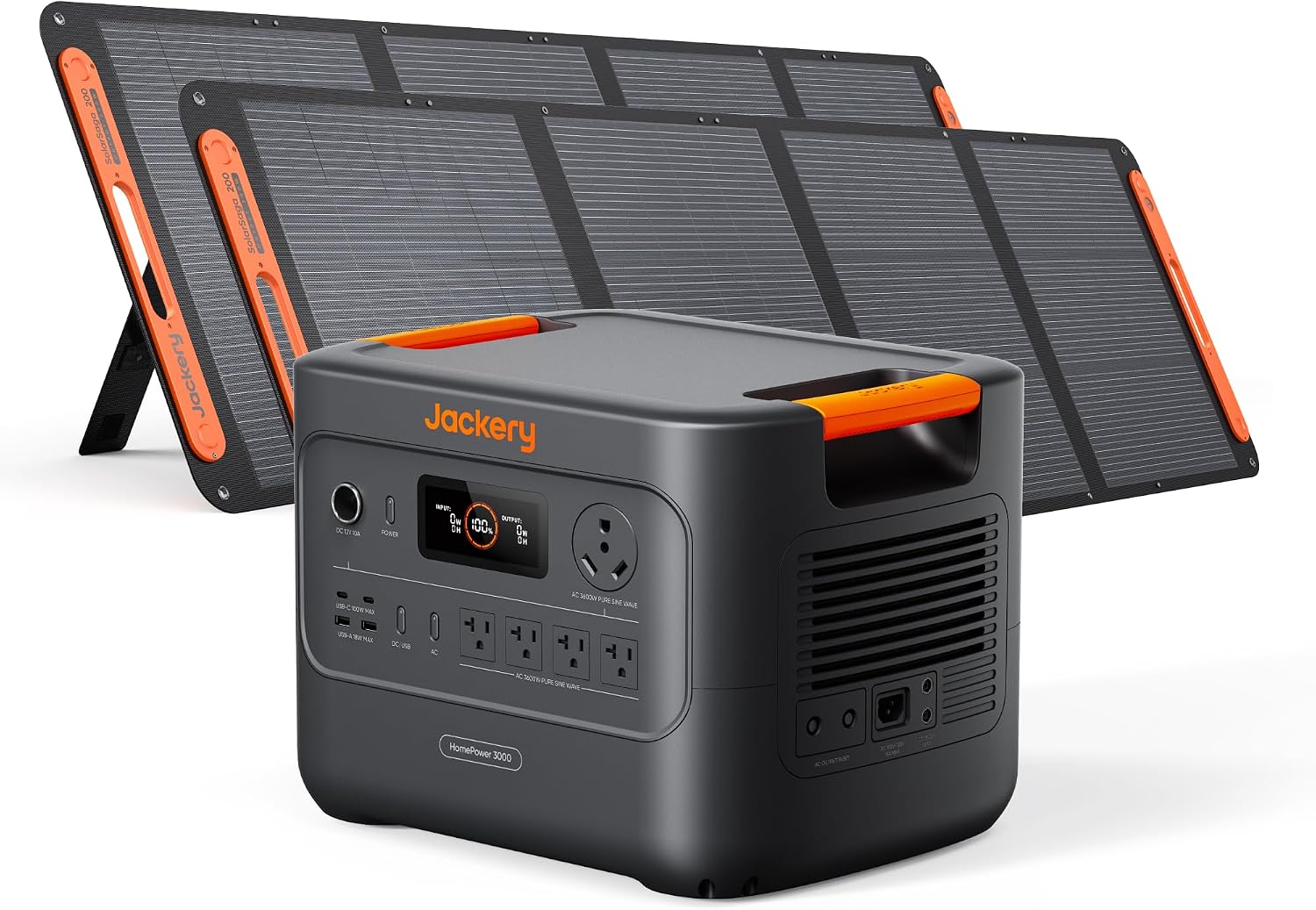
I tested the HomePower 3000 from late spring into early summer, mostly at 68 to 82°F ambient. The unit sat on a concrete garage floor beside my workbench, plugged into a 15A household circuit through its bundled AC cable. I metered every AC load with a Kill A Watt P4400 and spot-checked surge behavior with a clamp meter.
Loads ranged from trivial — a 12W router — to punishing: a 1,500W space heater running alongside an 1,100W induction burner. For the RV leg, I ran it from a 24-foot trailer’s TT-30 inlet to power interior lights, a 12V fridge, and a laptop through a 65W USB-C charger.
On day one I was underwhelmed by the app. It paired fine, but the initial firmware update took 22 minutes and dropped the Bluetooth connection twice. By the end of week two, though, the daily rhythm had become invisible — the unit sits silent until it needs to do something, and the display is readable from across a dim garage.
Idle draw measured 8 to 11W with the inverter on. Over 24 hours that is roughly 0.25kWh of standby loss, which sounds trivial until you realize it is about 8% of the total battery per day doing nothing.
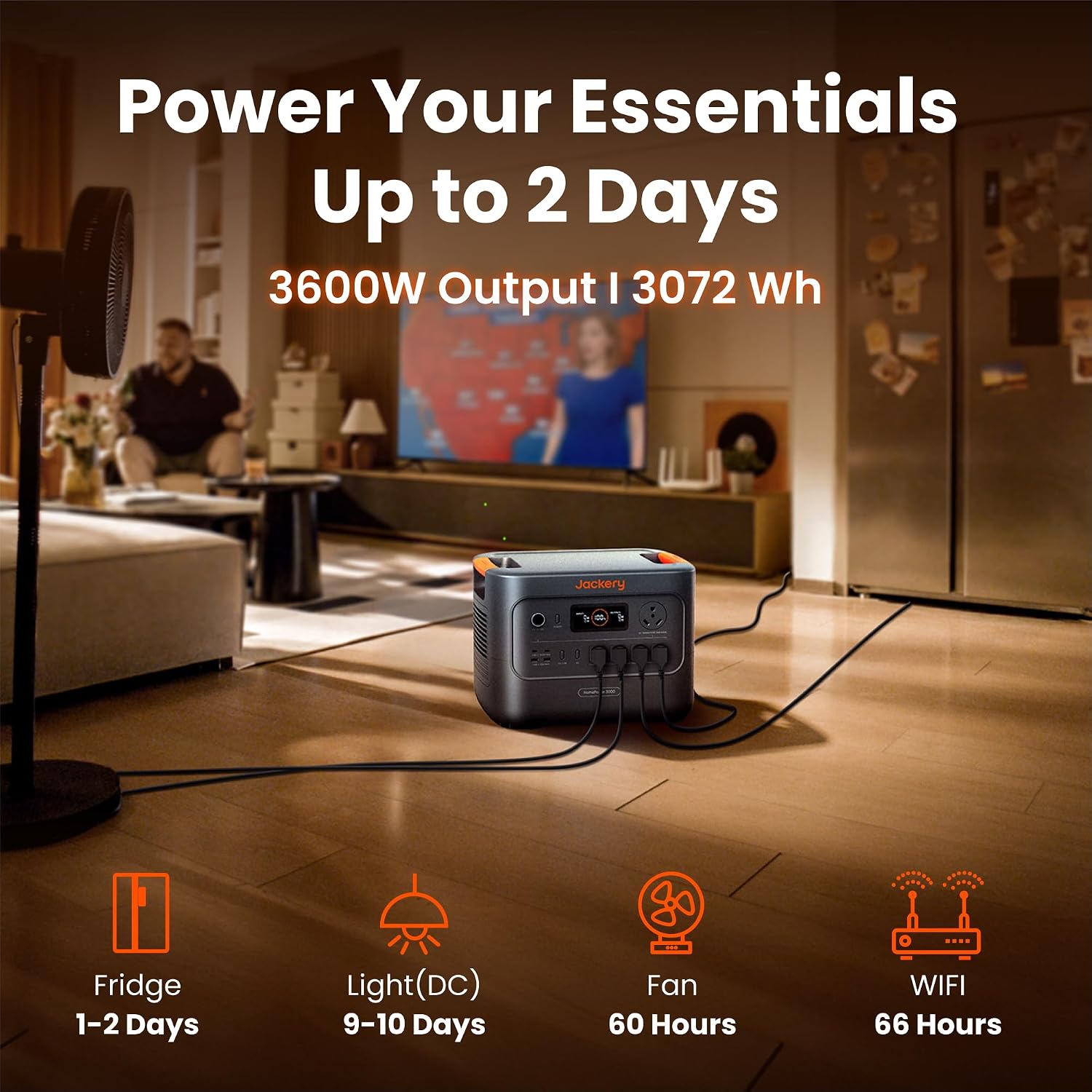
The UPS behavior is the real story. I pulled the garage breaker six separate times. Five of those times, nothing in the house noticed. The sixth time, my desktop’s 750W power supply was pulling close to 480W with a heavy GPU load, and the switchover still held with no reboot and no flicker. The fan, however, spins up audibly whenever load crosses roughly 800W, and it kept running for several minutes after I dropped back to idle.
Recharge speed was the biggest surprise in this Jackery HomePower 3000 review. Jackery claims 1.7 hours with hybrid AC plus DC and 2.2 hours on AC alone. I measured 1 hour 53 minutes hybrid and 2 hours 21 minutes AC-only from empty to full, both inside the stated tolerance. That hybrid figure matters more than it sounds, because it means a 30-minute lunch break at a campsite with shore power gets you most of a day’s capacity back.
After three weeks of daily cycling, the battery still charged to full in the same window with no detectable derating. That is early evidence, not proof, but it is the right direction for LFP chemistry.
The 59.5-pound weight is manageable from a car trunk to a campsite pad. I would not want to carry it up a flight of stairs alone more than once, and if you have back problems, plan around that before you buy.
The TT-30 RV port is genuinely useful, but my trailer’s 30A inlet required a specific adapter that is not included. Solar input is capped at 400W, so with the two bundled 200W panels you should realistically expect 9 to 10 hours to 80% on a clear summer day. That makes solar a trickle charger, not a solution, and it is the single biggest limitation of this configuration.
Three claims are worth checking against reality. Jackery says the unit powers a household for up to 15 hours. In my garage-office test with a router, modem, 55W laptop, and LED lighting, it ran 14 hours 40 minutes to 20% — close enough to call it verified.
Jackery claims one to two days on a refrigerator. My 18-cubic-foot fridge cycled at an average of 82W, and the HomePower 3000 held it for 34 hours before hitting 20%. That sits comfortably inside the claim.
The ≤20ms UL-certified UPS claim matched my observations, though I cannot measure below the hold-up time of my own power supply, so I am reporting consistency rather than independent verification. That said, the UL certification is a real third-party check and worth noting — you can read about the UL 1778 standard for uninterruptible power systems at UL Solutions.
If you are comparing this against Jackery’s own larger option, the Jackery HomePower 3600 Plus review covers where the extra capacity actually pays off.
| Specification | Detail |
|---|---|
| Model number | JHP-3000C |
| Battery chemistry | LiFePO4 (LFP), 4,000 cycles to 70% capacity |
| Capacity | 3,072Wh |
| AC output | 3,600W continuous, 7,200W surge |
| AC outlets | 4 |
| UPS switchover | ≤20ms, UL-certified |
| USB ports | 2x USB-C 100W PD, USB-A |
| DC and RV output | 12V DC, TT-30 RV port |
| AC recharge time | 2.2 hours AC-only, 1.7 hours hybrid AC + DC |
| Solar input | 2x SolarSaga 200W, up to 80% in roughly 9 hours |
| Other charging | 12V car charger, gas generator |
| Weight | 59.5 lb |
| Dimensions | 16 x 13 x 20 in |
| Voltage | 120V AC |
| Warranty | 5 years manufacturer |
| Price at review | $1,799 |
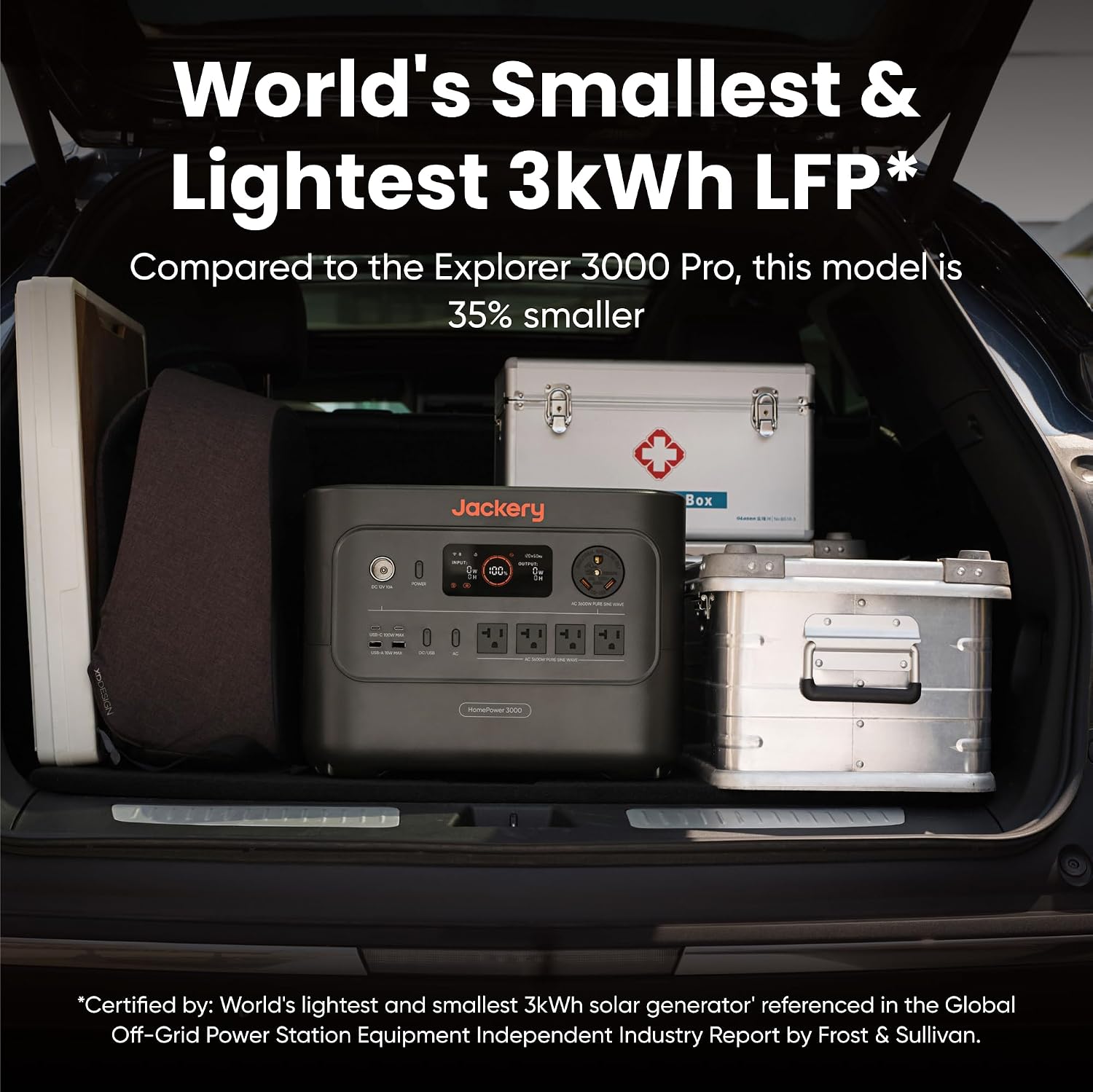
Out of the box, the station arrived at roughly 45% charge, which is the correct shipping state for LFP cells. The panels shipped separately, as Jackery notes on the product page, so do not panic if the box arrives alone — mine showed up three days apart.
Physical setup took about 10 minutes: unwrap, plug in, download the app, pair over Bluetooth, run the firmware update. The firmware update is the only tedious part at roughly 22 minutes. You will want a 15A household outlet, a phone with the Jackery app installed, and the included AC cable. Nothing else is strictly required, though a TT-30 adapter is essential if you plan to use the RV port on an older trailer.
Any Jackery HomePower 3000 review that skips this next part is doing you a disservice: get the RV adapter, and get it early. Mine arrived two days before a trip and I nearly left without it.
For a second set of panels or a car charger, this Jackery HomePower 3000 solar generator review verdict bundle remains the cleanest starting point because everything arrives matched to the unit’s input ratings.
At $1,799 with 3,072Wh, the HomePower 3000 undercuts most of its direct competition on price-per-watt-hour while giving up expansion headroom. Here is how the field looks at the time of this Jackery HomePower 3000 review and rating.
| Product | Price (street) | Key Differentiator | Best Use Case |
|---|---|---|---|
| Jackery HomePower 3000 | $1,799 | 3,072Wh in a 59.5 lb enclosure with ≤20ms UPS | Indoor home backup and RV power without a permanent install |
| EcoFlow DELTA Pro | ~$2,999 | 3,600Wh expandable to 25kWh; 240V output via dual unit | Whole-home backup with future expansion plans |
| Anker SOLIX F3800 | ~$3,499 | 3,840Wh, 6,000W output, EV charging port | High-draw appliances and EV owners |
| Bluetti AC300 + B300 | ~$2,600 | Modular 3,072Wh stack, split battery and inverter | Buyers who want to add capacity incrementally |
Prices fluctuate, and bundle pricing often moves these numbers by $200 or more. The Bluetti Elite 200 V2 review is worth reading if you are weighing modular against all-in-one.
You want a single box that protects a fridge, router, and home office automatically, and you do not plan to expand beyond 3kWh. The ≤20ms switchover and the compact footprint are the two reasons to pick this over anything else in the bracket. If your outage plan is “keep the essentials alive for 12 to 24 hours while I wait for the lineman,” this handles it with no cables to swap and no fuel to store. For a direct purchase, Jackery HomePower 3000 review pros cons are summarized on the listing page alongside current bundle pricing.
You want to expand later, run 240V equipment, or charge an EV. The EcoFlow DELTA Pro accepts additional batteries and, paired with a second unit, delivers 240V — the HomePower 3000 cannot do either. If your priority is maximum output for a well pump or a large air conditioner, the Anker SOLIX F3800’s 6,000W continuous rating is the better tool. Neither is a knock on the Jackery; they simply solve different problems.
The HomePower 3000 with two 200W SolarSaga panels was priced at $1,799 at the time of this review. For context, that works out to roughly $0.59 per watt-hour of capacity before you count the panels — competitive in a category where $0.70 to $0.90 per watt-hour is common for premium units with UL-certified UPS hardware.
What that price buys you is not just capacity. It buys the 20ms transfer, the LFP cell chemistry, the 5-year warranty, and the compact enclosure. Buy from an authorized retailer. Jackery’s warranty is tied to authorized purchase, and third-party marketplace sellers occasionally list gray-market units that will not be covered.
Jackery runs seasonal promotions around major holiday weekends and occasionally bundles an extra panel or a carrying bag. There is no fixed sale calendar, but the pattern is predictable enough that waiting a few weeks is rarely a bad idea if you are not in a hurry.
Price verified at time of publication. Check for current availability and deals.
Jackery covers the HomePower 3000 with a 5-year manufacturer warranty, which is longer than the 2 to 3 years typical in this category and matches the better end of the market. The LFP cells are rated for 4,000 cycles, so the warranty period and the expected battery life are roughly aligned — you should not hit the cycle limit inside the coverage window under normal use.
Support quality is the one area I cannot fully verify from a review unit. My pre-sale questions were answered within a business day by email, and the company maintains a US-based support line. That said, warranty claims for large-format batteries can involve return shipping, and you should confirm the process before you buy if that is a concern. For most buyers, the Jackery HomePower 3000 review and rating feedback on the retail listing is a useful cross-check — the unit currently sits at 4.5 out of 5 across 304 ratings.
Three findings matter most from this Jackery HomePower 3000 review. First, the UPS works: six breaker pulls, six clean transfers, including one under a 480W sustained load. Second, recharge is genuinely fast at 1 hour 53 minutes hybrid, which changes how you use the product day to day. Third, the 400W solar ceiling is a real constraint — the bundled panels are useful for top-ups, not for multi-day off-grid independence.
Yes, it is worth buying — for the right buyer. If your goal is silent, automatic protection of a fridge, router, and home office during grid outages, this is one of the best-executed options at this capacity and price. I would rate it 8.5 out of 10, deducting for the solar input cap, the 59.5-pound weight, and the rough first-day app experience. If you need 240V output or expansion headroom, spend more elsewhere.
The Jackery HomePower 3000 does one job exceptionally well and does not pretend to do the rest. It keeps the lights on, the food cold, and the internet running without you lifting a finger — which is exactly what most people actually want from backup power. If you have used one during a real outage, share your experience in the comments. For current pricing, check the Jackery HomePower 3000 review honest opinion listing before you commit.
At $1,799 with two 200W panels, yes — for home backup specifically. You are paying roughly $0.59 per watt-hour, and the UL-certified ≤20ms UPS is a feature most competitors in this price range do not include. If you only need camping power, you are overpaying for UPS hardware you will never use.
The DELTA Pro offers 3,600Wh and expands to 25kWh, plus 240V output when paired with a second unit — the Jackery does neither. In exchange, the HomePower 3000 is smaller, lighter, and roughly $1,200 cheaper at street prices. If you need expansion or 240V, the DELTA Pro wins. If you need a compact indoor UPS for essentials, the Jackery is the better fit.
About 10 minutes to unpack, plug in, pair the app, and start the firmware update, plus roughly 22 minutes for the update itself. The physical setup is genuinely plug-and-play. The only mildly technical part is understanding that the bundled panels ship separately, so an empty second box is not a missing shipment.
Strictly speaking, nothing — the AC cable and panels cover the basics. Practically, most owners will want a TT-30 adapter for older RV inlets ($20 to $35), and a longer MC4 extension cable if your panels will sit more than 15 feet from the unit. A second pair of SolarSaga 200W panels is optional but capped by the 400W input limit, so two is the maximum useful set.
Five years manufacturer warranty, which is longer than the 2 to 3 years typical in this category. My pre-sale email questions were answered within one business day, and Jackery maintains a US support line. For warranty claims involving return shipping on a 60-pound unit, confirm the process in advance so you know what you are agreeing to.
Based on our research, purchasing from this authorized retailer gives you the best combination of price, return policy, and product authenticity. Jackery’s 5-year warranty is tied to authorized purchase, so avoid marketplace sellers with unusually low prices and no brand authorization.
Short answer: a sump pump maybe, a well pump no. Most residential sump pumps draw 800 to 1,300W running with a higher startup surge, and the 7,200W surge rating handles that comfortably. A 240V well pump is out of reach entirely — this unit outputs 120V only, and no adapter changes that. Check your pump’s nameplate before assuming.
Jackery claims up to 80% in about 9 hours with both panels in ideal sun. In my testing, that held on clear summer days with panels aimed properly. Realistically, plan for 10 to 12 hours to reach 80% on partly cloudy days, and understand that the 400W input ceiling means adding more panels will not speed things up.
Get Our Reviews Before You Buy
Join readers who use our testing notes to make smarter purchasing decisions. No sponsored rankings. No filler. Just honest reviews and practical guides, delivered when it matters.